25.2 De Moivres Theorem
If \(\, z = \cos \theta + i\sin \theta .\,\) Then \[\left (\cos \theta + i \sin \theta \right )^n = \cos n\theta + i \sin n\theta \quad \text {for all } n \in \mathbb {Z}.\]
Note 25.6. The theorem is stated for integer \(n\), and the restriction is real. For \(n=\frac {1}{3}\) and \(\theta =2\pi \) the left side is \(1^{1/3}=1\), while the right side is \(\cos \frac {2\pi }{3}+i\sin \frac {2\pi }{3}=-\frac {1}{2}+\frac {\sqrt {3}}{2}i\). The two are different numbers.
What goes wrong is that a fractional power of a complex number has several values — a cube root has three — and the right-hand side picks out only one of them. For fractional \(n\) the correct statement is that \(\cos n\theta +i\sin n\theta \) is one of the values of \((\cos \theta +i\sin \theta )^{n}\), and that is exactly how the theorem is used to find roots: replacing \(\theta \) by \(\theta +2k\pi \) for \(k=0,1,\dots ,n-1\) generates all \(n\) of the \(n\)th roots.
For negative integers the theorem holds as stated, since \((\cos \theta +i\sin \theta )^{-1}=\cos \theta -i\sin \theta =\cos (-\theta )+i\sin (-\theta )\) — which is the step used in the worked example below to turn a minus sign inside the bracket into a negative angle.
Simplify without calculator \(\,\displaystyle {\frac {\left (\cos \frac {\pi }{7} - i\sin \frac {\pi }{7}\right )^3}{\left (\cos \frac {\pi }{7}+ i\sin \frac {\pi }{7}\right )^4}}\)
\begin {align*} \frac {\left (\cos \frac {\pi }{7} - i\sin \frac {\pi }{7}\right )^3}{\left (\cos \frac {\pi }{7}+ i\sin \frac {\pi }{7}\right )^4} & = \frac {\left (\cos \left (-\frac {\pi }{7}\right ) + i\sin \left (-\frac {\pi }{7}\right )\right )^3}{\cos \left (\frac {4\pi }{7}\right )+ i\sin \left (\frac {4\pi }{7}\right )}\\\\ & = \frac {\cos \left (-\frac {3\pi }{7}\right ) + i\sin \left (-\frac {3\pi }{7}\right )}{\cos \frac {4\pi }{7}+ i\sin \frac {4\pi }{7}}\\\\ & = \cos \left (-\frac {3\pi }{7}-\frac {4\pi }{7}\right ) + i \sin \left (-\frac {3\pi }{7}-\frac {4\pi }{7}\right )\\\\ & = \cos \pi - i \sin \pi \\ & = -1 + 0 i\\\\ \end {align*}
Solution.
\(\therefore \quad \left ( \cos \theta + i\sin \theta \right )^5 = \cos 5\theta + i\sin 5\theta \,\) by De Moivres theorem.
Now, \begin {align*} \left ( \cos \theta + i\sin \theta \right )^5 = & \cos ^5\theta + 5\cos ^4 \theta \left (i\sin \theta \right ) + 10\cos ^3\theta \left (i\sin \theta \right )^2 + 10\cos ^2\theta \left (i\sin \theta \right )^3\\ & + 5\cos \theta \left (i\sin \theta \right )^4 + \left (i\sin \theta \right )^5\\ = & \cos ^5\theta + 5i\cos ^4 \theta \sin \theta - 10\cos ^3\theta \sin ^2\theta + 10 i \cos ^2\theta \sin ^3 \theta \\ & + 5\cos \theta \sin ^4\theta + i\sin ^5 \theta \end {align*}
\begin {align*} \implies \quad \cos 5\theta & = \cos ^5\theta - 10\cos ^3\theta \sin ^2\theta + 5\cos \theta \sin ^4\theta \\ & = \cos ^5\theta - 10\cos ^3\theta \left (1 - \cos ^2\theta \right ) + 5\cos \theta \left (1 - \cos ^2\theta \right )^2 \end {align*}
\[\therefore \quad \cos 5\theta = 16\cos ^5\theta - 20\cos ^3\theta + 5\cos \theta \]
Express \(\, \cos ^4\theta \,\) in terms of \(\, \cos 4\theta \,\) and \(\, \cos 2\theta \).
Solution.
Let \(\, z = \cos \theta + i\sin \theta \)
\(\frac {1}{z} = z^{-1} = \left (\cos \theta + i\sin \theta \right )^{-1} = \cos \theta - i\sin \theta \quad \) by De Moivres theorem.
\[ z + \frac {1}{z} = \cos \theta + i\sin \theta + \cos \theta - i\sin \theta \]
\[\left (z + \frac {1}{z}\right )^4 = 2^4\cos ^4\theta \]
\[\implies \quad z^4 + 4z^3\cdot \frac {1}{z}+ 6z^2\cdot \frac {1}{z^2} + 4z\cdot \frac {1}{z^4} + \frac {1}{z^4} = 16\cos ^4\theta \]
\[\implies \quad z^4 + \frac {1}{z^4} + 4\left ( z^2 + \frac {1}{z^2}\right ) + 6 = 16\cos ^4\theta \]
\[z^4 + \frac {1}{z^4} = \cos 4\theta + i \sin 4\theta + \cos 4\theta - i\sin 4\theta = 2\cos 4\theta \]
\[z^2 + \frac {1}{z^2} = 2\cos 2\theta \]
\begin {align*} z^4 + \frac {1}{z^4} + 4 \left (z^2 + \frac {1}{z^2}\right ) + 6 & = 16\cos ^4\theta \\ \implies \quad 2\cos 4\theta + 4\left (\cos 2\theta \right ) + 6 & = 16\cos ^4\theta \\ \implies \quad 2\cos 4\theta + 8\cos 2\theta + 6 & = 16\cos ^4\theta \end {align*}
\begin {align*} \therefore \quad \cos ^4\theta & = \frac {1}{16}\left [2\cos 4\theta + 8\cos 2\theta + 6 \right ]\\\\ & = \frac {1}{8}\cos 4\theta + \frac {1}{2}\cos 2\theta + \frac {3}{8}\\ \end {align*}
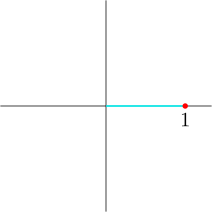
\(*\quad z = 1\,\) principle angle is \(\, \theta = 0, \, r = 1\)
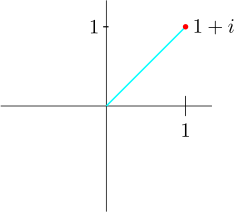
\(*\quad z = 1 + i\,\) principle angle is \(\,\frac {\pi }{4}\qquad \)
Questions on this section
Stuck on something here? Ask below and it stays attached to this topic.