12.1 Trigonometric Functions
Consider the right angled triangle \(ABC\) below.
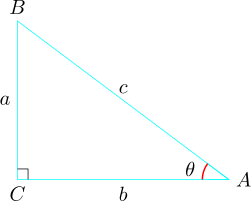
\[AB^2 = BC^2 + CA^2\quad \text {or}\quad c^2 = a^2 + b^2\]
The ratios of angle \(\theta \) are given as
\begin {align*} \sin \theta & = \frac {\text {opp}}{\text {hyp}} = \frac {BC}{AB} = \frac {a}{c}\\\\ \cos \theta & = \frac {\text {adj}}{\text {hyp}}= \frac {AC}{AB} = \frac {b}{c}\\\\ \tan \theta & = \frac {\text {opp}}{\text {adj}} = \frac {BC}{AC} = \frac {a}{b} \end {align*}
\[\text { Infact},\quad \tan \theta = \frac {\sin \theta }{\cos \theta }\]
Given that \(\, \sin \theta = \frac {3}{5}.\,\) Find \(\cos \theta \) and \(\tan \theta \).
Solution.
To find the required ratios in this case we use the right angled triangle to find the other side assuming that the opposite side is 3 units while the hypotenuses is 5 units.
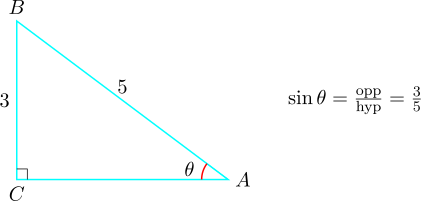
To find \(AC\) , we have \begin {align*} AB^2 & = BC^2 + AC^2\\ \implies \quad 5^2 & = 3^2 + AC^2\\ \implies \quad AC^2 & = 25 - 9\\ \implies \quad AC & = \sqrt {16} = 4 \end {align*}
Therefore,
\(\cos \theta = \frac {\text {adj}}{\text {hyp}} = \frac {4}{5}\)
\(\tan \theta = \frac {\text {opp}}{\text {adj}} = \frac {3}{4}\)
Three further ratios are defined as reciprocals of these: cosecant, secant and cotangent.
These are defined as follows
\begin {align*} \text {cosec}\theta & = \frac {1}{\sin \theta }\\\\ \sec \theta & = \frac {1}{\cos \theta }\\\\ \cot \theta & = \frac {1}{\tan \theta }= \frac {\cos \theta }{\sin \theta } \end {align*}
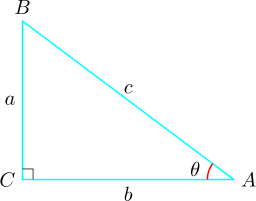
\[\text {From this triangle, we have}\quad \sin \theta = \frac {a}{c}\quad , \quad \cos \theta = \frac {b}{c}\quad \text {and}\quad c^2 = a^2 + b^2\]
\begin {align*} \text {Now},\qquad \sin ^2\theta + \cos ^2\theta & = \left (\sin \theta \right )^2 + \left (\cos \theta \right )^2\\\\ & = \left (\frac {a}{c}\right )^2 + \left (\frac {b}{c}\right )^2\\\\ & = \frac {a^2}{c^2} + \frac {b^2}{c^2}\\\\ & = \frac {a^2 + b^2}{c^2}\\\\ & = \frac {c^2}{c^2}\\\\ \implies \quad \sin ^2\theta + \cos ^2\theta & = 1 \end {align*}
Thus for any angle \(\theta \)
\(*\quad \sin ^2\theta + \cos ^2\theta = 1\)
Proof.
\begin {align*} \text {L.H.S}\qquad \sec ^2 \theta & = \left (\sec \theta \right )^2 = \left (\frac {1}{\cos \theta }\right )^2\\\\ & = \frac {1}{\cos ^2\theta }\\\\ & = \frac {\cos ^2\theta + \sin ^2\theta }{\cos ^2\theta }\\\\ & = \frac {\cos ^2\theta }{\cos ^2\theta } + \frac {\sin ^2\theta }{\cos ^2\theta }\\\\ & = 1 + \tan ^2\theta = \text {R.H.S}\\ \end {align*}
\begin {align*} \text {R.H.S}\qquad 1 + \tan ^2\theta & = 1 + \frac {\sin ^2\theta }{\cos ^2\theta }\\\\ & = \frac {\cos ^2\theta + \sin ^2\theta }{\cos ^2\theta }\\\\ & = \frac {1}{\cos ^2\theta }\\\\ & = \sec ^2\theta = \text {L.H.S}\\ \end {align*} □
Prove that \(\quad \left ( 1 - \cos A\right )\left (1 + \sec A\right ) = \sin A \tan A\)
Proof.
\begin {align*} \text {L.H.S}\qquad (1 - \cos A)(1 + \sec A) & = 1 (1 + \sec A) - \cos A (1 + \sec A)\\ & = 1 + \sec A - \cos A - \cos A\sec A\\ & = 1 + \frac {1}{\cos A} - \cos A - \cos A\left (\frac {1}{\cos A}\right )\\ & = 1 + \frac {1}{\cos A} - \cos A - 1\\\\ & = \frac {1}{\cos A}-\cos A\\\\ & = \frac {1 - \cos ^2 A}{\cos A}\qquad \left (\sin ^{2}A = 1 - \cos ^{2}A\right )\\\\ & = \frac {\sin ^2A}{\cos A}\\\\ & = \sin A\,\frac {\sin A}{\cos A}\\\\ & = \sin A \tan A = \text {R.H.S}\\\\ \end {align*}
Let \(A\) and \(B\) be two angles. Then \[\sin (A + B) = \sin A \cos B + \cos A \sin B,\] \[\sin (A - B) = \sin A \cos B - \cos A \sin B,\] \[\cos (A + B) = \cos A \cos B - \sin A \sin B,\] \[\cos (A - B) = \cos A \cos B + \sin A \sin B.\] □
Theorem 12.4 (Double angle formulas). Putting \(B=A\) in the addition formulas, \[\sin 2A = 2\sin A\cos A,\qquad \cos 2A = \cos ^{2}A - \sin ^{2}A .\]
Note 12.5. Four formulas, but really only two — the difference versions come free by replacing \(B\) with \(-B\) and using \(\cos (-B)=\cos B\), \(\sin (-B)=-\sin B\), which is why only the middle sign changes.
The signs are the thing to fix in memory, and they behave opposite to expectation: the sine formula keeps the sign it is given, while the cosine formula flips it. A quick check costs nothing — put \(A=B=0\), or take \(A=B=\frac {\pi }{2}\) in the cosine formula and confirm it gives \(\cos \pi =-1\) rather than \(+1\).
Using \(\sin ^{2}A+\cos ^{2}A=1\), the cosine double angle has two further forms, \[\cos 2A = 2\cos ^{2}A-1 = 1-2\sin ^{2}A,\] and these are the ones actually used in integration, because each contains only one trigonometric function. Rearranged they give \[\cos ^{2}A=\frac {1+\cos 2A}{2},\qquad \sin ^{2}A=\frac {1-\cos 2A}{2},\] the identities proved immediately below.
Proof.
Note that \(\, \cos 2\theta \,\) and \(\,\cos ^2\theta \,\) are connected by the formula
\[\cos 2\theta = \cos ^2\theta - \sin ^2\theta \]
But \(\,\sin ^2\theta \,\) doesn’t appear in the given identity. Therefore we must eliminate it.
i.e \(\cos 2\theta = \cos ^2\theta - \sin ^2\theta \,\) But \(\,\sin ^2\theta = 1 - \cos ^2\theta \). Thus \begin {align*} \cos 2\theta & = \cos ^2\theta - ( 1 - \cos ^2\theta )\\ & = \cos ^2\theta - 1 + \cos ^2\theta \\ & = 2\cos ^2\theta - 1 \end {align*}
\[\implies \quad \cos 2\theta + 1 = 2\cos ^2\theta \]
\[\implies \quad \frac {\cos 2\theta + 1}{2} = \cos ^2\theta \] □
Example 12.7. Prove the following identities \(\displaystyle {\tan (A+B) = \frac {\tan A + \tan B}{1 - \tan A\tan B}}\)
Proof. \[\text {L.H.S}\quad \tan (A + B) = \frac {\sin (A+ B)}{\cos (A + B)} = \frac {\sin A\cos B + \sin B \cos A}{\cos A \cos B - \sin A \sin B}\]
Divide both the numerator and the denominator by \(\quad \cos A \cos B\,.\,\) Then
\begin {align*} \tan (A + B) & = \frac {\frac {\sin A \cos B}{\cos A\cos B} + \frac {\sin B\cos A}{\cos A\cos B}}{\frac {\cos A \cos B}{\cos A\cos B} - \frac {\sin A\sin B}{\cos A\cos B}}\\\\ & = \frac {\frac {\sin A}{\cos A} + \frac {\sin B}{\cos B}}{1 - \frac {\sin A}{\cos A}\cdot \frac {\sin B}{\cos B}}\\\\ & = \frac {\tan A + \tan B}{1 - \tan A \tan B}\\\\ \end {align*} □
Example 12.8. Prove the following identities \(\,\displaystyle {\sin 2 x = \frac {2\tan x}{1 + \tan ^2 x}}\)
Proof. \begin {align*} \text {L.H.S},\qquad \sin 2 x & = \frac {\sin 2x}{1}\\\\ & = \frac {2\sin x \cos x}{1}\\\\ & = \frac {2\sin x \cos x}{\cos ^2x + \sin ^2x} \end {align*}
Divide both the numerator and the denominator by \(\, \cos ^2x\,.\,\) Then \begin {align*} \sin 2x & = \frac {\frac {2\sin x \cos x}{\cos ^2x}}{1 + \frac {\sin ^2x}{\cos ^2x}}\\\\ & = \frac {\frac {2\sin x}{\cos x}}{1 + \left (\frac {\sin x}{\cos x}\right )^2}\\\\ & = \frac {2\tan x }{1 + \tan ^2x} = \text {R.H.S}\\\\ \end {align*} □
- (i).
- \(\operatorname {cosec}^{2}x = 1 + \cot ^{2}x\)
- (ii).
- \(\sin ^{2}x = \frac {1 - \cos 2x}{2}\)
- (iii).
- \(\tan (A - B) = \frac {\tan A - \tan B}{1 + \tan A \tan B}\)
- (iv).
- \(\cos 2x = \frac {1 - \tan ^{2}x}{1 + \tan ^{2}x}\)
Solution. (i). Divide \(\sin ^{2}x+\cos ^{2}x=1\) through by \(\sin ^{2}x\): \[1+\frac {\cos ^{2}x}{\sin ^{2}x}=\frac {1}{\sin ^{2}x} \quad \implies \quad 1+\cot ^{2}x=\operatorname {cosec}^{2}x .\]
(ii). From the double angle formula in the form \(\cos 2x=1-2\sin ^{2}x\), \[2\sin ^{2}x=1-\cos 2x \quad \implies \quad \sin ^{2}x=\frac {1-\cos 2x}{2} .\]
(iii). Using the difference formulas and then dividing above and below by \(\cos A\cos B\): \begin {align*} \tan (A-B)&=\frac {\sin (A-B)}{\cos (A-B)} =\frac {\sin A\cos B-\cos A\sin B}{\cos A\cos B+\sin A\sin B}\\[4pt] &=\frac {\frac {\sin A}{\cos A}-\frac {\sin B}{\cos B}} {1+\frac {\sin A\sin B}{\cos A\cos B}} =\frac {\tan A-\tan B}{1+\tan A\tan B} . \end {align*}
(iv). Start from \(\cos 2x=\cos ^{2}x-\sin ^{2}x\) and divide above and below by \(\cos ^{2}x\), which is legitimate wherever \(\cos x\neq 0\): \[\cos 2x=\frac {\cos ^{2}x-\sin ^{2}x}{1} =\frac {\cos ^{2}x-\sin ^{2}x}{\cos ^{2}x+\sin ^{2}x} =\frac {1-\tan ^{2}x}{1+\tan ^{2}x} ,\] replacing the denominator \(1\) by \(\cos ^{2}x+\sin ^{2}x\) first — the standard move for turning an identity into one in \(\tan \) alone.
Note 12.10. Part (ii) as originally set read \(\sin ^{2}x=\frac {1-\cos ^{2}x}{2}\), with \(\cos ^{2}x\) in place of \(\cos 2x\). That statement is false: since \(1-\cos ^{2}x=\sin ^{2}x\), it asserts \(\sin ^{2}x=\frac {\sin ^{2}x}{2}\), which holds only where \(\sin x=0\).
The near-collision of \(\cos ^{2}x\) and \(\cos 2x\) in print is a genuine hazard, and the two mean quite different things. When an identity refuses to come out, testing it at a single convenient value is the quickest check — here \(x=\frac {\pi }{2}\) gives \(1\) on the left and \(\frac {1}{2}\) on the right, settling it at once.
Questions on this section
Stuck on something here? Ask below and it stays attached to this topic.