3.2 Complex Numbers, Real and Imaginary Parts
If \(b\) is a real number, a number of the form \(bi\) is called an imaginary number; \(5i\), \(-12i\), \(17i\) and \(-102i\) are examples. If \(a\) and \(b\) are both real, a number of the form \(a+bi\) is called a complex number, as are \(3+2i\), \(7-23i\) and \(-14+35i\). The set of all complex numbers is denoted by \(\mathbb {C}\).
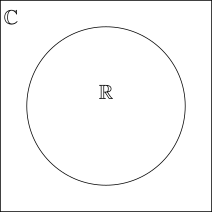
Every real number \(a\) is the complex number \(a+0i\), so \(\mathbb {R}\) sits inside \(\mathbb {C}\) — which is what the figure below records.
Let \(z=x+iy\) be a complex number. Then \(x\) is called the real part of \(z\) and \(y\) the imaginary part, written \[\operatorname {Re}z=x,\qquad \operatorname {Im}z=y .\] Note that the imaginary part is the real number \(y\), not \(iy\).
Let \(z_1=x_1+iy_1\) and \(z_2=x_2+iy_2\) be two complex numbers. Then
- 1.
- \(z_1=z_2\) if and only if \(x_1=x_2\) and \(y_1=y_2\).
- 2.
- \(z_1\pm z_2 = (x_1\pm x_2)+i(y_1\pm y_2)\)
For example, \[(4+3i)+(7-5i)=(4+7)+i(3-5)=11-2i .\]
Solution.
- 1.
- \(x+iy=7-4i\)
Equating the real parts and the imaginary parts, we get \(x=7\), \(y=-4\). - 2.
- \((3x-iy)+(2+13i) =-7+3i\)
Adding the real parts and the imaginary parts
\((3x-iy)=-9-10i\)
\(\implies \quad 3x=-9\) and \(-y=-10\)
\(\implies \quad x=-3\) and \(y=10\)
Questions on this section
Stuck on something here? Ask below and it stays attached to this topic.