1.1 Set Operations
Definition 1.18 (Intersection). The intersection of \(A\) and \(B\) is \[A\cap B=\{x : x\in A \text { and } x\in B\}.\] Two sets are disjoint if \(A\cap B=\emptyset \), that is, if they share no element.
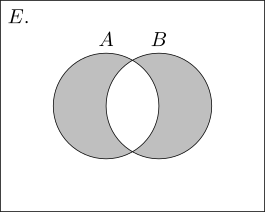
Definition 1.19 (Union). The union of \(A\) and \(B\) is \[A\cup B=\{x : x\in A \text { or } x\in B\}.\]
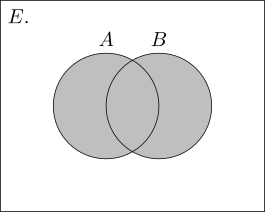
Note 1.20. The “or” here is inclusive: \(x\in A\cup B\) if \(x\) is in \(A\), or in \(B\), or in both. Everyday English often uses “or” exclusively — “tea or coffee” usually means not both — and that is not what the symbol means. This is the commonest source of mistakes in this chapter, and it is exactly the point at which De Morgan’s laws below are misremembered.
Example 1.21. Let \(A=\{1,2,3,4,5,6,7,8\}\), \(B=\{3,6,9,12,15\}\) and \(C=\{2,5,7\}\). Find
- (a).
- \(A\cap B\);
- (b).
- \(B\cup C\);
- (c).
- \(B\cap C\);
- (d).
- \(C-A\);
- (e).
- \((A-B)\cup (B-A)\).
Solution.
- (a).
- The elements in both lists: \(A\cap B=\{3,6\}\).
- (b).
- Everything in either list, each written once: \(B\cup C=\{2,3,5,6,7,9,12,15\}\).
- (c).
- \(B\) and \(C\) share nothing, so \(B\cap C=\emptyset \); the two sets are disjoint.
- (d).
- Every element of \(C\) is already in \(A\), so \(C-A=\emptyset \). Equivalently \(C\subset A\).
- (e).
- \(A-B=\{1,2,4,5,7,8\}\) and \(B-A=\{9,12,15\}\), so \[(A-B)\cup (B-A)=\{1,2,4,5,7,8,9,12,15\}.\]
Note 1.22. The set in part (e) is called the symmetric difference of \(A\) and \(B\), written \(A\triangle B\). It collects the elements belonging to exactly one of the two sets — everything in the union except the overlap, so \(A\triangle B=(A\cup B)-(A\cap B)\).
Questions on this section
Stuck on something here? Ask below and it stays attached to this topic.