16 Exponential and Logarithm
A function of the form \(f(x)=a^x\), where \(x\) is real and \(a\) is a positive constant with \(a\neq 1\), is called an exponential
function. The word exponential comes from a word exponent, \('\)Power\('\) or index. So for an
exponential function \(f(x)=a^x\), \(x\in \mathbb {R}\), the variable \(x\) is called the power or the index or the exponent for
\(a=1,2,3,\cdots \).
Here are graphs of the corresponding
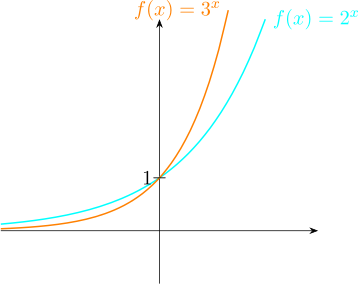
Therefore, \(f(x)=a^x\) is a one-to-one function and the inverse exists.
Note 16.1. The condition \(a\neq 1\) matters. If \(a=1\) then \(1^{x}=1\) for every \(x\), which is a constant function — not one-to-one, and with no inverse. Negative bases are excluded for a different reason: \((-4)^{1/2}\) is not real, so \(a^{x}\) would fail to be defined for most \(x\).
Note also that \(a^{x}>0\) for every real \(x\), whatever the base. An exponential curve approaches the \(x\)-axis but never touches it, which is why its inverse, the logarithm, is defined only for positive arguments.
\(e\) is the number such that the gradient of \(y=e^x\) at \((0,1)\) is 1.
\(e^x\) is called the exponential function \(f(x)=e^x\), where \(e\approx 2.71828\).
16.2 Laws of Logarithm
16.3 Change of Bases
16.4 Equations of The Form \(a^x=b\)
16.5 Derivatives of Logarithmic Function
16.6 Practice Problems
Questions on this section
Stuck on something here? Ask below and it stays attached to this topic.