26.7 The Scalar Product of Two Vectors
The scalar (or dot) product of two vectors \(\underline {a}\) and \(\underline {b}\) is defined as \(\,\left |\underline {a}\right | \left |\underline {b}\right |\cos \theta \)
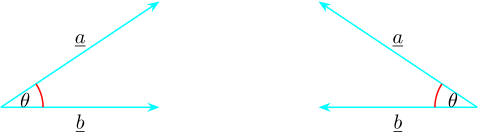
The result of this calculation is a scalar. The scalar product is written as
\[\underline {a}\cdot \underline {b} = \left |\underline {a}\right | \left |\underline {b}\right |\cos \theta \]
Properties
- 1.
- For two perpendicular vectors
\(\underline {a}\cdot \underline {b} = \left |\underline {a}\right | \left |\underline {b}\right |\cos \theta \)
\(\underline {a}\cdot \underline {b} = \left |\underline {a}\right | \left |\underline {b}\right |\cos 90\)
\(\underline {a}\cdot \underline {b} = 0\)
- 2.
- A vector with itself: the angle between \(\underline {a}\) and \(\underline {a}\) is \(0\) and \(\cos 0=1\), so
\[\underline {a}\cdot \underline {a} =\left |\underline {a}\right |\left |\underline {a}\right |\cos 0 =\left |\underline {a}\right |^{2}.\]
This is the usual way of recovering a length from a dot product: \(\left |\underline {a}\right |=\sqrt {\underline {a}\cdot \underline {a}}\).
- 3.
- \(\underline {a}\cdot \underline {b} = \left |\underline {a}\right | \left |\underline {b}\right |\cos \theta \)
\(\underline {b}\cdot \underline {a} = \left |\underline {b}\right | \left |\underline {a}\right |\cos \theta \)
\( \implies \quad \underline {b}\cdot \underline {a} = \underline {a}\cdot \underline {b}\)
- 4.
- \(\lambda \left (\underline {a}\cdot \underline {b}\right ) = \left (\lambda \underline {a}\right )\cdot \underline {b} = \underline {a}\cdot \left (\lambda \underline {b}\right )\)
\(\lambda \left ( \underline {a}\cdot \underline {b}\right ) = \lambda \left |\underline {a}\right | \left |\underline {b}\right |\cos \theta = \lambda \left |\underline {b}\right | \left |\underline {a}\right |\cos \theta \)
- 5.
- \(\underline {a}\cdot \left (\underline {b} + \underline {c}\right ) = \underline {a}\cdot \underline {b} + \underline {a}\cdot \underline {c}\)
The dot product is distributive \((+)\)
Let \(\, \underline {a} = x_1\textbf {i} + y_1\textbf {j} + z_1\textbf {k}\quad \) and \(\quad \underline {b} = x_2\textbf {i} + y_2\textbf {j} + z_2\textbf {k}\)
\begin {align*} \underline {a}\cdot \underline {b} & = \left ( x_1\textbf {i} + y_1\textbf {j} + z_1\textbf {k}\right )\cdot \left (x_2\textbf {i} + y_2\textbf {j} + z_2\textbf {k}\right )\\ & = \big \langle x_1, y_1, z_1\big \rangle \cdot \big \langle x_2, y_2, z_2\big \rangle \\ & = x_1x_2 + y_1y_2 + z_1z_2\\\\ \end {align*}
Questions on this section
Stuck on something here? Ask below and it stays attached to this topic.