WJWJ Maths

University mathematics, explained clearly

Course notes and worked problems for mathematics and statistics students.

For the sake of brevity, we will always represent this number 2.718281828459… by the letter e. Leonhard Euler

Courses

22 available
Foundation · First year

Foundation Mathematics

The first-year groundwork: sets and the algebra of sets, sets of numbers, complex numbers and surds, relations and functions, quadratics, equations and inequalities, trigonometry, limits and differentiation, polynomials, exponentials and logarithms, curve sketching, induction and the binomial expansion, integration, matrices and vectors.
Sets Functions Trigonometry Calculus
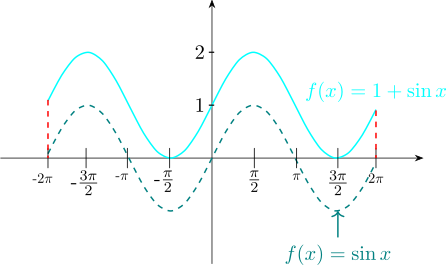
Two sine curves on the same axes, the second shifted a quarter period to
                  the right, illustrating phase shift
Foundation · First year

Foundation Mathematics and Statistics for the Social Sciences

Sets and numbers, functions, polynomial and rational functions, trigonometry, exponentials and logarithms, differentiation and integration, then descriptive statistics and probability. Every tutorial-sheet question is worked in full.

Functions Calculus Descriptive Statistics Probability
Histogram with bars of unequal width, drawn against frequency density
Probability & Statistics · Second year

Introduction to Probability

Probability axioms, conditional probability and Bayes' theorem, counting techniques, random variables, and the standard discrete and continuous distributions.

Probability Random Variables Distributions
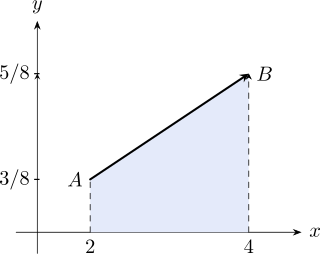
Diagram of a probability density function shown as a shaded trapezoid
Probability & Statistics · Third year

Probability Theory

The machinery behind the limit theorems. Generating functions turn the convolution of independent sums into a product, and uniqueness turns the product back into a distribution. Conditioning gives the compound distributions and the martingales. Four distinct senses of convergence are separated, each converse settled by a counterexample, and the central limit theorem is then proved in the one that is meant. The course closes with stochastic processes, Markov chains and simulation. Every result is proved and every problem worked in full.

Generating Functions Conditioning Convergence Martingales Simulation
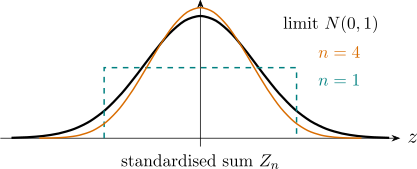
Three densities of a standardised sum drawn together: a flat rectangle for
                  one term, a nearly normal curve for four, and the limiting standard normal
Probability & Statistics · Fourth year

Stochastic Processes

Randomness indexed by time. Conditioning comes first, because everything after it is an expectation computed one step at a time, and the Chapman–Kolmogorov equation is what that buys. States are then classified as transient or recurrent, and the random walk answers the question the classification was built for: it returns in one and two dimensions and escapes in three. Every result is proved and every problem worked in full.

Conditioning Markov Chains Random Walks Branching
A diagram from the Markov chains chapter
Statistics · Fourth year

Time Series Analysis

Data where the order of the observations is the whole point. Stationarity and the autocorrelation function first, then the AR, MA and ARMA models built on them, and differencing to reach the ones that are not stationary. The partial autocorrelation makes identification possible; the spectrum shows the same series as a mixture of cycles; state space models and the Kalman filter handle what ARMA cannot; and ARCH addresses the variance that every earlier model assumed constant. Every problem is worked in full.

Stationarity ARIMA Spectral Analysis Kalman Filter ARCH
Statistics · Second year

Introduction to Statistics

Describing data, sampling distributions, estimation and confidence intervals, hypothesis testing and P-values, analysis of variance, and linear regression and correlation.

Estimation Hypothesis Testing ANOVA Regression
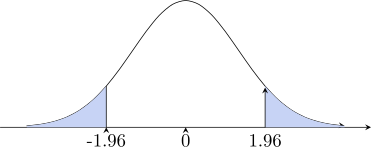
Normal curve with both tails shaded, showing a two-tailed critical region
Calculus · Second year

Analytic Geometry and Calculus

Geometry done by algebra, then the calculus built on it. The conic sections are derived from their focal definitions and reunified by eccentricity, collapsing into a single polar equation. Limits lead to the mean value theorems, and through them to series and curvature; integration is developed as technique and then applied to area, volume, arc length and surface. Vectors carry the subject into three dimensions and into motion, and the course closes with differential equations. Every result is proved and the tutorial questions are worked in full.

Conic Sections Limits & Series Integration Vectors Differential Equations
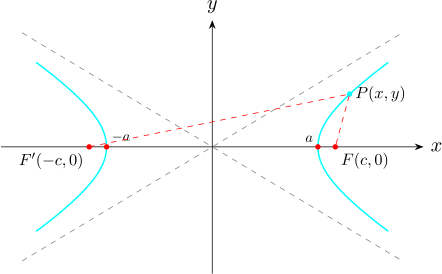
A hyperbola drawn on x and y axes, both branches curving away from the
                  origin towards a pair of dashed asymptotes that cross at the centre, with
                  the two foci marked on the x-axis
Calculus · Third year

Multivariate Calculus

Calculus carried into several variables and then into three dimensions. Partial derivatives give the gradient and the tangent plane, and the Jacobian that measures how a change of variables stretches area returns as the factor in the multiple integral. Vector fields bring the divergence and the curl, and the course converges on Green’s, Stokes’ and the divergence theorems — one theorem in three dresses, each saying that integrating a derivative over a region equals integrating the original over its boundary. It closes with Laplace transforms and Fourier series. All 114 tutorial questions are worked in full.

Several Variables Multiple Integration Vector Analysis Laplace Transforms Fourier Series
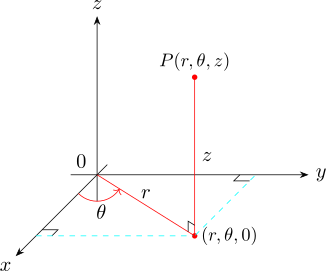
A point plotted in three dimensions with x, y and z axes, showing its cylindrical coordinates: the radius r and angle theta measured in the horizontal plane, and the height z
Algebra · Second year

Linear Algebra

Matrices and row reduction built up until they become statements about linear maps rather than procedures. Determinants are developed as a test for invertibility; rank–nullity ties what a map collapses to what it reaches; and the course ends with the spectral theorem, which makes every real symmetric matrix diagonalizable and every quadratic form a sum of squares. Every result is proved, and all 64 practice problems are fully worked.

Matrices Determinants Vector Spaces Eigenvalues
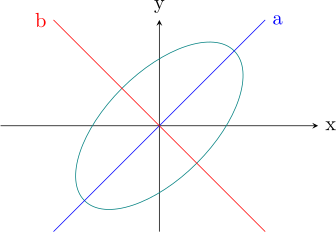
A tilted ellipse drawn against x and y axes, with its two principal axes marked a and b crossing at right angles through the centre — a conic section referred to its rotated axes
Algebra · Third year

Abstract Algebra

Structure studied for its own sake. Groups first, where Lagrange’s theorem is the earliest result that could not have been guessed from the definitions, then the quotient constructions that make homomorphisms intelligible. Rings follow, and the discovery that ideals rather than subrings are what quotients need. It closes with fields and the polynomial quotients that build them. All 62 results are proved and every problem worked in full.

Groups Group Actions Rings Fields
A diagram from the group theory chapter
Probability & Statistics · Third year

Mathematical Statistics

Distributions of functions of random variables and order statistics, estimation by moments, least squares and maximum likelihood, properties of estimators, and the theory of hypothesis testing.

Order Statistics Estimation Likelihood Neyman–Pearson
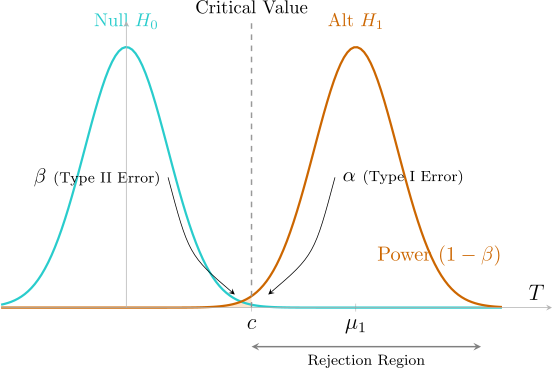
Null and alternative densities overlapping, with the type I error, type II
                  error and power marked either side of a critical value
Statistics · Postgraduate

Statistical Inference

What makes one estimator better than another, and how far the question can be pushed. Sufficiency reduces the data without losing information; completeness makes the reduction unique, and the two together deliver the minimum-variance unbiased estimator. Maximum likelihood is then developed with its score, its information and the bound that information places on any unbiased estimator. The last chapter turns to testing, from the Neyman–Pearson lemma to the three large-sample tests that agree asymptotically and differ in what they ask you to compute. Every result is proved and all 56 problems are worked in full.

Sufficiency UMVUE Maximum Likelihood Information Hypothesis Tests
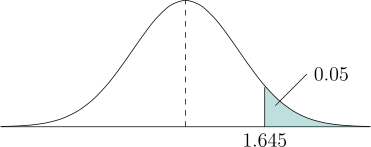
A normal density curve with the upper tail beyond 1.645 shaded, marking the
                  five per cent rejection region of a one-sided test
Analysis · Fourth year

Theory of Functions of Complex Variables

The complex plane and power series, analytic functions and the Cauchy–Riemann equations, conformal mappings, contour integration and the Cauchy–Goursat theorem, the maximum modulus principle, the calculus of residues, and analytic continuation through to the monodromy theorem.

Analytic Functions Contour Integration Residues Analytic Continuation
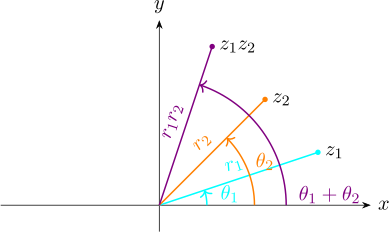
Argand diagram showing two complex numbers drawn as arrows from the origin
                  and their product, whose modulus is the product of the two moduli and whose
                  argument is the sum of the two arguments
Analysis · Fourth year

Elements of Functional Analysis

An undergraduate first course in the subject. Metric spaces are developed as far as completeness, then put to work: the contraction mapping theorem yields Picard’s existence theorem for differential equations, and the Baire category theorem follows. Norms and inner products are then added to the vector space structure, giving Banach and Hilbert spaces, the Hahn–Banach theorem, the projection theorem and the Riesz representation theorem. Every result is proved and every practice problem is fully worked.

Metric Spaces Completeness Banach Spaces Hilbert Spaces
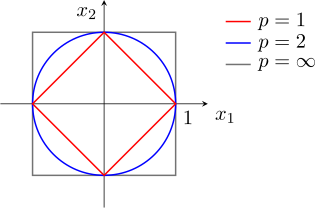
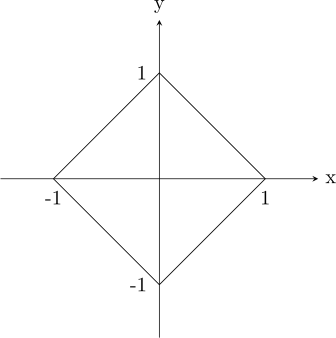
Three unit balls of the plane drawn on the same axes — a diamond for the
                  p equals 1 norm, a circle for p equals 2, and a square for p equals
                  infinity — showing how the exponent changes the geometry of the space
Analysis · Fourth year

Topology

What survives when distance is thrown away. Metric spaces come first, then the observation that every proof about continuity used only the open sets — so the open sets alone are taken as the definition. Compactness and connectedness follow, and with them the theorems of a first analysis course reappear as statements about spaces: the intermediate value theorem becomes a remark about connectedness, and the extreme value theorem one about compactness. Every result is proved and every problem worked in full.

Metric Spaces Topological Spaces Compactness Connectedness
A diagram from the metric spaces chapter
Analysis · Third year

Real Analysis

The calculus rebuilt on the completeness of the real line. Open and closed sets come first, then compactness and connectedness, and from those two the theorems everyone already knows — intermediate value, extreme value, mean value — fall out as consequences rather than assertions. Bounded variation and the Riemann–Stieltjes integral close it. Every one of the 98 results is proved and every problem worked in full.

Topology of the Line Continuity Differentiation Riemann Integral
A diagram from the topology of the real line chapter
Statistics · Fourth year

Methods of Non-Parametric Statistics

Distribution-free inference: the sign test and confidence intervals for the median, Wilcoxon signed-rank and rank-sum, Kruskal–Wallis, Kolmogorov–Smirnov, rank correlation by Spearman and Kendall, tests of randomness, and non-parametric trend detection by Mann–Kendall and Theil–Sen.

Rank Tests Distribution-Free Rank Correlation Trend Detection
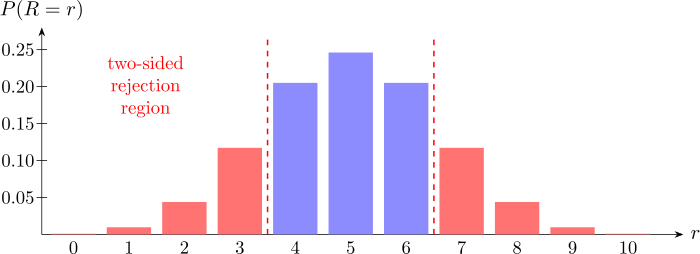
Normal curve with both tails shaded, marking the two-sided rejection
                  region either side of the critical values
Statistics · Fourth year

Multivariate Statistical Analysis

Matrix algebra and the geometry of random vectors, the multivariate normal distribution with Hotelling’s $T^2$ and Wilks’ lambda, classification by Fisher’s discriminant, multivariate analysis of variance, and multivariate multiple regression.

Random Vectors Multivariate Normal Discrimination MANOVA
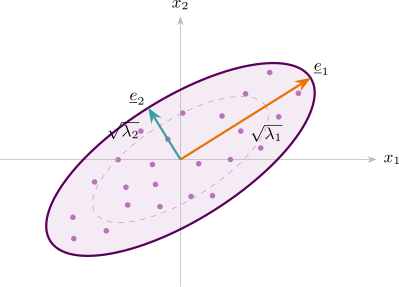
A tilted ellipse enclosing a scatter of points, with arrows along its two principal axes labelled by the square roots of the eigenvalues
Statistics · Third year

Linear Models and Design of Experiments

The analysis of variance and regression treated as one subject. Quadratic forms and Cochran’s theorem supply the distribution theory the $F$ test rests on; estimability says which parameters a rank-deficient design can speak about; and the general linear hypothesis reduces every test in the course to one. Ends with regression diagnostics and variable selection.

Analysis of Variance Quadratic Forms Estimability Diagnostics
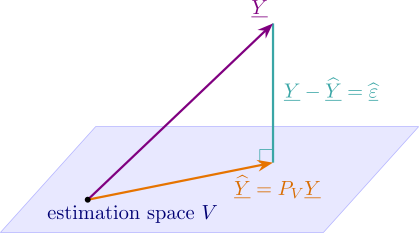
A vector Y above a shaded plane, its projection Y-hat lying in the plane, and the residual drawn perpendicular between them
Statistics · Postgraduate

Theory of Non-Parametric Statistics

The theory beneath the methods. Order statistics and their exact distributions, statistics that are distribution-free over a class, and Hoeffding’s theory of $U$-statistics with the projection principle that gives them their asymptotic normality.

Order Statistics $U$-Statistics Asymptotics Proofs
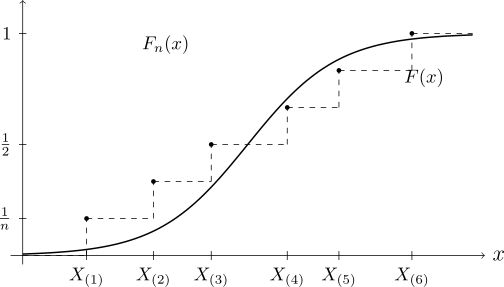
A smooth distribution function with the empirical distribution function
                  stepping up by one over n at each of six order statistics
Mathematics · Postgraduate

Topics in Mathematical Methods

Improper integrals and the special functions they define — gamma, beta, error and the incomplete forms that carry the classical statistical distributions. Then the orthogonal polynomials and the Sturm–Liouville theory that shows why all of them are orthogonal for one reason, Fourier series and the transform they become on an unbounded domain, and the Laplace transform.

Special Functions Orthogonal Polynomials Sturm–Liouville Fourier & Laplace
The first five Legendre polynomials plotted on the interval minus one to
                  one, alternating in parity and each passing through one at the right end

About

This site is a companion to help you through your studies. It is not a replacement for attending class — use it alongside your lectures, not instead of them.

A count is kept of how many times each page is opened, so it is possible to see which topics are useful. No cookies are set, nothing personal is recorded, and nothing is shared with anyone.