22 The Straight Line and the Circle
We can write the equation of a straight line if
- 1.
-
- i.
- we are given two points where the line passes \((x_1,y_1)\) and \((x_2,y_2)\).
- ii.
- we find the gradient using the formula \[m = \frac {y_2 - y_1}{x_2 - x_1}\]
- iii.
- using either point, the equation is \[ y - y_1 = m(x - x_1)\]
- 2.
- If we are given one point \((x_1,y_1)\) and the gradient \(m\), we write the equation directly as \[y- y_1 = m(x - x_1)\]
- 3.
- If we are given one point and told the line is parallel to a given line, we take the gradient of that line as \(m\) and use the formula above.
- 4.
- If we are given one point and told the line is perpendicular to a given line of gradient \(m_1\), we use
\(m=-\frac {1}{m_1}\).
Theorem 22.1 (Parallel and perpendicular lines). Two lines with gradients \(m_1\) and \(m_2\) are \[\text {parallel} \iff m_1=m_2, \qquad \text {perpendicular} \iff m_1m_2=-1 .\]
Note 22.2. Read the perpendicular condition as “negative reciprocal”: if one gradient is \(\frac {2}{3}\) the other is \(-\frac {3}{2}\). Turn the fraction over and change the sign.
It has one exception, and that is why the condition is written as a product rather than as \(m_2=-\frac {1}{m_1}\). A vertical line has no gradient at all and its perpendicular is horizontal with gradient \(0\), so neither form applies to that pair and it must be recognised separately.
Both conditions come from gradient being the tangent of the angle a line makes with the \(x\)-axis. Parallel lines make equal angles; turning a line through \(90^{\circ }\) swaps rise and run and reverses one sign, which is exactly what the negative reciprocal does.
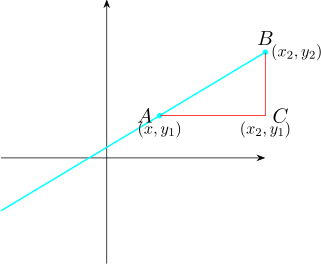
\begin {align*} AB^2 & = AC^2 + BC^2\\ AB^2 & = (x_2 - x_1)^2 + (y_1 - y_2)^2\\\\ AB & = \sqrt {(x_2 - x_1)^2 + (y_2 - y_1)^2} \end {align*}
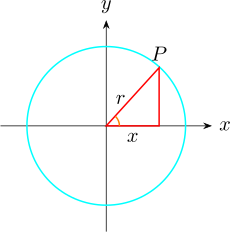
Using Pythagoras theorem \(\, x^2 + y^2 = r^2.\,\) This is the equation of the circle with centre \((0,0)\) radius \(r\).
- 1.
- Find the gradient of the circle at a general point on it.
- 2.
- Find the equation of the tangent and the normal to the circle with centre \((0,0)\) and \(r = 9\) at the point where \(x = 1\) and \(y>0\).
Note 22.3. A circle does not have a gradient; it has a gradient at each of its points, found by implicit differentiation. Differentiating \(x^{2}+y^{2}=r^{2}\), \[2x+2y\frac {dy}{dx}=0 \implies \frac {dy}{dx}=-\frac {x}{y},\] the result already obtained in the chapter on derivatives. Note too that \(x=1\) does not by itself fix a point on the circle — there are two, one above the axis and one below — which is why the sign of \(y\) has to be specified.
\(\implies \quad \) we find \(\,\frac {dy}{dx}\,\) of the equation of the circle
Equation of the tangent: \(\quad y - f(x_0) = f'(x_0) \left ( x - x_0\right )\)
- \(*\)
- The Cartesian equation of the circle centre \((0,0)\) and radius \(r\) is \(x^2 + y^2 = r^2\)
- 1.
- The Cartesian equation of the circle, centre \((h,k)\) and radius \(r\) is \((x - h)^2 + (y - k)^2 = r^2\)
- 2.
- The general equation of a circle is usually in the form \(x^2 + y^2 + 2gx + 2fy + c = 0\) where \(g, \, f\) and \(c\) are constants.
- 1.
- The equation is second degree because \(x^2\) and \(y^2\), are the highest power term.
- 2.
- The coefficients of \(x^2\) and \(y^2\) are same.
- 3.
- There is no term \(xy\)
\begin {align*} \implies \quad x^2 + 2gx & = x^2 + 2gx + g^2 - g^2\\ & = \left (x + g\right )^2 - g^2 \end {align*}
\[\implies \quad y^2 + 2fy = \left (y + f\right )^2 - f^2\]
\begin {align*} x^2 + 2gx + y^2 + 2fy + c & = 0\\ \left (x + g\right )^2 + \left (y + f\right )^2 & = g^2 + f^2 - c\\ \implies \quad \left (x + g\right )^2 + \left (y + f\right )^2 & = \left ( \sqrt {g^2 + f^2 - c}\right )^2 \end {align*}
This is a circle centre \(\, (-g,-f)\,\) and radius \(\, r = \sqrt {g^2 + f^2 - c}\).
- 1.
- Find in Cartesian form an equation of the circle with centre \((-3,5)\) and \(r = 4\).
Working
Since we know the centre, we use the standard form of a circle. \begin {align*} (x - h)^2 + (y - k)^2 & = r^2\\ (x + 3)^2 + (y - 5)^2 & = 4^2\\ x^2 + 6x + 9 + y^2 - 10y + 25 & = 16\\ x^2 + y^2 + 6x - 10y + 34 - 16 & = 0\\\\ \therefore \quad x^2 + y^2 +6x - 10y + 18 & = 0\quad \text {general form}\\ \end {align*} - 2.
- Find the coordinates of the centre and the radius of the circle with equation
\[2x^2 + 2y^2 - 18x + 12y + \frac {3}{2} = 0\]
Ans: \(\quad \) centre \(\left (\frac {9}{2}, -3\right )\quad , \quad r = \sqrt {\frac {57}{2}}\)
Find the Cartesian form, an equation of the circle passing through the points \(A(1,6),\, B(3,2)\) and \(C(2,3)\).
Solution.
- Method 1
The centre of the required circle lies on the perpendicular bisector of \(AB\).
Therefore, the midpoint of \(AB\) using the formula \(\quad \left (\frac {x_1 + x_2}{2}, \frac {y_1 + y_2}{2}\right )\)
\[\left (\frac {1 + 3}{2},\frac {6 + 2}{2}\right ) = (2,4)\]
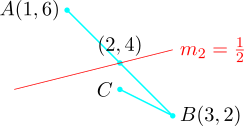
We find the gradient of \(AB\) \[m = \frac {6-2}{1-3} = -2\]
\begin {align*} y - y_1 & = m_2 (x - x_1)\\ \implies \quad y - 4 & = \frac {1}{2}(x - 2)\\ 2y - 8 & = x - 2\\\\ \therefore \quad 2y - x - 6 & = 0\quad \cdots \quad (1) \end {align*}
The centre of the circle lie also on the perpendicular bisector of \(BC\).
Midpoint of \(BC\) is \(\quad \left (\frac {3 + 2}{2}, \frac {2 + 3}{2}\right ) = \left (2\frac {1}{2},2\frac {1}{2}\right )\)
Gradient of \(BC =\frac {3 - 2}{2 - 3} = -1\)
\[\therefore \quad y - 2\frac {1}{2} = 1\left (x - 2\frac {1}{2}\right )\]
\[\implies \quad y = x \quad \cdots \quad (2)\]
\begin {align*} \text {Now},\qquad 2y - x - 6 & = 0\\ y & = x\\\\ \implies \quad 2x - x & = 6 \end {align*}
\[x = 6\quad ,\quad y = 6\]
\(\therefore \quad (6,6)\,\) is the centre of the circle.
\[r^2 = (6-1)^2 + (6-6)^2 = 25\]
Our equation in standard form is \((x - 6)^2 + (y - 6)^2 = 25\)
- Method 2
\(x^2 + y^2 + 2gx + 2fy + c = 0\)
At \((6,1)\), we have \begin {align*} 1^2 + 6^2 + 2g(1) + 2(6)f + c & = 0\\ \implies \quad 1 + 36 + 2g + 12f + c & = 0\\ \therefore \quad 37 + 2g + 12f + c & = 0\quad \cdots \quad (1)\\ \end {align*}
At \((3,2)\), we have \begin {align*} 3^2 +2^2 + 2g(3) + 2(2)f + c & = 0\\ \implies \quad 9 + 4 + 6g + 4f + c & = 0\\ \implies \quad 6g + 4f + c + 13 & = 0\quad \cdots \quad (2)\\ \end {align*}
At \((2,3)\), we have \begin {align*} 2^2 + 3^2 + 2g(2) + 2f(3) + c & = 0\\ \implies \quad 4g + 6f + 13 + c & = 0\quad \cdots \quad (3)\\ \end {align*}
We solve for \(\, g, f, c\) \begin {align*} 37 + 2g + 12f + c & = 0\quad \cdots \quad (1)\\ 13 + 6g + 4f + c & = 0\quad \cdots \quad (2)\\ 13 + 4g + 6f + c & = 0\quad \cdots \quad (3) \end {align*}
And we get \(\quad g = -6\,, \quad f = -6\, , \quad c = 47\)
22.2 The Equation and Proportional of Tangents to a Circle
22.3 The Distance of a Point from a Line
22.4 Division of a Line in a Given Ratio
22.4.1 Internal Division of a Line Segment
22.4.2 External Division of the Line Segment
22.5 Concentric Circles
22.6 Contact of Circles
22.7 Practice Problems
Questions on this section
Stuck on something here? Ask below and it stays attached to this topic.