16.1 The Natural Logarithm Function
Let \(f(x)=e^x, x\in \mathbb {R}\), this function is one-to-one. Hence, the inverse exists.
To find the inverse function we have, \(y=e^x\). if we solve for \(x\), we find \(f^{-1}(x)\).
\[x=e^y\]
In the expression \(e^{y}\), \(e\) is the base and \(y\) is the exponent. When the relation is read the other way
round — as giving \(y\) in terms of \(x\) — that same \(y\) is called the logarithm of \(x\) to base \(e\). The two
statements
\[y=\ln x \qquad \text {and}\qquad x=e^{y}\]
say exactly the same thing, and moving between them is the single manoeuvre on which this whole
chapter rests.
- 1.
- \(\log _aa=1\iff a^1=a\)
- 2.
- \(\log _ba=c\iff a=b^c\)
- 3.
- \(\log _e1=0\iff e^0=1\)
So \(x=e^y\) we take log to a base \(e\) both sides, \(\log _ex=\log _ee^y\)
\(\implies \log _ex=y\log _ee\) \(\implies y=\log _ex\)
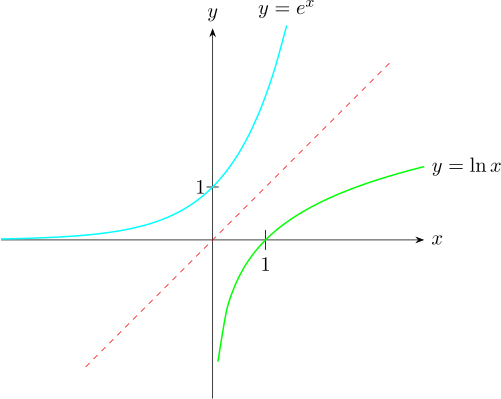
\(y=e^x\) and its inverse \(y=\ln x\)
Note 16.4. The graph of \(y=\ln x\) is the reflection of the graph of \(y=e^{x}\) in the line \(y=x\), as the graph of any
inverse function is. That is why the two curves meet the axes as mirror images: \(y=e^{x}\) passes through
\((0,1)\) and \(y=\ln x\) through \((1,0)\).
| \(\log _{\displaystyle {b}}a=c\) | \(\iff \) | \(\displaystyle {b^{\displaystyle {c}}=a}\) | ||
| logarithm | Exponent |
Questions on this section
Stuck on something here? Ask below and it stays attached to this topic.