22.4 Division of a Line in a Given Ratio
Given any line segment \(PQ\) with coordinates. We can divide this line \(PQ\) in any given ratio internally or
externally.
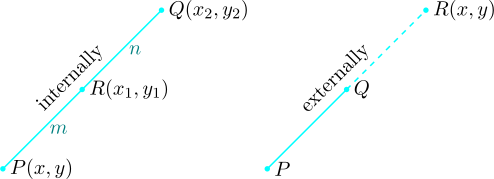
22.4.1 Internal Division of a Line Segment
Let \((x_1,y_1)\) and \((x_2,y_2)\) be the Cartesian coordinates of the points \(P\) and \(Q\) respectively referred to rectangular
coordinates \(OX\) and \(OY\) and the point \(R\) divides the line segment \(PQ\) internally in a given ration \(m: n\) say
\(PR : RQ = m: n\)
We want to find the coordinates of \(R\).
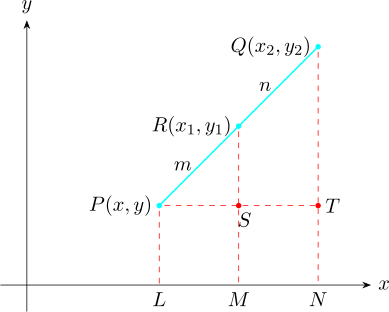
Let \((x,y)\) be the required coordinates of \(R\) from \(PQ\) and \(R\) drawin \(PL, \, OM\,\) and \(\, RN\).
\begin {align*} PS = LN = ON - OL & = x - x_1\\ PT = LM = OM - OL & = x_2 - x_1\\ RS = RN = RN - PL & = y - y_1 \end {align*}
\[\frac {PR}{RQ} = \frac {m}{n}\qquad ,\qquad \frac {RQ}{PR}= \frac {n}{m}\]
\begin {align*} \therefore \quad \frac {RQ}{PR} + 1 & = \frac {n}{m} + 1\\\\ \frac {RQ + PR}{QR} & = \frac {n + m}{n}\\\\ \frac {PQ}{PR} & = \frac {n + m}{m} \end {align*}
Now by construction the \(\triangle PRS\) and \(\triangle PQT\) are similar \[\frac {PS}{PT}= \frac {RS}{QT} = \frac {PR}{PQ}\]
Taking \(\quad \frac {PS}{PT} = \frac {PR}{PQ}\)
\[\frac {x - x_1}{x_2 - x_1} = \frac {m}{m + n}\quad \implies \quad x = \frac {mx_2 + nx_1}{m + n}\]
Taking \(\quad \frac {RS}{QT}= \frac {PR}{PQ}\)
\[\frac {y - y_1}{y_2 - y_1} = \frac {m}{m + n} \quad \implies \quad y = \frac {my_2 + ny_1}{m + n}\]
\(\therefore \quad \) The coordinates of \(R\) are \(\left (\frac {mx_2 + nx_1}{m + n}, \frac {my_2 + ny_1}{m + n}\right )\)
22.4.2 External Division of the Line Segment
Let \((x_1,y_1)\) and \((x_2,y_2)\) be the coordinates of \(P\) and \(Q\) respectively and the point \(R\) divides the line segment \(PQ\) externally in the ratio \(m: n\) \[\text {i.e}\quad PR : RQ = m:n\]
We want to find the coordinates of \(R\).
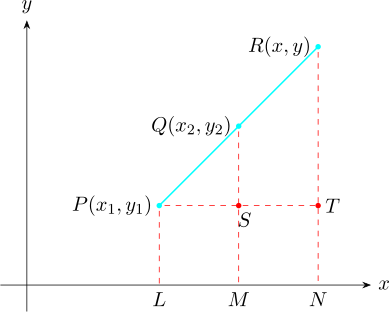
\begin {align*} PS = LM = 0M - OL & = x_2 - x_1\\ PT = LN = ON - OL & = x - x_1\\\\ QS = QM - SM = QM - PL & = y_2 - y_1\\ RT = RN - TN = RN - PL & = y - y_1 \end {align*}
\(\frac {PR}{PQ} = \frac {m}{n}\)
\begin {align*} 1 - \frac {QR}{PR} & = 1 - \frac {n}{m}\quad \implies \quad \frac {PR - QR}{PR} = \frac {m - n}{m}\\\\ \implies \quad \frac {PQ}{PR} & = \frac {m - n}{m}\\ \end {align*}
Taking \(\quad \frac {PS}{PT} = \frac {PQ}{PR}\)
\[\frac {x_2 - x_1}{x - x_1} = \frac {m - n}{m}\]
\(\triangle PQS\quad \) and \(\quad \triangle PRT\,\) are similar \[\frac {PS}{PT}= \frac {QS}{RT} = \frac {PQ}{PR}\]
\[\implies \quad x = \frac {mx_2 - nx_1}{m-n}\]
The coordinates of \(R\) are \(\left (\frac {mx_2 - nx_1}{m - n}, \frac {my_2 - ny_1}{m - n}\right )\)
- 1.
- A point divides internally the line segment joining the points \((8,9)\) and \((-7,4)\) in the ration \(\, 2:3\,\). Find the coordinates of the point.
- 2.
- \(A(4,5)\) and \(B(7,-1)\) are two given points and the point \(C\) divides the line segment \(AB\) externally in the ratio
\(\, 4: 3\). Find the coordinates of \(C\).
Find the ratio in which the line segment joining the points \((5,-4)\) and \((2,3)\) divided by the \(x-\)axis.
Solution.
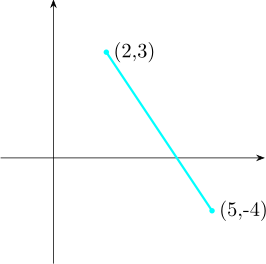
Since \(x-\)axis divides the line internally \[P\left (\frac {mx_2 + nx_1}{m + n}, \frac {my_2 + ny_1}{m + n}\right )\]
\[\implies \quad P\left (\frac {2m + 5n}{m + n}, \frac {3m - 4n}{m + n}\right )\]
Along the \(x-\)axis \(\quad y = 0\)
\begin {align*} \therefore \quad \frac {3m - 4n}{m + n} & = 0 \quad \implies \quad 3m - 4n = 0\\\\ \implies \quad 3m & = 4n\\\\ \implies \quad \frac {m}{n}= \frac {4}{3} \end {align*}
\[\therefore \quad 4: 3\]
Questions on this section
Stuck on something here? Ask below and it stays attached to this topic.