25 Polar Form of Complex Numbers
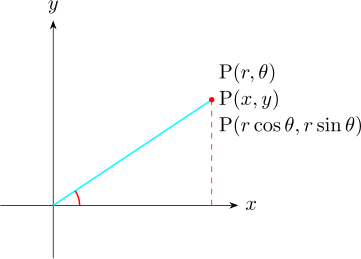
Let \(\quad z = x + i y,\,\) where \(x,y\in \mathbb {R}\)
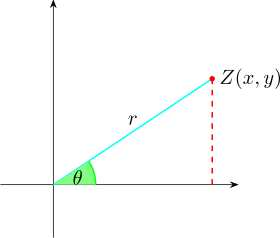
\[ x = r\cos \theta \quad , \quad y = r\sin \theta \]
The second form of a complex number number is \(\, z = r\left ( \cos \theta + i \sin \theta \right ).\,\) This is called the polar form of a complex
number.
The exponential series \(e^{w}=1+w+\frac {w^{2}}{2!}+\frac {w^{3}}{3!}+\cdots \) converges for every complex \(w\), and putting \(w=i\theta \) and separating the real and
imaginary terms gives the series for \(\cos \theta \) and \(\sin \theta \):
\[\boxed {\therefore \quad e^{i\theta } = \cos \theta + i\sin \theta }\]
This is called Euler’s Formula.
\(\therefore \), we can write a complex number in the third form, namely \( z = re^{i\theta }\)
This third form is the exponential form, where \(r=\left |z\right |\) and \(\theta \) is the argument of \(z\), written \(\arg z\).
Definition 25.1. For \(z=x+iy\neq 0\), the modulus is \(r=\left |z\right |=\sqrt {x^{2}+y^{2}}\), the distance from the origin, and the argument is any angle \(\theta \) with \[x=r\cos \theta ,\qquad y=r\sin \theta .\] The argument lying in \(-\pi <\theta \leq \pi \) is the principal argument.
Note 25.2. The argument is not unique: adding \(2\pi \) to \(\theta \) gives the same point, so every complex number has infinitely many arguments differing by multiples of \(2\pi \). That is why a principal value has to be singled out before “the” argument means anything.
Finding \(\theta \) from \(\tan \theta =\frac {y}{x}\) needs care, and this is where most mistakes happen. The tangent cannot distinguish a point from its opposite — \(1+i\) and \(-1-i\) both give \(\tan \theta =1\) — so the quadrant must be settled from the signs of \(x\) and \(y\) separately. A calculator’s \(\tan ^{-1}\) always returns an angle in \(\left (-\frac {\pi }{2},\frac {\pi }{2}\right )\), so for \(z\) in the second or third quadrant it gives an answer \(\pi \) out.
Note also that \(z=0\) has modulus \(0\) and no argument at all — there is no direction to speak of — which is why the definition excludes it.
\begin {align*} \cos iz & = \cosh z\\ \sin iz & = i\sinh z \\ \cos z & = \cosh iz\\ i \sin z & = \sinh iz \end {align*}
\begin {align*} e^{iz} & = \cos z + i\sin z\\ e^{-iz} & = \cos z - i\sin z \end {align*}
\begin {align*} e^{iz} + e^{-iz} & = \cos z + i\sin z + \cos z - i\sin z\\ e^{iz} + e^{-iz} & = 2\cos z\\\\ \implies \quad \cos z & = \frac {e^{iz} + e^{-iz} }{2} = \cosh i z\\\\ \therefore \quad \cos z & = \cosh i z \end {align*}
\begin {align*} e^{iz} - e^{-iz} & = \cos z + i\sin z - \cos z + i\sin z\\ \implies \quad 2i\sin z & = e^{iz} - e^{-iz} \\\\ \implies \quad \sin z & = \frac {e^{iz} - e^{-iz}}{2i}\\ \implies \quad i\sin z & = \frac {e^{iz} - e^{-iz}}{2}\\\\ \therefore \quad i\sin z & = \sinh iz\\\\ \end {align*}
25.2 De Moivres Theorem
25.3 The \(n^{\text {th}}\) Root of any Complex Number
Questions on this section
Stuck on something here? Ask below and it stays attached to this topic.