26.6 Position Vectors
Suppose that the position vector of \(A\) is \(\overrightarrow {OA} = \underline {a}\) and position vector of \(B\) is \(\overrightarrow {OB} = \underline {b}\).
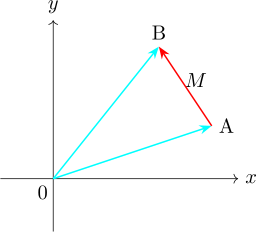
\[\overrightarrow {AB} = \overrightarrow {AO}+\overrightarrow {OB} = -\underline {a}+\underline {b} = \underline {b} - \underline {a}\]
Note 26.3. The route is \(A\) to \(O\) to \(B\), not \(O\) to \(A\) to \(B\) — and \(\overrightarrow {AO}\) is \(-\overrightarrow {OA}=-\underline {a}\), which is where the minus sign comes from. Reversing a vector reverses its sign.
The result is worth remembering in words: the vector from \(A\) to \(B\) is the position vector of the destination minus that of the start. The order is the opposite of what the notation \(\overrightarrow {AB}\) suggests, and getting it backwards is the commonest slip in this chapter.
\[\overrightarrow {OM} = \overrightarrow {OB} + \overrightarrow {BM} = \overrightarrow {OB} + \frac {1}{2}\overrightarrow {BA} = \frac {1}{2}\left (\underline {a} + \underline {b}\right )\]
Cartesian component of a vector in 2 dimension (plane or \(\mathbb {R}^2\)).
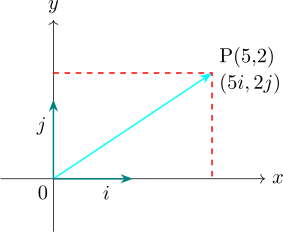
The unit vector of \(\overrightarrow {OP}\) is \[\frac {5\textbf {i} + 2\textbf {j}}{\left |5\textbf {i} + 2\textbf {j}\right |} = \frac {5\textbf {i} + 2\textbf {j}}{\sqrt {25 + 4}} = \frac {5\textbf {i} + 2\textbf {j}}{\sqrt {29}}\]
This is the unit vector in the direction of \(\overrightarrow {OP}\).
The general vector in \(\mathbb {R}^2\) is \(\, x\textbf {i} + y \textbf {j}\,\) and its unit vector is \(\,\frac {x\textbf {i} + y \textbf {j}}{\sqrt {x^2 + y^2}}\,\) is the direction of \(\overrightarrow {OP}\).
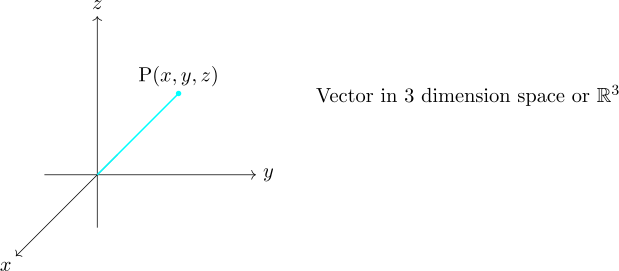
\[\overrightarrow {OP} = x\textbf {i} + y \textbf {j} + z\textbf {k}\]
The unit vector in \(\mathbb {R}^3\) is \(\,\frac {x\textbf {i} + y \textbf {j} + z\textbf {k}}{\sqrt {x^2 + y^2 + z^2}}\,\) in the direction of \(\overrightarrow {OP}\).
- 1.
- If \(\quad \underline {a} = 2\underline {i} + 7\underline {j}\). Find \(\left |\underline {a}\right |\)
- 2.
- Find \(\quad \underline {a} = 3\textbf {i} + 2\textbf {j}, \quad \underline {b} = 4\textbf {i} - 7\textbf {j}\,\). Find \[(\text {a})\quad \underline {a} + \underline {b} \qquad (\text {b})\quad \underline {a} - \underline {b} \qquad (\text {c})\quad \left |\underline {a} - \underline {b}\right |\]
- 3.
- Find the unit vector in the direction of \(\, 2\textbf {i} - 3\textbf {j}\).
- 4.
- If \(\quad \underline {a} = \textbf {i} + 3\textbf {j} - \textbf {k}, \quad \underline {b} = -2\textbf {i} + \textbf {k}\quad \) and \(\quad \underline {c}\).
Find- (a)
- \(\underline {a} + \underline {b}\)
- (b)
- \(\left |\underline {a} - \underline {c}\right |\)
- (c)
- the unit vector of \(\quad \textbf {i} - \textbf {j} - \textbf {k}\)
Questions on this section
Stuck on something here? Ask below and it stays attached to this topic.