22.3 The Distance of a Point from a Line
Another common problem in coordinate geometry is in determining the distance of a point from a
line.
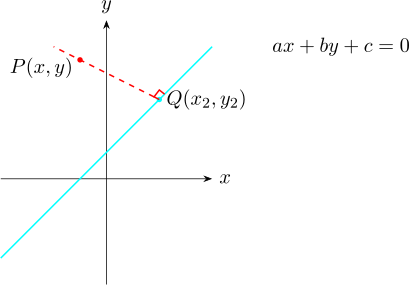
To calculate the distance from a point \(P(x,y)\) to a line \(L\), you find the point \(Q(x_2,y_2)\) at the foot of the perpendicular
from \(P\) to \(Q\) and calculate the distance from \(P\) to \(Q\).
Find the distance from point \((2,1)\) to the line \(\, L :\, y = x + 2\)
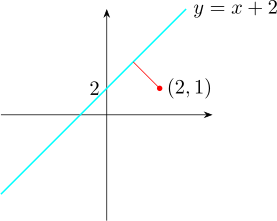
The gradient to the given line is \(m = 1\). Gradient of the perpendicular \((2,1)\) is \(m_1 = -1\).
\(\therefore \,\) The equation of the line perpendicular to \(\, y = x + 2\,\) from \((2,1)\) is
\[y - 1 = -1(x -2)\] \[\implies \quad y = 3 - x \quad \cdots \quad (2)\]
\begin {align*} \text {Now}\quad y & = 2 + x \quad \cdots \quad (1)\\ y & = 3 - x \quad \cdots \quad (2) \end {align*}
\begin {align*} x + 2 & = 3 - x\\ \implies \quad 2x & = 1 \implies x = \frac {1}{2}\qquad \text {and}\qquad y = \frac {1}{2} + 2 = \frac {5}{2} \end {align*}
\(\therefore \quad \left (\frac {1}{2},\frac {5}{2}\right )\quad \) and \(\quad (2,1)\) \begin {align*} d & = \sqrt {\left (2 - \frac {1}{2}\right )^2 + \left (1 - \frac {5}{2}\right )^2} = \sqrt {\frac {18}{4}}\\ & = \frac {3}{2}\sqrt {2}\\\\ \end {align*}
Another method for finding the distance from a point to a line is by the use of the formula, given the equation of the line \(L\,\, ax + by + c = 0\) and a point \((m,n)\) then the distance from \(P\) to \(L\) is given by \[ d = \frac { \left |am + bn + c\right | }{\sqrt {a^2 + b^2}}\]
- 1.
- Find the distance of each of the given points from the line \(\quad 2x + 3y - 6 = 0\) \[(\text {a}) \quad (1,3)\,, \qquad (\text {b}) \quad (-3,4)\,, \qquad (\text {c}) \quad (4,-2)\]
- 2.
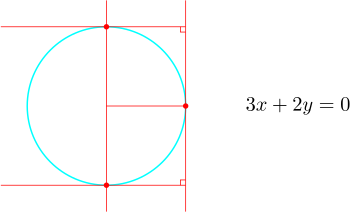
- Find the equation of the tangents to the circle \(\quad x^2 + y^2 - 4x - 2y - 8 = 0\quad \) which is parallel to the line \(\quad 3x + 2y = 0\)
- 3.
- Find the equation of the tangents to the circle \(\quad x^2 + y^2 + 4x + 8y - 5 = 0\quad \) which is parallel to the line \(\quad 4y - 3x = 0\).
Show that the line \(\quad 3x + 2y = 0\quad \) touches the circle \(\quad x^2 + y^2 + 6x + 4y = 0\quad \) and find the equation of the perpendicular tangents.
Solution.
Make \(y\) the subject in the equation of the line and substitute in the equation of the circle, \[3x + 2y = 0 \quad \implies \quad y = \frac {-3x}{2}\]
\begin {align*} \therefore \quad x^2 + \left (\frac {-3x}{2}\right )^2 + 6x + 4 \left (\frac {-3x}{2}\right )& = 0 \\ x^2 + \frac {9x^2}{4} + 6x - 6x & = 0 \end {align*}
\[x^2\left ( 1 + \frac {9}{4}\right ) = 0 \quad \implies \quad x = 0\]
\(\therefore \quad y = 0\qquad [0,0]\)
Questions on this section
Stuck on something here? Ask below and it stays attached to this topic.