12.4 Graphs
Consider the function \(\, f(x) = \sin x , \, 0 \leq x \leq 2\pi \).
| \(x\) | 0 | \(\frac {\pi }{6}\) | \(\frac {\pi }{3}\) | \(\frac {\pi }{2}\) | \(\frac {2\pi }{3}\) | \(\frac {5\pi }{6}\) | \(\pi \) | \(\frac {7\pi }{6}\) | \(\frac {4\pi }{3}\) | \(\frac {3\pi }{2}\) | \(\frac {5\pi }{3}\) | \(\frac {11\pi }{6}\) | \(2\pi \) |
| \(\sin x\) | 0 | \(\frac {1}{2}\) | 0.866 | 1 | 0.866 | \(\frac {1}{2}\) | 0 | \(-\frac {1}{2}\) | \(- 0.866\) | \(-1\) | \(- 0.866\) | \(-\frac {1}{2}\) | 0 |
Plotting the curve.
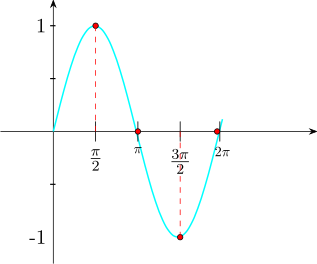
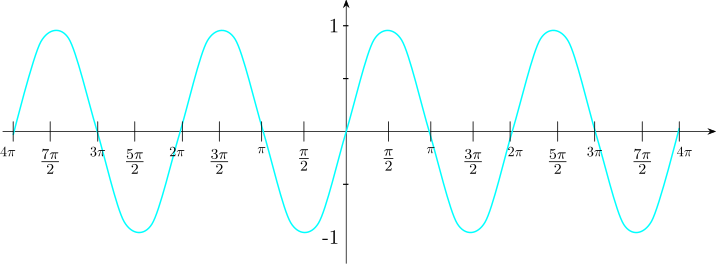
The sine function will repeat itself after \(2\pi \) radians. We can therefore expect the graph to repeat itself as
\(x\) decreases to \(\, - \infty \,\) and also as \(x\) increases \(\,+\infty .\,\)
Using this factor, we now sketch the graph of \(\,f(x) = \sin x \,, \quad -4\pi \leq x \leq 4\pi \).
Similarly, the graph of the function \(\, f(x) = \cos x\,\) behaves in the same way as the graph \(\, f(x) = \sin x\).
We sketch the the graph \(\, f(x) = \cos x \,, \, -2\pi \leq x \leq 2\pi \).
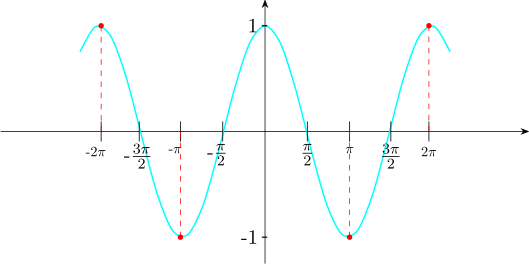
\[-1\leq \sin x \leq 1\quad ,\quad - 1\leq \cos x \leq 1\]
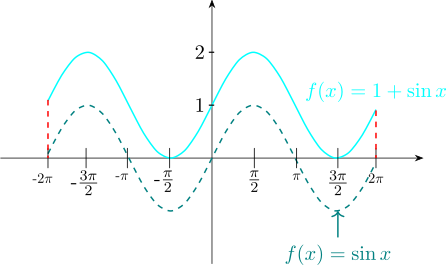
\(f(x) = 1 + \sin x \quad , \quad - 2\pi \leq x \leq 2\pi \)
| \(x\) | \(\frac {\pi }{2}\) | \(\pi \) | \(\frac {3\pi }{2}\) | \(2\pi \) |
| \(f(x) = 1 + \sin x\) | 2 | 1 | 0 | 1 |
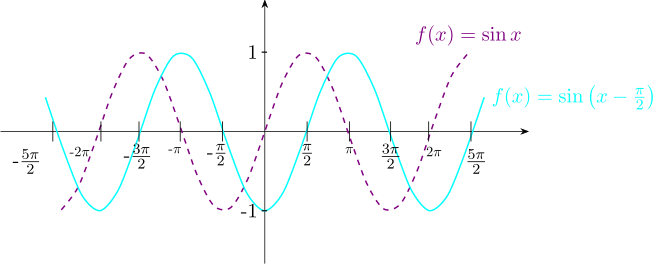
Sketch the graph of \(\quad f(x ) = \sin \left (x - \frac {\pi }{2}\right )\,, \, -2\pi \leq x \leq 2\pi \).
Solution.
The graph of \(\, f(x) = \sin \left (x - \frac {\pi }{2}\right )\,\) is the graph of \(\, f(x) = \sin x \,\) but moved \(\frac {\pi }{2}\) units to the right.
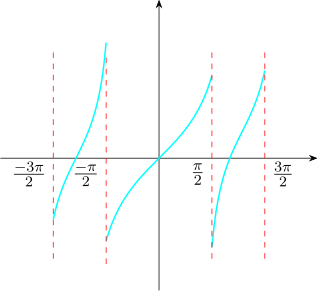
The graph of \(\, f(x) = \tan x\,\) for values of \(x\) such that \(\,-\frac {3\pi }{2}< x < \frac {3\pi }{2}\)
Questions on this section
Stuck on something here? Ask below and it stays attached to this topic.