26.8 The Vector Product
The scalar product of the vector \(\underline {a}\) and \(\underline {b}\) is \(\, \underline {a}\cdot \underline {b} = \left |\underline {a}\right | \left |\underline {b}\right |\cos \theta \), where \(\theta \) is the angle between the vectors \(\underline {a}\) and
\(\underline {b}\).
The vectors (or cross) product of the vectors \(\underline {a}\) and \(\underline {b}\) is defined as \[\underline {a}\times \underline {b} = \left |\underline {a}\right | \left |\underline {b}\right |\sin \theta \,(\hat {\textbf {n}})\]
where \(\theta \) is the angle between \(\underline {a}\) and \(\underline {b}\) and \(\hat {\textbf {n}}\) is a unit vector perpendicular to both \(\underline {a}\) and \(\underline {b}\). The directions of \(\hat {\textbf {n}}\) is that in which a right handed cork screws would move when turned from \(\underline {a}\) to \(\underline {b}\).
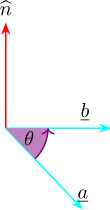
If the turn is in the opposite sense, that is from \(\underline {b}\) to \(\underline {a}\), the corkscrew moves in the direction of \(-\hat {\textbf {n}}\).
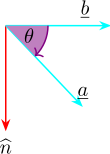
\begin {align*} \text {So}\quad \underline {b}\times \underline {a} & = \left |\underline {b}\right | \left |\underline {a}\right |\sin \theta \,(-\hat {\textbf {n}}) \\ & = - \left |\underline {a}\right | \left |\underline {b}\right |\sin \theta \,(\hat {\textbf {n}})\\\\ \implies \quad \underline {b}\times \underline {a} & = - \underline {a}\times \underline {b} \\ \end {align*}
So the cross product is not commutative: in general \(\underline {a}\times \underline {b}\neq \underline {b}\times \underline {a}\). It is anti-commutative, the two products being equal in magnitude and opposite in direction.
Note 26.5. This is the first product in the course that fails to commute, and the geometry says why: the answer is a direction perpendicular to both vectors, and there are two such directions. Which one is chosen depends on the order of the factors, so swapping them must flip the result.
One consequence worth noting: \(\underline {a}\times \underline {a}=\underline {0}\) for every vector. Setting \(\underline {b}=\underline {a}\) in \(\underline {b}\times \underline {a}=-\underline {a}\times \underline {b}\) gives \(\underline {a}\times \underline {a}=-\underline {a}\times \underline {a}\), and the only vector equal to its own negative is the zero vector. The same follows from the definition, since \(\sin 0=0\).
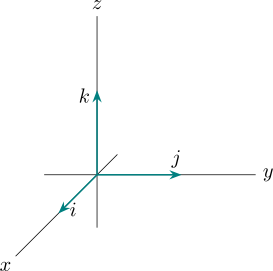
By definition, \begin {align*} \textbf {i} \times \textbf {j} & = -\left (\textbf {j} \times \textbf {i}\right ) = \textbf {k}\\ \textbf {j} \times \textbf {k} & = -\left (\textbf {k} \times \textbf {j}\right ) = \textbf {i}\\ \textbf {k} \times \textbf {i} & = -\left (\textbf {i} \times \textbf {k}\right ) = \textbf {j} \end {align*}
\[\textbf {i} \times \textbf {i} = \textbf {j} \times \textbf {j} = \textbf {k} \times \textbf {k} = \textbf {0}\]
Let \(\, \underline {a} = a_1 \textbf {i} + a_2\textbf {j} + a_3\textbf {k}\,\) and \(\, \underline {b} = b_1 \textbf {i} + b_2\textbf {j} + b_3\textbf {k}\,\)
\begin {align*} \underline {a}\times \underline {b} & = \left ( a_1 \textbf {i} + a_2\textbf {j} + a_3\textbf {k}\right )\times \left (b_1 \textbf {i} + b_2\textbf {j} + b_3\textbf {k}\right )\\ & = a_1b_2\textbf {k} + a_1b_3\left (-\textbf {j}\right ) + a_2b_1\left (-\textbf {k}\right ) + a_2b_3\textbf {i} + a_3b_1\textbf {j} + a_3b_2\left (-\textbf {i} \right )\\ & = a_1b_2\textbf {k} - a_1b_3\textbf {j} - a_2b_1\textbf {k} + a_2b_3\textbf {i} + a_3b_1\textbf {j} - a_3b_2\textbf {i}\\ & = \left (a_2b_3 - a_3b_2\right )\textbf {i} - \left (a_3b_1 - a_1b_3\right )\textbf {j} + \left (a_1b_2 - a_2b_1\right )\textbf {k} \end {align*}
\begin {align*} \underline {a}\times \underline {b} & = \begin {vmatrix} \textbf {i} & \textbf {j} & \textbf {k}\\ a_1 & a_2 & a_3\\ b_1 & b_2 & b_3\\ \end {vmatrix}\\\\ & = \textbf {i}\begin {vmatrix} a_2 & a_3\\ b_2 & b_3\\ \end {vmatrix} - \textbf {j}\begin {vmatrix} a_1 & a_3\\ b_1 & b_3\\ \end {vmatrix} + \textbf {k}\begin {vmatrix} a_1 & a_2\\ b_1 & b_2\\ \end {vmatrix}\\ \end {align*}
So,
- 1.
- \(\,\underline {a} \times \underline {b} = |\underline {a}||\underline {b}|\,\sin \theta \left (\hat {\textbf {n}}\right )\quad \) formula
- 2.
- \(\,\underline {a} \times \underline {b} = \left ( a_1 \textbf {i} + a_2\textbf {j} + a_3\textbf {k}\right )\times \left (b_1 \textbf {i} + b_2\textbf {j} + b_3\textbf {k}\right )\quad \) Directly
\(\underline {a}\times \underline {b} = \begin {vmatrix} \textbf {i} & \textbf {j} & \textbf {k}\\ a_1 & a_2 & a_3\\ b_1 & b_2 & b_3\\ \end {vmatrix}\quad \) Appropriate determinate
\(*\quad \) If \(\,\underline {a}\times \underline {b} = 0,\,\) then \(\,\underline {a}\times \underline {b} = \left |\underline {a}\right | \left |\underline {b}\right |\sin \theta \,(\hat {\textbf {n}})\,\) either \(\, \left |\underline {a}\right | = 0 \implies \underline {a}= \underline {0}\,\) or \(\, \left |\underline {b}\right | = 0\implies \underline {b} = \underline {0}\)
\[\sin \theta = 0 \quad \implies \quad \theta = 0, \quad \pi \]
Then \(\underline {a}\) and \(\underline {b}\) are in the same direction or in the same sense or opposite sense. If \(\sin \theta = 0\) then \(\underline {a}\) and \(\underline {b}\) are
parallel.
- 1.
-
- (a)
- \(\quad \left (\textbf {i} - 2\textbf {j} + 5\textbf {k}\right )\times \left (-2\textbf {i} + \textbf {j} - 3\textbf {k}\right )\)
- (b)
- \(\quad \left (3\textbf {j} - 2\textbf {k}\right ) \times \left (\textbf {j} + 3\textbf {k}\right )\)
- i.
- Evaluate the cross product directly.
- ii.
- Evaluate the cross product by an appropriate determinant.
- 2.
- Find a unit vector which is perpendicular to both \(\quad \underline {a} = 2\textbf {i} - \textbf {j} + 3\textbf {k}\,\) and
\(\, \underline {b} = -\textbf {i} + 3\textbf {j} - \textbf {k}\). - 3.
- Find the sine of the acute angle between \(\quad \underline {a} = 2\textbf {i} - \textbf {j} + 2\textbf {k}\,\) and \(\quad \underline {b} = -3\textbf {i} + 4\textbf {j} + \textbf {k}\,\)
- 4.
- Given that \(\quad \underline {a} = \textbf {i} + 2 \textbf {j} - 2\textbf {k}\,\) and \(\quad \underline {b} = p\textbf {i} + q\textbf {k}\,\) and that \(\underline {a}\times \underline {b} = 2\textbf {j} + \lambda \textbf { k}\). Find the values of the scalars constant \(\, p, q\,\) and \(\, \lambda \).
- 5.
- Given that \(\quad \underline {u} = 2\textbf {i} - \textbf {j} + 2\textbf {k}\,\) and \(\quad \underline {v} = a\textbf {i} + b\textbf {k}\,\) and \(\underline {u}\times \underline {v} = \textbf {j} + c\textbf {k}\).
- (a)
- Find \(\quad a, b, c\)
- (b)
- Find the cosine of the angle between \(\underline {u}\) and \(\underline {v}\).
Questions
- 1.
-
- (a)
- Given the vectors \(\quad \underline {u} = 2\alpha \textbf {i} + 4\textbf {j} - 3\textbf {k}\,\) and \(\quad \underline {v} = 4\textbf {i} + \beta \textbf {j} + 3\textbf {k}\,\), find
- i.
- the values of \(\alpha \) and \(\beta \) if the vectors are parallel
- ii.
- a relation between \(\alpha \) and \(\beta \) if the vectors are perpendicular.
- (b)
- Find the area of the parallelogram \(ABCD\) given that its vertices are \(\, A(2,1,-1),\\ \quad B(1,-7,3),\quad C(-2,5,1)\,\) and \(\, D(-1, 13, -3)\).
- 2.
- Given that \(\quad \underline {a} = 4\textbf {i} - 3\textbf {j} - \textbf {k}\,m\), \(\quad \underline {b} = \textbf {i} + 2\textbf {j} + 3\textbf {k}\,\) and \(\quad \underline {c} = -5\textbf {i} - 3\textbf {j} + 5\textbf {k}\,\).
Find the following:
- (a)
- \(\, 2\underline {a}\cdot \underline {b}\)
- (b)
- \(\, \underline {a}\times 3\underline {b}\)
- (c)
- \(\, \underline {a}\cdot \left (\underline {b}\times \underline {c}\right )\)
- (d)
- Find the area of the triangle \(ABC\) whose vertices are \(\, A(2,-3,4),\quad B(0,1,2)\,\) and \(\, C(-1,2,0)\)
- 3.
-
- (a)
- If the point \(P\) has position vector \(\quad 2\textbf {i} - 4\textbf {j} + 5\textbf {k}\,\) and \(\quad \overrightarrow {PQ} = 3\textbf {i} + 6\textbf {j} - 2\textbf {k},\,\) find the position vector of the point \(Q\).
- (b)
- Find the values of \(a\) and \(b\) for which the vector \(\quad 2\textbf {i} + \textbf {j} + 3\textbf {k}\,\) is perpendicular to both \(\, 3\textbf {i}- b\textbf {k}\quad \) and \(\quad a\textbf {i} + 2 \textbf {j} + 2b\textbf {k}\,\).
- (c)
- Given that \(\quad \underline {c} = 3\textbf {i} - \textbf {j} + 2\textbf {k}\,\), \(\quad \underline {d} = -4\textbf {i} + 2\textbf {k}\,\) and \(\quad \underline {e} = \textbf {i} - \textbf {j} - 2\textbf {k},\,\) find \(\,\underline {c}\cdot \left ( \underline {d}\times \underline {e}\right )\).
- (d)
- Given that \(\quad \underline {a} = i\textbf {i} + 2\textbf {j} - 3\textbf {k}\,\) and \(\quad \underline {a} = -2\textbf {i} - \textbf {j} + 3,\textbf {k}\,\) find \(\cot \theta ,\,\) where \(\theta \) is angle between \(\underline {a}\) and \(\underline {b}\)
Questions on this section
Stuck on something here? Ask below and it stays attached to this topic.