23 Integration
Consider the function \(\, F(x) = 3x^2 + 7x - 2\,\) and we want to find its derivatives as \(f(x)\), that is \[\frac {d F(x)}{dx} = f(x)\]
\[F'(x) = 6x + 7 = f(x)\]
\(F(x) = 3x^2 + 7x - 2\,\) is called an anti-derivative.
\(F(x) = 4x^3 - 7x^2 + 12x - 4\)
\(\frac {d}{dx}F(x) = f(x) = 12x^2 - 14x + 12\)
The anti-derivative of \(f(x) = 12x^2 - 14x + 12\) is
\begin {align*} & = \frac {12 x^{2+1}}{2 + 1} - \frac {14x^{1+1}}{1 + 1} + \frac {12 x^1}{1} + c\\\\ & = \frac {12}{3}x^3 - \frac {14}{2}x^2 + 12x + c\\\\ & = 4x^3 - 7x^2 + 12x + c \end {align*}
\(c\) is the constant of integration.
Definition 23.1. A function \(F(x)\) is an anti-derivative of \(f(x)\) if \(\frac {dF(x)}{dx}=f(x)\).
If \(F(x)\) is an anti-derivative of \(f(x)\) then so is \(F(x)+c\) for any constant \(c\), since differentiating a constant gives zero. Conversely, any two anti-derivatives of the same function differ only by a constant — if \(F'=G'\) then \((F-G)'=0\), and a function with zero derivative everywhere is constant.
Note 23.2. That is why the arbitrary constant is not optional decoration. \(\int f(x)\,dx\) denotes not one function but a whole family of them, every member differing from the next by a vertical shift, and \(+c\) is what says so. Omitting it gives one member of the family and claims it is all of them.
The constant disappears only in a definite integral, where it cancels in the subtraction \(F(b)-F(a)\) — as the first example below shows explicitly.
The table below can be read from right to left to get anti-derivatives.
| \(f(x)\) | \(F(x)\) an anti-derivative | |||
| 1. | \(K\) (constant) | \(Kx + c\) | ||
| 2. | \(x\) | \(\frac {x^2}{2} + c\) | ||
| 3. | \(x^2\) | \(\frac {x^3}{3} + c\) | ||
| 4. | \(x^n \) | \( \frac {x^{n + 1}}{n + 1} + c\) | ||
| 5. | \(\sin mx\) | \(\frac {-\cos mx}{m} + c\) | ||
| 6. | \(\cos mx \) | \(\frac {\sin mx}{m} + c\) | ||
| 7. | \(e^{mx}\) | \(\frac {e^{mx}}{m} + c\) | ||
| 8. | \(\frac {1}{x}\) | \(\ln \left |x\right | + c\) | ||
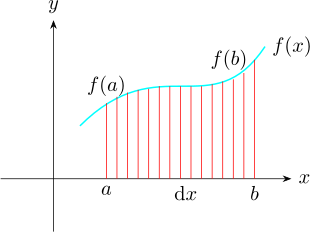
\[A = \lim \limits _{dx \rightarrow 0} \sum ^b_a f(x)\,dx = \int ^b_a f(x)\,dx\]
23.2 Methods of Integration
23.2.1 Integration of powers
23.2.2 Integration by Parts
23.2.3 Integration by Substitution
23.3 Trigonometric Substitution
23.4 Partial Fractions
23.5 Area Under the Curve
Questions on this section
Stuck on something here? Ask below and it stays attached to this topic.