13 Limits
Everything in the calculus that follows — derivatives, and later integrals — is built on one idea: what a function approaches as its input approaches some value, whether or not it ever arrives.
Definition 13.1 (Limit). Let \(f\) be defined near \(a\), though not necessarily at \(a\). We say \[\lim _{x\to a}f(x)=L\] if the values of \(f(x)\) can be made as close to \(L\) as we please by taking \(x\) close enough to \(a\), on either side, but not equal to \(a\).
Note 13.2. The phrase “but not equal to \(a\)” is the whole point of the idea. The limit as \(x\to a\) says nothing whatever about \(f(a)\); the function need not even be defined there. This is exactly the situation a derivative presents — the quotient \(\frac {f(x+h)-f(x)}{h}\) is undefined at \(h=0\), which is the one value we care about — and it is why limits had to be invented.
Definition 13.3 (One-sided limits). \(\lim \limits _{x\to a^{-}}f(x)=L\) means \(f(x)\to L\) as \(x\) approaches \(a\) through values less than \(a\), and \(\lim \limits _{x\to a^{+}}f(x)=L\) through values greater than \(a\). The two-sided limit exists precisely when both one-sided limits exist and are equal: \[\lim _{x\to a}f(x)=L \iff \lim _{x\to a^{-}}f(x)=\lim _{x\to a^{+}}f(x)=L .\]
Consider the function \(f(x)=x^2\). We can find the limit as \(x\) approaches 2.
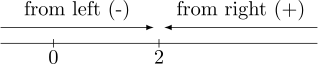
| From Left | From Right
| ||
| \(x\) | \(x^2\) | \(x\) | \(x^2\) |
| 1.9 | 3.61 | 2.1 | 4.41 |
| 1.99 | 3.9601 | 2.01 | 4.0401 |
| 1.999 | 3.996001 | 2.001 | 4.004001 |
| 1.9999 | 3.99960001 | 2.0001 | 4.00040001 |
Both columns close in on \(4\), and \(f(2)=4\) as well, so \(\lim \limits _{x\to 2}x^{2}=4\). For a function as well behaved as this one the limit is simply the value, and the table tells us nothing we could not have got by substituting. The next example is the interesting case.
Consider now \(f(x)=\frac {x^2+x-2}{x-1}\) and find the limit as \(x\) approaches \(1\). Note that \(f(1)\) does not exist — substituting gives \(\frac {0}{0}\) — so
here the limit cannot be read off the function’s value.
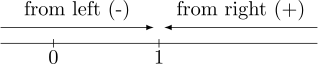
| \(x\longrightarrow 1^{-}\) (from left) | \(x\longrightarrow 1^{+}\) (from right)
| ||
| \(x\) | \(f(x)\) | \(x\) | \(f(x)\) |
| 0.9 | 2.9 | 1.1 | 3.1 |
| 0.99 | 2.99 | 1.01 | 3.01 |
| 0.999 | 2.999 | 1.001 | 3.001 |
| 0.9999 | 2.9999 | ||
Here since \(f(x)\) approaches 3 as \(x\longrightarrow 1^{-}\) as well as when \(x\longrightarrow 1^+\) we say that the limit of the function exists and the limit
is 3.
We write \(\lim \limits _{x\longrightarrow 1}f(x)=\lim \limits _{x\longrightarrow 1} \frac {x^2+x-2}{x-1}=3\).
Let \(f(x)= \begin {cases} 1-x^2 & \text {if}\quad x\leq -2\\\\ 3+x & \text {if}\quad x>-2\\ \end {cases} \)
find the limit if it exists at \(x=-2\).
| \(x\longrightarrow -2^{+}\) | \(x\longrightarrow -2^{-}\) | ||
| \(x\) | \(3+x\) | \(x\) | \(1-x^{2}\) |
| \(-1.9\) | 1.1 | \(-2.1\) | \(-3.41\) |
| \(-1.99\) | 1.01 | \(-2.01\) | \(-3.0401\) |
| \(-1.999\) | 1.001 | ||
| \(-1.9999\) | 1.0001 | ||
| \(\lim \limits _{x\to -2^{+}}f(x)=1\) | \(\lim \limits _{x\to -2^{-}}f(x)=-3\) | ||
Since \(\lim \limits _{x\longrightarrow -2^+}f(x)=1\neq \lim \limits _{x\longrightarrow -2^-}f(x)=-3.\) The limit does not exist.
Example 13.5. Let \[f(x)= \begin {cases} 2x+1, & x\leq -1\\ x^{2}-2, & x>-1 \end {cases}\] and find \(\lim \limits _{x\to -1}f(x)\).
Solution. Approaching from the left we use the first branch, and from the right the second: \[\lim _{x\to -1^{-}}f(x)=2(-1)+1=-1,\qquad \lim _{x\to -1^{+}}f(x)=(-1)^{2}-2=-1 .\] The two agree, so the limit exists and \[\lim _{x\to -1}f(x)=-1 .\]
Note 13.6. Compare this with the previous example, where the one-sided limits were \(1\) and \(-3\) and the limit failed to exist. A piecewise function does not automatically break at the join — it breaks only if the two branches disagree there. Here they happen to meet, and the graph has no jump.
To evaluate a limit at a point, substitute the value of \(x\) directly whenever doing so gives a real number.
- 1.
- \(\lim \limits _{x\longrightarrow 0} 3x^2-2x+1=3(0)^2-2(0)+1=1\)
- 2.
- \(\lim \limits _{x\longrightarrow -3}\frac {x}{x-2}\)
However, difficult situations arise if we get \(\frac {0}{0}\) or \(\frac {\infty }{\infty }\). These situations are however dealt with in a special way.
13.2 Standard Limits
13.3 Limits Of The Form \(\dfrac {\infty }{\infty }\)
13.4 Some Standard Limits:
13.5 Continuity
13.6 Practice Problems
Questions on this section
Stuck on something here? Ask below and it stays attached to this topic.