23.5 Area Under the Curve
Integration is applied in:
- 1.
- Determining the area under the curves i.e
\(\displaystyle {\int f(x) dx = F(b) - F(a)}\quad \) by the fundamental theorem of calculus.
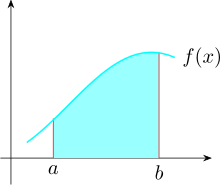
The area is determined by the area between the curve and the \(x-\)axis bounded by \(x = a\) and \(x = b\).
The area below the \(x-\)axis is negative.
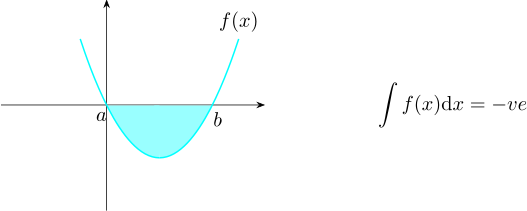
We can find the area between two curves such as
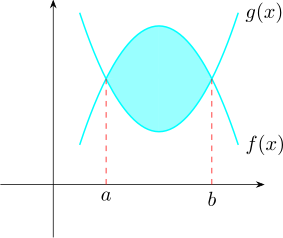
\[A = \int ^b_a \left [f(x) - g(x)\right ]\,dx\]
- (a)
- Find the area enclosed by the curve \(\, y_1 = x^2\,\) and \(\, y_2 = x^2 -2x\,\) and the limits \(\, x = 1\,\) and \(\, x = 3\)
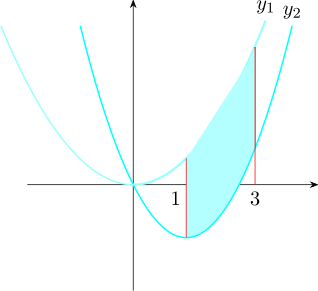
\begin {align*} A & = \int ^3_1 \left [f(x) - g(x)\right ]\,dx = \int ^3_1\left [x^2 - \left (x^2 -2x\right )\right ]\,dx\\\\ & = \int ^3_12x\,dx\\\\ & = x^2\Bigg |^3_1\\\\ & = 9 - 1\\ & = 8\,\text {units squared}\\\\ \end {align*}
- (b)
- \(x = \sqrt {y}\,\implies \, f(y) = \sqrt {y}\)
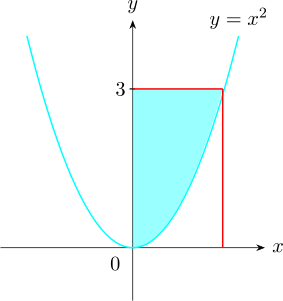
\begin {align*} \therefore \quad \int ^3_0 f(y) \,dy & = \int ^3_0y^{1/2}\,dy\\\\ & = \frac {y^{1/2+1}}{3/2}\Bigg |^3_0 = \frac {2}{3}\left [3^{3/2}\right ]\\\\ & = 2\sqrt {3}\,\text {units squared}\\\\ \end {align*}
Here we deal with marginal functions which are:
Marginal cost given as \(\frac {dc}{dx}\) where \(x-\)products or marginal revenue and marginal profits. All these functions are first derivated such that \(\frac {dc}{dx}\quad \implies \,\) to find the cost function you simply find \begin {align*} dc & = f(x)\,dx\\ \int dc & = \int f(x)\,dx\\\\ c & = \int f(x)\,dx\\\\\ \end {align*}
Sample Questions
- 1.
- Find the integral of
- (a)
- \(\quad \displaystyle {\int e^{2x}\,dx}\)
- (b)
- \(\quad \displaystyle {\int \sin 3x\,dx}\)
- (c)
- \(\quad \displaystyle {\int e^{-3x}\,dx}\)
- (d)
- \(\quad \displaystyle {\int \frac {1}{x^5}\,dx}\)
- (e)
- \(\quad \displaystyle {\int \frac {1}{x}\,dx}\)
- (f)
- \(\quad \displaystyle {\int ^1_0\left (x^2 + 1\right )\,dx}\)
- (g)
- \(\quad \displaystyle {\int ^e_1\frac {1}{x}\,dx}\)
- 2.
- Find
\[(\text {a})\quad \int x\cos x \,dx\qquad (\text {b})\quad \int x^2e^{3x}\,dx\qquad (\text {c})\quad \int e^x\sin x \,dx\]
- 3.
- Evaluate
\[(\text {a})\quad \int ^{\pi }_0 x \cos \frac {1}{2}x\,dx \qquad (\text {b})\quad \int ^1_0x^2e^{x}\,dx\qquad (\text {c})\quad \int ^2_1x^3\ln x \,dx\]
\[(\text {d})\quad \int ^{\pi /4}_0x^2\sin 2x\, dx\qquad (\text {e})\quad \int ^{\frac {\pi }{2}}_0\cos \left (1- 2x\right )\,dx\]
- 4.
- Find \[(\text {a})\quad \int \frac {x}{\sqrt {1 + x}}\,dx \qquad (\text {b})\quad \int \frac {e^x}{\sqrt {\left (e^x - 1\right )}}\]
- 5.
- Find the area under the curve \(\quad y = 2 + x - x^2\)
- 6.
- Find the area under the curve \(\, y = x^2 + 2\, \) between \(\, x = 1\,\) and \(\, x = 3\).
- 7.
- Find the area between the curve \(\, y = x ( x - 2)\,\) and the \(x-\)axis from \(\, x = -1\,\) to \(\, x = 2\).
- 8.
- Find the area between \(\, y = x^2 - 3x + 2\,\) and \(x-\)axis.
- 9.
- Find the area of the region bounded by the \(x-\)axis, the graph of \(\, y = x^2 - 2x - 1\,\) and \(y = -e^x - 1\), for \(\, x = -1\,\) and \(\, x = 1\).
- 10.
- Find the area of the region bounded by the function \(\, y = x^3\), the \(x-\)axis and the lines \(\, x = -1\,\) and \(\, x = 1\).
- 11.
- Find the area of the region completely enclosed by the graphs of the functions \(\, f(x) = x^3 - 3x + 3\,\) and \(\, g(x) = x + 3\).
- 12.
-
- (a)
- Find the area bounded by the curve of \(\, f(x) = x^2 - x\), the \(x-\)axis, between \(\, x = -1\,\) and \(\, x = 2\)
- (b)
- Evaluate the following integrals \[(\text {i})\quad \int \left (2x + 1\right )\left (x^2 + x\right )\,dx \qquad (\text {ii})\quad \int \frac {x}{\left (1 - 2x^2\right )}\,dx\qquad \] \[(\text {iii})\quad \int \frac {x}{\left (x - 2\right )\left (x + 4\right )}\,dx\qquad (\text {iv})\quad \displaystyle {\int e^{2x}\cos x \,dx}\]
- 13.
- Evaluate the following indefinite integrals:
\(\displaystyle {(\text {a})\quad \int \left (3\frac {1}{\sqrt {x}} - \frac {1}{x - 4}\right )\,dx\qquad (\text {b})\quad \int \left [\cos \left (x + 1\right ) - \sin \left (2x + 1\right )\right ]\,dx}\)
\(\displaystyle {(\text {c})\quad \int \left (e^{2x + 1} + x^{-1}\right )\,dx}\)
- 14.
-
- (a)
- Evaluate the integrals:
\((\text {i})\quad \displaystyle {\int \frac {\left (\ln x\right )^2}{x}\, \qquad (\text {ii})\quad \int xe^{2x}\,dx}\)
\((\text {iii})\quad \displaystyle {\int ^3_0\frac {x}{\sqrt {x + 1}}\,dx\qquad (\text {iv})\quad \int xe^{-x}\,dx}\)
- (b)
- On the same diagram, sketch the graphs of the curves \(\, y = 2x^2 + 3\,\) and \(\, y = 10x - x^2\,\) and state their points of intersection. Hence, find the area between the two curves.
- (c)
- Same as (b) by use \(\, y = 8 - x^2\,\) and \(\, y = x^2\)
- (a).
- \(\displaystyle \int (2x+1)\left (x^{2}-1\right )dx\)
- (b).
- \(\displaystyle \int ^{4}_{1}\left (\sqrt {t}-2\right )dt\)
Show solution
Solution. (a). There is no product rule for integration, so expand first: \[(2x+1)\left (x^{2}-1\right )=2x^{3}-2x+x^{2}-1 .\] Integrating term by term, \[\int \left (2x^{3}+x^{2}-2x-1\right )dx =\frac {x^{4}}{2}+\frac {x^{3}}{3}-x^{2}-x+c .\]
(b). Write \(\sqrt {t}=t^{1/2}\) and apply the power rule: \[\int ^{4}_{1}\left (t^{1/2}-2\right )dt =\left [\frac {2}{3}t^{3/2}-2t\right ]^{4}_{1} =\left (\frac {2}{3}(8)-8\right )-\left (\frac {2}{3}-2\right ) =\frac {16}{3}-8-\frac {2}{3}+2=-\frac {4}{3}.\]
Note 23.15. The negative answer in (b) is not an error. Over \([1,4]\) the integrand \(\sqrt {t}-2\) is negative for \(t<4\) and zero at \(t=4\), so the curve lies below the axis and the integral counts that area with a minus sign — exactly the point made when the fundamental theorem was stated. The area between the curve and the axis is \(\frac {4}{3}\).
Part (a) is worth noticing for what it does not do. There is no rule allowing \(\int fg\) to be split into \(\int f\cdot \int g\); expanding into a sum is the only elementary route, and it works because integration is linear over sums.
- (a).
- \(\displaystyle \int \frac {x}{\sqrt {4-x^{2}}}\,dx\)
- (b).
- \(\displaystyle \int x^{2}\ln x\,dx\)
- (c).
- \(\displaystyle \int ^{3}_{2}\frac {4x+5}{(x+2)(x-1)}\,dx\)
- (d).
- \(\displaystyle \int ^{\pi /2}_{0}\sin ^{3}x\,dx\)
Show solution
Solution. (a). Substitute \(u=4-x^{2}\), so \(du=-2x\,dx\) and \(x\,dx=-\frac {1}{2}du\): \[\int \frac {-\frac {1}{2}\,du}{\sqrt {u}} =-\frac {1}{2}\int u^{-1/2}du=-u^{1/2}+c=-\sqrt {4-x^{2}}+c .\]
(b). By parts with \(u=\ln x\) and \(v'=x^{2}\), so \(u'=\frac {1}{x}\) and \(v=\frac {x^{3}}{3}\): \[\int x^{2}\ln x\,dx=\frac {x^{3}}{3}\ln x-\int \frac {x^{3}}{3}\cdot \frac {1}{x}dx =\frac {x^{3}}{3}\ln x-\frac {x^{3}}{9}+c =\frac {x^{3}}{9}\left (3\ln x-1\right )+c .\]
(c). Partial fractions first: \[\frac {4x+5}{(x+2)(x-1)}=\frac {A}{x+2}+\frac {B}{x-1} \implies 4x+5=A(x-1)+B(x+2).\] Putting \(x=1\) gives \(9=3B\), so \(B=3\); putting \(x=-2\) gives \(-3=-3A\), so \(A=1\). Hence \[\int ^{3}_{2}\left (\frac {1}{x+2}+\frac {3}{x-1}\right )dx =\left [\ln \left |x+2\right |+3\ln \left |x-1\right |\right ]^{3}_{2}\] \[=\left (\ln 5+3\ln 2\right )-\left (\ln 4+0\right ) =\ln \frac {5\cdot 8}{4}=\ln 10 .\]
(d). An odd power of sine: peel off one factor and convert the rest. \[\int ^{\pi /2}_{0}\sin ^{3}x\,dx=\int ^{\pi /2}_{0}\left (1-\cos ^{2}x\right )\sin x\,dx .\] Substituting \(u=\cos x\), \(du=-\sin x\,dx\), with \(u=1\) at \(x=0\) and \(u=0\) at \(x=\frac {\pi }{2}\): \[\int ^{0}_{1}\left (1-u^{2}\right )(-du)=\int ^{1}_{0}\left (1-u^{2}\right )du =\left [u-\frac {u^{3}}{3}\right ]^{1}_{0}=\frac {2}{3}.\]
Note 23.16. Each part is a different technique, and recognising which applies is most of the skill.
(a) is a substitution because the numerator is, up to a constant, the derivative of what is under the root. Whenever \(\int f'(x)g\left (f(x)\right )dx\) appears, substitute \(u=f(x)\).
(b) is by parts because \(\ln x\) has no elementary anti-derivative but a simple derivative — so it must be the part that gets differentiated.
(c) is partial fractions because the denominator factorises and the numerator has lower degree.
(d) is the odd-power trick: with an odd power of sine, one factor of \(\sin x\) pairs with \(dx\) to become \(-du\), and the even remainder converts to cosines. The same works for an odd power of cosine with the roles swapped. An even power needs the half-angle identities instead.
Show solution
Solution. The repeated factor \((x+2)^{2}\) needs two terms, one for each power: \[\frac {2x^{2}+6x+1}{(x-1)(x+2)^{2}} =\frac {A}{x-1}+\frac {B}{x+2}+\frac {C}{(x+2)^{2}} .\] Multiplying through by \((x-1)(x+2)^{2}\), \[2x^{2}+6x+1=A(x+2)^{2}+B(x-1)(x+2)+C(x-1).\] Choose values of \(x\) that kill terms. At \(x=1\): \(9=9A\), so \(A=1\). At \(x=-2\): \(8-12+1=-3C\), so \(-3=-3C\) and \(C=1\).
For \(B\), compare coefficients of \(x^{2}\): on the left \(2\), on the right \(A+B\). Hence \(B=1\), and \[\frac {2x^{2}+6x+1}{(x-1)(x+2)^{2}} =\frac {1}{x-1}+\frac {1}{x+2}+\frac {1}{(x+2)^{2}} .\]
Note 23.17. The two terms for a repeated factor are not optional. With only \(\frac {B}{(x+2)^{2}}\) there would be three unknowns’ worth of freedom missing and the identity could not hold for all \(x\) — a denominator \((x+a)^{k}\) needs one term for each of \((x+a),(x+a)^{2},\dots ,(x+a)^{k}\).
Note also the two techniques used together. Substituting the roots of the denominator is quickest, but it only ever reaches \(A\) and \(C\) here, since no value of \(x\) isolates \(B\). Comparing coefficients supplies the rest, and comparing the highest power is usually the least work.
Questions on this section
Stuck on something here? Ask below and it stays attached to this topic.