12.3 Identities
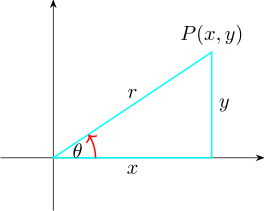
By Pythagoras
\(r^2 = x^2 + y^2\quad \cdots \quad (i)\)
\(\sin \theta = \frac {y}{r}\quad \cdots \quad (ii)\)
\(\cos \theta = \frac {x}{r}\quad \cdots \quad (iii)\)
From \((i)\) divide through by \(r^2\)
\[\frac {r^2}{r^2} = \frac {x^2}{r^2} + \frac {y^2}{r^2} \quad \implies \quad 1 = \left (\frac {x}{r}\right )^2 + \left (\frac {y}{r}\right )^2\]
From \((ii)\) and \((iii)\) we get
\[1 = \cos ^2\theta + \sin ^2\theta \quad \cdots \quad (1)\]
From \((1)\) divide through by \(\,\cos ^2\theta \) \begin {align*} \frac {\cos ^2\theta }{\cos ^2\theta } + \frac {\sin ^2\theta }{\cos ^2\theta } & = \frac {1}{\cos ^2 \theta }\\\\ \implies \quad 1 + \tan ^2\theta & = \sec ^2\theta \quad \cdots \quad (2)\\ \end {align*}
Again from \((1)\) divide through by \(\, \sin ^2\theta \) \begin {align*} \frac {\cos ^2\theta }{\sin ^2\theta } + \frac {\sin ^2\theta }{\sin ^2\theta } & = \frac {1}{\sin ^2\theta }\\\\ \implies \quad \cot ^2 \theta + 1 & = \text {cosec}^2\theta \quad \cdots \quad (3)\\ \end {align*}
Proof.
\begin {align*} \text {L.H.S}\qquad (1 - \cos A)(1 + \sec A) & = 1( 1 + \sec A) - \cos A ( 1 + \sec A)\\ & = 1 + \sec A - \cos A - \cos A\sec A\\ & = 1 + \sec A - \cos A - 1\\ & = \frac {1}{\cos A} - \cos A\\ & = \frac {1 - \cos ^2 A}{\cos A} = \frac {\sin ^2A}{\cos A}\\ & = \sin A \tan A = \text {R.H.S}\\\\ \end {align*} □
Evaluate without using tables
- i.
- \(\sin 150^o\)
- ii.
- \(\tan 75^o\)
- iii.
- \(\cos 105^o\)
Solution.
The method in each case is to write the given angle as a sum or difference of two angles whose ratios are known exactly, then apply an addition formula.
- (i).
- \(\sin 150^{o}\). Write \(150^{o}=180^{o}-30^{o}\): \begin {align*} \sin 150^{o} &= \sin 180^{o}\cos 30^{o} - \cos 180^{o}\sin 30^{o}\\ &= (0)\left (\tfrac {\sqrt {3}}{2}\right ) - (-1)\left (\tfrac {1}{2}\right ) = \frac {1}{2} . \end {align*}
- (ii).
- \(\tan 75^{o}=\tan (45^{o}+30^{o})\): \begin {align*} \tan 75^o & = \frac {\tan 45^o + \tan 30^o}{1 - \tan 45^o\tan 30^o} = \frac {1 + \frac {1}{\sqrt {3}}}{1 - \frac {1}{\sqrt {3}}} = \frac {\sqrt {3} + 1}{\sqrt {3} - 1} . \end {align*}
Rationalise, as in chapter 4, by multiplying above and below by \(\sqrt {3}+1\): \[\tan 75^{o}=\frac {\left (\sqrt {3}+1\right )^{2}}{\left (\sqrt {3}\right )^{2}-1^{2}} =\frac {3+2\sqrt {3}+1}{2}=\frac {4+2\sqrt {3}}{2}=2+\sqrt {3}\approx 3.732 .\]
- (iii).
- \(\cos 105^{o}=\cos (60^{o}+45^{o})\): \begin {align*} \cos 105^{o} &= \cos 60^{o}\cos 45^{o} - \sin 60^{o}\sin 45^{o}\\ &= \left (\tfrac {1}{2}\right )\left (\tfrac {\sqrt {2}}{2}\right ) -\left (\tfrac {\sqrt {3}}{2}\right )\left (\tfrac {\sqrt {2}}{2}\right ) = \frac {\sqrt {2}-\sqrt {6}}{4}\approx -0.259 . \end {align*}
The answer is negative, as it must be — \(105^{o}\) lies in the second quadrant, where the cosine is negative. Checking the sign of an answer against its quadrant catches most slips in this kind of question.
Prove
- i.
- \(\sin \left (\frac {\pi }{4} + A\right ) + \sin \left ( \frac {\pi }{4} - A\right ) = \sqrt {2}\cos A\)
- ii.
- \(\tan (x + y) - \tan x = \frac {\sin y }{\cos x \cos (x + y)}\)
Solution.
- i.
- \(\sin \left (\frac {\pi }{4} + A\right ) + \sin \left ( \frac {\pi }{4} - A\right ) = \sqrt {2}\cos A\) \begin {align*} \text {L.H.S}\qquad & \sin \left (\frac {\pi }{4} + A\right ) + \sin \left ( \frac {\pi }{4} - A\right )\\ & = \sin \frac {\pi }{4}\cdot \cos A + \cos \frac {\pi }{4}\cdot \sin A + \sin \frac {\pi }{4} \cos A - \cos \frac {\pi }{4} \sin A \\ & = \sin \frac {\pi }{4}\cos A + \sin \frac {\pi }{4}\cos A\\ & = 2\sin \frac {\pi }{4}\cos A\\ & = 2\cdot \frac {\sqrt {2}}{2}\cdot \cos A\\ & = \sqrt {2}\cos A = \text {R.H.S}\\\\ \end {align*}
- ii.
- \(\tan (x + y) - \tan x = \frac {\sin y}{\cos x\cos (x+y)}\). \begin {align*} \text {L.H.S}\quad \tan (x+y)-\tan x &= \frac {\sin (x+y)}{\cos (x+y)}-\frac {\sin x}{\cos x}\\[4pt] &= \frac {\sin (x+y)\cos x-\sin x\cos (x+y)}{\cos x\cos (x+y)} . \end {align*}
The numerator is the expansion of \(\sin \left ((x+y)-x\right )\) read backwards, by the difference formula for sine. Hence \[\tan (x+y)-\tan x=\frac {\sin y}{\cos x\cos (x+y)}=\text {R.H.S}\]
Note 12.23. Recognising an addition formula backwards is the skill worth taking from part (ii). Combining the two fractions was routine; seeing that \(\sin (x+y)\cos x-\sin x\cos (x+y)\) is \(\sin \left ((x+y)-x\right )\) is what finished it, and no amount of further expanding would have.
Whenever an expression has the shape \(\sin P\cos Q\pm \cos P\sin Q\) or \(\cos P\cos Q\mp \sin P\sin Q\), try reading it as a single ratio of \(P\pm Q\) before doing anything else.
Questions on this section
Stuck on something here? Ask below and it stays attached to this topic.