6.6 Inverse Functions
The inverse function of \(f(x)\) is denoted by \(f^{-1}(x)\). To find the inverse of a function \(f\), we write \(y=f(x)\) and solve the
equation for \(x\).
\(f^{-1}(x)\) then is obtained by replacing \(y\) by \(x\).
- 1.
- Find the inverse of \(f(x)=\dfrac {2x-1}{3}\).
Solution. Put \(y=f(x)\) and solve for \(x\): \begin {align*} y & = \frac {2x-1}{3}\\ 3y & = 2x-1\\ x & = \frac {3y+1}{2} . \end {align*}
Interchanging \(x\) and \(y\) gives \[f^{-1}(x)=\frac {3x+1}{2}.\]
- 2.
- Let \(f(x)=\dfrac {x-c}{x+2}\), where \(c\) is a constant.
- (a)
- Find \(c\), given that \(f(5)=\dfrac {3}{2}\).
- (b)
- Find \(f^{-1}(x)\).
- (c)
- State the value of \(x\) for which \(f^{-1}\) is undefined.
Solution. (a) Substituting \(x=5\), \begin {align*} \frac {3}{2} & = \frac {5-c}{5+2} = \frac {5-c}{7}\\ 5-c & = \frac {21}{2}\\ c & = 5-\frac {21}{2} = -\frac {11}{2}, \end {align*}
so the function is \[f(x)=\frac {x+\frac {11}{2}}{x+2}=\frac {2x+11}{2x+4}.\]
(b) Put \(y=f(x)\) and solve for \(x\): \begin {align*} y & = \frac {2x+11}{2x+4}\\ 2xy+4y & = 2x+11\\ 2x(y-1) & = 11-4y\\ x & = \frac {11-4y}{2(y-1)} . \end {align*}
Interchanging \(x\) and \(y\), \[f^{-1}(x)=\frac {11-4x}{2(x-1)} .\]
(c) The denominator \(2(x-1)\) vanishes at \(x=1\), so \(f^{-1}\) is undefined there.
- 3.
- Let \(g(x)=x^2\)
- (a)
- Does the function \(g(x)\) have an inverse?
- (b)
- What can you do to the function in order to have an inverse?
Solution.
- (a)
- Solving \(y=x^{2}\) for \(x\) gives \(x=\pm \sqrt {y}\), so a single value of \(y\) would be sent to two values of \(x\). That fails the definition of a function, so \(g(x)=x^{2}\) has no inverse on this domain.
- (b)
- The problem in this function is that it is not one-to-one. Therefore we have to redefine
the domain of the function so that the given domain of the function \(g(x)=x^2\) is one-to-one.
e.g If we restrict the domain i.e \(D_g=[0,\infty )\) is the domain of the function, then the function is one-to-one and so has an inverse \[g^{-1}(x)=\sqrt {x}\] . The second possibility to make \(D_g=(-\infty ,0]\)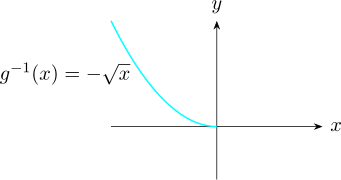
In this case \(g^{-1}(x)=-\sqrt {x}\).
Questions on this section
Stuck on something here? Ask below and it stays attached to this topic.