23.2 Methods of Integration
23.2.1 Integration of powers
If the integrand of the function is a power of functions: such as
- 1.
- \(\, \displaystyle {\int x^n\, dx = \frac {x^{n + 1}}{n + 1} + c}\)
- 2.
- \(\,\displaystyle {\int \left (ax + b\right )^n \,dx = \frac {\left (ax + b\right )^{n +1}}{a(n+ 1)} + c}\)
- 3.
- \(\,\displaystyle {\int \frac {1}{ax + b}\,dx = \frac {1}{a}\,\ln \left |ax + b\right | + c}\)
- 4.
- \(\,\displaystyle {\int \cos ^2x\,dx}\)
\begin {align*} \int \cos ^2x\,dx & = \frac {1}{2}\int \left (1 + \cos 2x\right )\,dx\\\\ & = \frac {1}{2}\int dx + \frac {1}{2}\int \cos 2x\,dx\\\\ & = \frac {1}{2}x + \frac {1}{2}\cdot \frac {\sin 2x}{2} + c\\\\ & = \frac {1}{2}\left [2x + \sin 2x\right ] + c\\\\ \end {align*}
23.2.2 Integration by Parts
Integration by parts is used when integrating products of two functions.
So, if \(f\) and \(g\) are differentiable functions of \(x\), the product rule says that
\[\frac {d}{dx}\left (f(x)\cdot g(x)\right ) = f'(x)\cdot g(x) + f(x)\cdot g'(x)\quad \cdots \quad (1)\]
In terms of indefinite integrals, this equation becomes
\[\int \frac {d}{dx}\left (f(x)\cdot g(x)\right )\,dx = \int f'(x)g(x)\,dx + \int f(x) g'(x)\,dx \quad \cdots \quad (2)\]
Rearranging the terms of (2), we get
\[\int f(x) g'(x)\,dx = \int \frac {d}{dx}\left (f(x)\cdot g(x)\right )\,dx- \int f'(x)g(x)\,dx \quad \cdots \quad (3)\]
Leading to the integration by parts formula
\[\int f(x) g'(x)\,dx = f(x)g(x)- \int f'(x)g(x)\,dx \quad \cdots \quad (4)\]
Thus, we let \(\, u = f(x)\,\) and \(\, v = g(x)\). Then \(\, du = f'(x)dx\,\) and \(\, dv = g'(x)dx\).
So the integration by parts formula
\[\int u dv = uv - \int vdu \quad \cdots \quad (5) \]
When the integrand is a product of two functions, choose \(u\) and \(v'\) so that \(u\) becomes simpler on differentiating — usually meaning it loses a power or turns into an algebraic expression — while \(v'\) is easy to integrate.
Note 23.8. The choice is the whole difficulty, and a wrong one makes the integral worse rather than better. In \(\int xe^{3x}dx\), taking \(u=x\) reduces it to \(1\) and leaves \(\int \frac {e^{3x}}{3}dx\), which is easy; taking \(u=e^{3x}\) instead would leave \(\int \frac {x^{2}}{2}\cdot 3e^{3x}dx\), with a higher power of \(x\) than we started with.
A common ordering for choosing \(u\) runs: logarithmic, inverse trigonometric, algebraic, trigonometric, exponential — take \(u\) to be whichever appears first in that list. It puts \(\ln x\) first because \(\ln x\) is awkward to integrate but differentiates to \(\frac {1}{x}\), and exponentials last because they integrate as easily as they differentiate.
That also explains the third example below. \(\int \ln x\,dx\) looks like a single function rather than a product, but writing it as \(\ln x\cdot 1\) and taking \(u=\ln x\), \(v'=1\) turns it into something elementary.
- 1.
- \(\quad \displaystyle {\int xe^{3x}\,dx}\)
So, we let \(\, u = x \implies du = 1\, dx\,\) and \(\, dv = e^{3x}\,dx \implies v = \frac {e^{3x}}{3}\)
\[\int uv' = uv - \int v u'\]
\begin {align*} \implies \quad \int xe^{3x}\,dx & = x\cdot \frac {e^{3x}}{3} - \int \frac {e^{3x}}{3}\,dx\\\\ & = \frac {xe^{3x}}{3}-\frac {1}{9}e^{3x} + c\\ \end {align*}
- 2.
- \(\quad \displaystyle {\int x \ln x \,dx}\)
Let \(\, u = \ln x \implies u' = \frac {1}{x}\,dx\,\) and \(\, v' = x\,dx \implies v = \frac {x^2}{2}\)
\begin {align*} \int x \ln x \,dx & = \frac {x^2}{2}\ln x - \int \frac {x^2}{2}\cdot \frac {1}{x}\,dx\\\\ & = \frac {x^2}{2}\ln x - \frac {1}{2}\int x\,dx\\\\ & = \frac {x^2}{2}\ln x - \frac {1}{4}x^2 + c\\\\ \therefore \quad \int x \ln x \,dx & = \frac {x^2}{4}\left [2\ln (x) - 1\right ] + c\\ \end {align*}
- 3.
- \(\quad \displaystyle {\int \ln x\,dx}\)
Let \(\, u = \ln x \implies du = \frac {1}{x}\,dx\,\) and \(\, dv = dx \implies v = x\)
\begin {align*} \int \ln x\,dx & = x\ln x - \int x\cdot \frac {1}{x}\,dx\\\\ & = x\ln x - x + c\\\\ \therefore \quad \int \ln x\,dx & = x \left [\ln x - 1\right ] + c\\\\ \end {align*}
23.2.3 Integration by Substitution
There are times when we can change the variable of integration to make integration easy. When we change the variable in definite integrals, you need to change the limits as well. The guidelines are check the integrand and if it is of the following forms:
- 1.
- \(\quad \displaystyle {\int f\left (g(x)\right )g'(x)\,dx\,}\) i.e a function and its derivatives form an integrand.
- 2.
- \(\quad \displaystyle {\int \frac {F'(x)}{f(x)}\,dx\,}\) the integrand has its function the denominator and its derivative the numerator.
The change the variable of use of the substitution method \[\int \frac {F'(x)}{f(x)}\,dx = \ln \left |f(x)\right | + c\]
Find
- 1.
- \(\quad \displaystyle {\int 2x e^{(x^2 - 5)}\,dx}\)
Let \(\, u = x^2 - 5 \implies du = 2x\,dx\,\) Then
\begin {align*} \int 2x e^{\left (x^2 - 5\right )}\,dx & = \int e^u\,du\\ & = e^u + c\\ & = e^{(x^2 - 5)} + c\\\\ \end {align*}
- 2.
- \(\quad \displaystyle {\int 2x\,\sin \left ( 1 - x^2\right )\,dx}\)
Let \(\, u = 1-x^2 \implies du = -2xdx\). Hence \(\, -du = 2xdx\)
\begin {align*} \therefore \quad \int 2x \sin \left ( 1 - x^2\right )\,dx & = -\int \sin u \,du\\ & = -\left (-\cos u\right ) + c\\ & = \cos \left (1 - x^2\right ) + c\\\\ \end {align*}
- 3.
- \(\quad \displaystyle {\int \frac {\cos x}{\left (5 + \sin x \right )^2}\,dx}\)
Let \(\, u = 5 + \sin x\,\) Then \(\,du = \cos x dx\)
\begin {align*} \implies \quad \int \frac {\cos x}{\left (5 + \sin x \right )^2}\,dx & = \int u^{-2}\,du\\ & = \frac {u^{-2+1}}{-2 + 1} + c\\\\ & = -\frac {1}{u} + c\\ & = \frac {-1}{5 + \sin x} + c\\\\ \end {align*}
- 4.
- \(\quad \displaystyle {\int \frac {\left (\ln x\right )^2}{x}\,dx}\)
Let \(\, du = \ln x \implies du = d\frac {dx}{x}\)
\begin {align*} \int \frac {\left (\ln x\right )^2}{x}\,dx & = \int u^2\,du \\ & = \frac {u^3}{3} + c\\ & = \frac {\left (\ln x \right )^3}{3} + c\\\\ \end {align*}
- 5.
- \(\quad \displaystyle {\int ^5_0 x^3\sqrt {x^4 + 1}\,dx}\)
Let \(\quad u = x^4 + 1\implies du = 4x^3dx\quad \) Then \(\, \frac {du}{4} = x^3dx\)
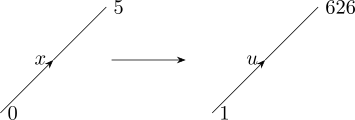
\begin {align*} \implies \quad \int ^{626}_1 u^{1/2}\,du & = \frac {1}{4}\Bigg [\frac {u^{1/2 + 1}}{1/2 + 1}\Bigg |^{626}_1\\\\ & = \frac {1}{4}\Bigg [\frac {u^{3/2}}{3/2}\Bigg |^{626}_1\\\\ & = \frac {1}{6}\left [\left (626\right )^{3/2} - \left (1\right )^{3/2}\right ]\\\\ & = \frac {1}{6}\left [626\sqrt {626} - 1\right ]\\\\ \end {align*}
Questions on this section
Stuck on something here? Ask below and it stays attached to this topic.