7.4 Convergence and Sum of Fourier Series
Theorem 7.4.1 (Dirichlet). Let \(f\) be periodic with period \(2\pi \), piecewise continuous on \(-\pi \leq x\leq \pi \), and with a left-hand and a right-hand derivative at each point. Then the Fourier series of \(f\) converges at every \(x\). Its sum is \(f(x)\) at every point where \(f\) is continuous, and at a point \(x_0\) where \(f\) has a jump it is the average of the left- and right-hand limits, \[\frac 12\Big (f(x_0^-) + f(x_0^+)\Big ) .\]
For the square wave of Example 7.3.2, the series therefore converges to \(k\) on \((0,\pi )\), to \(-k\) on \((-\pi ,0)\), and to \(0\) at the jumps \(x = 0, \pm \pi , \pm 2\pi , \dots \), the midpoints of the jumps, whatever value \(f\) was given there.
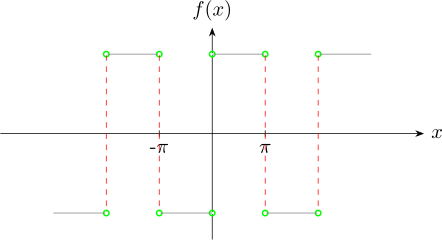
Near a jump the partial sums overshoot: \(S_n\) exceeds \(k\) by about \(9\%\) of the jump height just beside the discontinuity, however large \(n\) is, although the overshoot moves closer to the jump as \(n\) grows. This is the Gibbs phenomenon; it does not contradict the theorem, which is about each fixed \(x\).
Example 7.4.2. To what does the Fourier series of the function equal to \(x^2\) on \(0<x<2\pi \), extended with period \(2\pi \), converge at \(x = 0\)?
Solution. Near \(x = 0\) the left-hand limit is \(\lim _{x\to 2\pi ^-}x^2 = 4\pi ^2\) and the right-hand limit is \(0\), so the series converges to \(\frac 12(4\pi ^2 + 0) = 2\pi ^2\) there.
Questions on this section
Stuck on something here? Ask below and it stays attached to this topic.