1 Functions Of Several Variables
Most quantities worth measuring depend on more than one thing, and this section extends the differential calculus to that setting.
The extension is not a formality. With one variable a point can be approached from only two sides; with two there are infinitely many paths, and a function may behave perfectly along every straight line and still have no limit. Limits and continuity are therefore settled first.
What follows is built on one idea: near a point, a smooth function of several variables is well approximated by a linear one, and the partial derivatives are what specify it. From that come the directional derivative and the gradient — which points in the direction of steepest increase and whose length is that rate — then the chain rules, Taylor’s formula, and the classification of critical points, where a genuinely new possibility appears in the saddle.
The section closes with implicit functions and Jacobians. The Jacobian determinant measures how a change of variables stretches area or volume, and it is the object that decides when a system can be solved for one set of variables in terms of another. It returns in the next section as the factor in the change of variables formula for multiple integrals.
Definition 1.0.1. Let \(D\) be a set of ordered pairs of real numbers. A function of two variables on \(D\) is a rule \(f\) which assigns to each pair \((x,y)\in D\) exactly one real number, denoted \(f(x,y)\). The set \(D\) is the domain of \(f\), and the set of numbers \(f\) produces as \((x,y)\) runs over \(D\) is its range.
The value is usually given a name of its own, and one writes \[z = f(x,y).\] In this notation \(x\) and \(y\) are the independent variables and \(z\) is the dependent variable. The names say exactly what they mean: \(x\) and \(y\) may be chosen freely, subject only to the pair \((x,y)\) lying in \(D\), and once they have been chosen the value of \(z\) is determined — there is no freedom left in it. This is the same language used for a function of one variable, and it is used here in the same way.
What has changed is the shape of the domain. For \(y = f(x)\) the domain is a subset of the line, usually an interval; for \(z = f(x,y)\) it is a subset of the plane, and a region of the plane can have a boundary of any shape, can have holes, and can be approached from infinitely many directions. Almost everything that is genuinely new in this course traces back to that one change, and not to the extra letter.
Example 1.0.2. Quantities that depend on two or three others are the ordinary case rather than the exception.
- \(-\)
- The volume of a cylinder, \(V = \pi r^2h\), is a function of the two variables \(r\) and \(h\).
- \(-\)
- The ideal gas law, \(\displaystyle {P = \frac {RT}{V}}\), gives the pressure as a function of the temperature \(T\) and the volume \(V\), with \(R\) constant.
- \(-\)
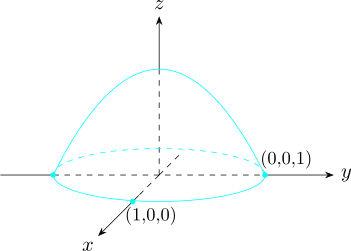
- For \(\displaystyle {z = f(x,y) = \sqrt {1 - x^2 - y^2}}\) the quantity under the root must not be negative, which restricts the pair \((x,y)\) before any
arithmetic is done: \begin {align*} \text {domain} & = \big \{(x,y)\ :\ x^2 + y^2 \leq 1\big \},\\\\ \text {range} & = \big \{z\ :\ 0\leq z \leq 1\big \} = [0,1]. \end {align*}
The domain is the closed unit disc — a region of the plane, as promised, and not an interval.
The last of these is worth following through, because its graph is a surface with a name. Squaring \(z = \sqrt {1 - x^2 - y^2}\) gives \(z^2 = 1 - x^2 - y^2\), that is \[x^2 + y^2 + z^2 = 1,\] the sphere of radius \(1\) centred at the origin. Squaring, however, throws away a sign, and the sphere is not the graph of \(f\): a sphere fails the vertical line test, since most points \((x,y)\) of the disc lie below two points of it. The function takes only the non-negative square root, so its graph is the upper half of the sphere — the hemisphere of radius \(1\) lying on or above the \(xy-\)plane.
1.2 Limits and Continuity
1.3 Directional Derivatives and Gradient Vector
1.4 Maximising the Directional Derivative
1.5 Maximum and Minimum Values
1.6 Extrema for Functions with Side Conditions (Constraints)
1.7 Absolute Maximum and Minimum Values
1.8 Taylor’s Formula For Functions of Several Variables
1.9 Composite Functions and Chain Rule Differentiation
1.10 Euler’s Theorem on Homogeneous Functions
1.11 Implicit Functions and Jacobians
1.12 Jacobians
1.13 Implicit Differentiation
1.14 Implicit Function Theorem
1.15 Functions From \(\mathbb {R}^n\) To \(\mathbb {R}^m\)
1.16 Inverse Function Theorem
1.17 Functional Dependence
1.18 Practice Problems
Questions on this section
Stuck on something here? Ask below and it stays attached to this topic.