3.10 Spherical Coordinates
\[x = \rho \sin \phi \cos \theta \hspace {0.5cm} , \hspace {0.5cm} y = \rho \sin \phi \sin \theta \hspace {0.5cm} , \hspace {0.5cm} z = \rho \cos \phi \]
\[ E = \big \{ (\rho , \theta , \phi ) \hspace {0.1cm} \big | \hspace {0.1cm} a\leq \rho \leq b\hspace {0.1cm} , \hspace {0.1cm} \alpha \leq \theta \leq \beta \hspace {0.1cm} , \hspace {0.1cm} c \leq \phi \leq d\big \}\] where \(a>0\hspace {0.2cm}, \hspace {0.2cm} \beta - \alpha \leq 2\pi \hspace {0.2cm}, \hspace {0.2cm} d-c \leq \pi \).
An approximation of the volume of a wedge.
\(E_{ijk}\) is given by \(\displaystyle {\big (\Delta \rho \big ) \times \big (\rho _i \Delta \phi \big )\times \big (\rho _i\sin \phi _k \Delta \theta \big )}\)
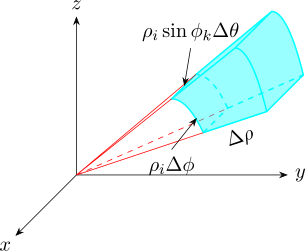
\[\sum ^l_{i=1}\sum ^m_{j=1}\sum ^n_{k=1} f\big (\rho \sin \phi \cos \theta \hspace {0.1cm},\hspace {0.1cm} \rho \sin \phi \sin \theta \hspace {0.1cm}, \hspace {0.1cm} \rho \cos \phi \big ) \hspace {0.1cm}\rho ^2_i\sin \phi _k\hspace {0.1cm}\Delta \rho \Delta \theta \Delta \phi \]
\[\iiint \limits _E f(x,y,z)\hspace {0.1cm}dV = \int ^d_c\int ^{\beta }_{\alpha } \int ^b_a f\big (\rho \sin \phi \cos \theta \hspace {0.1cm},\hspace {0.1cm} \rho \sin \phi \sin \theta \hspace {0.1cm}, \hspace {0.1cm} \rho \cos \phi \big )\hspace {0.1cm}\rho ^2\sin \phi \, d\rho \, d\theta \, d\phi \] where \(E\) is the spherical wedge
\[ E = \big \{ (\rho , \theta , \phi ) \hspace {0.1cm} \big | \hspace {0.1cm} a\leq \rho \leq b\hspace {0.1cm} , \hspace {0.1cm} \alpha \leq \theta \leq \beta \hspace {0.1cm} , \hspace {0.1cm} c \leq \phi \leq d\big \}\]
Evaluate \(\displaystyle {\iiint \limits _B e^{(x^2 + y^2 +z^2)^{3/2}}dV}\) where \(B\) is the unit ball \[B = \big \{(x,y,z)\hspace {0.1cm}\big |\hspace {0.1cm} x^2 + y^2 + z^2 = 1\big \}\]
Solution.
\(\displaystyle { B = \big \{(\rho ,\theta ,\phi )\hspace {0.1cm} \big |\hspace {0.1cm} 0\leq \rho \leq 1 \hspace {0.1cm} , \hspace {0.1cm} 0 \leq \theta \leq 2\pi \hspace {0.1cm},\hspace {0.1cm} 0\leq \phi \leq \pi \big \}}\) \[x^2 + y^2 + z^2 = \rho ^2\]
\begin {align*} \iiint \limits _B e^{(x^2+y^2+z^2)^{3/2}} dV & = \int ^{\pi }_0 \int ^{2\pi }_0 \int ^1_0 e^{(\rho ^2)^{3/2}}\hspace {0.1cm} \rho ^2 \hspace {0.1cm} \sin \phi \hspace {0.1cm} d\rho \hspace {0.1cm} d\theta \hspace {0.1cm} d\phi \\ & = \int ^{\pi }_0\sin \phi \,d\phi \int ^{2\pi }_0d\theta \int ^1_0\rho ^2 e^{\rho ^3}d\rho \\\\ & = -\cos \phi \Bigg |^{\pi }_0\cdot 2\pi \cdot \frac {1}{3}e^{\rho ^3}\Bigg |^1_0\\\\ & = \frac {4\pi }{3}(e -1)\\ \end {align*}
In rectangular coordinates \[\int ^1_{-1}\int ^{\sqrt {1-x^2}}_{-\sqrt {1-x^2}}\int ^{\sqrt {1-x^2 -y^2}}_{-\sqrt {1 - x^2 - y^2}}e^{(x^2+y^2+z^2)^{3/2}} \,dz\,dy\,dx\]
Use spherical coordinates to find the volume of the solid that lies above the cone \(z = \sqrt {x^2 + y^2}\) and below the sphere \(x^2 + y^2 + z^2 = z\) \[x^2 + y^2 + \Big ( z - \dfrac {1}{2}\Big ) = \frac {1}{4}\]
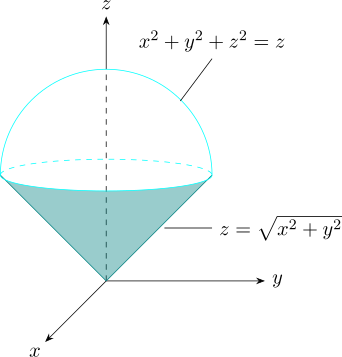
\begin {align*} \rho \cos \phi & = \sqrt {\rho ^2 \sin ^2\phi \cos ^2 \theta \phi ^2 \sin ^2\phi \sin ^2\theta }\\\\ \implies \hspace {0.5cm} \rho \cos \phi & = \rho \sin \phi \hspace {1cm} \therefore \hspace {0.4cm} \phi = \frac {\pi }{4}\\ \end {align*}
\[\therefore \hspace {0.4cm} E = \Big \{(\rho ,\theta ,\phi )\hspace {0.1cm} \big | \hspace {0.1cm} 0\leq \theta \leq 2\pi \hspace {0.1cm} , \hspace {0.1cm} 0 \leq \phi \leq \frac {\pi }{4}\hspace {0.1cm},\hspace {0.1cm} 0\leq \rho \leq \cos \phi \Big \}\]
\begin {align*} V(E) = \iiint \limits _EdV & = \int ^{2\pi }_0\int ^{\pi /4}_0 \int ^{\cos \phi }_0 \rho ^2 \hspace {0.1cm} \sin \phi \hspace {0.1cm} d\rho \hspace {0.1cm} d\phi \hspace {0.1cm} d\theta \\ & = \int ^{2\phi }_0d\theta \int ^{\pi /4}_0\int ^{\cos \phi }_0\rho ^2 \hspace {0.1cm} \sin \phi \hspace {0.1cm} d\rho \hspace {0.1cm} d\phi \\ & = \frac {2\pi }{3}\int ^{\pi /4}_0 \sin \phi \cos ^3 \phi d\phi \\ & = \frac {\pi }{8}\\\\ \end {align*}
Questions on this section
Stuck on something here? Ask below and it stays attached to this topic.