3.7 Triple Integrals
Suppose that \(f\) is defined on a rectangular box \[B = \big \{(x,y,z)\hspace {0.1cm} \big | \hspace {0.1cm} a\leq x \leq b\hspace {0.1cm} , \hspace {0.1cm} c\leq y \leq \hspace {0.1cm} , \hspace {0.1cm} r\leq z \leq s\big \}\] divide \([a,b]\) in \(L\) equal sub-intervals, \([c,d]\) into \(m\) intervals, and \([r,s]\) into \(n\) intervals. \[B_{ijk} = [x_{i-1},x_i]\times [y_{j-1},y_j] \times [z_{k-1},z_k]\]
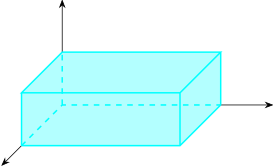
Each sub-box has volume \[\Delta V = \Delta x \Delta y \Delta z\]
Triple Riemann sum \[\sum ^l_{i=1} \sum ^m_{j=1} \sum ^n_{k=1} f\big (x^*_{ijk} , y_{ijk}^*, z^*_{ijk}\big )\] where the sample point \(\big (x^*_{ijk}, y^*_{ijk},z^*_{ijk}\big )\) is in \(B_{ijk}\).
The triple integral of \(f\) over the box \(B\) is \[\iiint \limits _B f(x,y,z)\hspace {0.1cm}dV = \lim _{l,m,n\rightarrow \infty } \sum \sum \sum f\big (x^*_{ijk} , y_{ijk}^*, z^*_{ijk}\big )\hspace {0.1cm}\Delta V\] if the limit exists.
Questions on this section
Stuck on something here? Ask below and it stays attached to this topic.