3.1 Volumes and Double Integration
In a similar manner, we consider a function \(f\) of two variables on a closed rectangle
\begin {align*} R & = [a,b]\times [c,d]\\ & = \big \{(x,y)\in \mathbb {R}^2\hspace {0.1cm}\big |\hspace {0.1cm} a\leq x\leq b\hspace {0.1cm} , \hspace {0.1cm} c \leq y \leq d\big \} \end {align*}
and suppose \(f(x,y)\geq 0\)
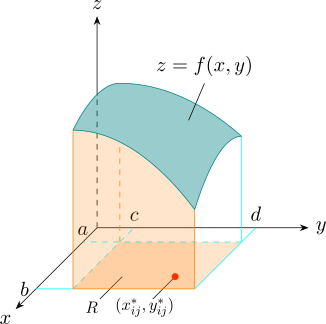
Let \(S\) be the solid that lies above \(R\) and under the surface of \(f\). \[\text {i.e}\hspace {0.3cm} S = \big \{(x,y,z)\in \mathbb {R}^3\hspace {0.1cm}\big |\hspace {0.1cm} 0\leq z \leq f(x,y) \in \mathbb {R}^2\big \}\]
Our goal is to find the volume of \(S\).
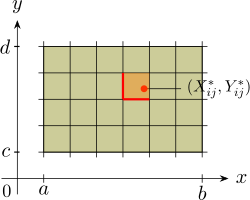
We can approximate the part of \(S\) that lies above \(R_{ij}\) by a thin rectangular box with base \(R_{ij}\) and height \(f\big (X^*_{ij},Y^*_{ij}\big )\) by \[f\big (X^*_{ij},Y^*_{ij}\big )\Delta A\]
\[V \approx \sum ^m_{i=1}\sum ^n_{j=1}f\big (X^*_{ij},Y^*_{ij}\big )\Delta A\]
The double integral of \(f\) over the rectangle \(R\) is given by \[\iint \limits _R f(x,y)dA = \lim _{m,n\rightarrow \infty }\sum ^m_{i=1}\sum ^n_{j=1}f\big (X^*_{ij},Y^*_{ij}\big )\Delta A\] if the limit exist.
If \(f(x,y)\geq 0\), then the volume of the solid that lies above \(R\) and below the surface \(z = f(x,y)\) is \[V = \iint \limits _R f(x,y) dA\]
If \(R = \big \{ (x,y)\hspace {0.1cm} \big |\hspace {0.1cm} -\leq x \leq 1 \hspace {0.1cm} , \hspace {0.1cm} -2\leq y\leq 2\big \}\). Evaluate the integral \[\iint \limits _R \sqrt {1 - x^2}\hspace {0.1cm} dA\]
Solution.
Let \(\displaystyle {z = \sqrt {1 - x^2}}\hspace {0.5cm} z\geq 0\)
\(z^2 + x^2 = 1\)
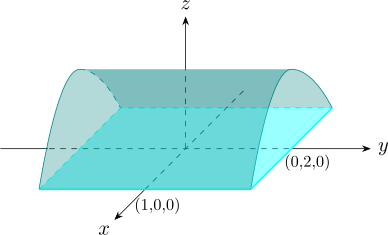
\begin {align*} V & = \iint \limits _R \sqrt {1 - x^2}\hspace {0.1cm} dA\\ & = \dfrac {1}{2}\, \pi \, r^2\, h\\\\ & = \dfrac {1}{2}\, \pi \, (1)\, (4)\\\\ & = 2\pi \\\\ \end {align*}
Questions on this section
Stuck on something here? Ask below and it stays attached to this topic.