3.6 Applications Of Double Integrals
Applications include computing volumes, surface ares, joint density functions, expected values, moments of inertial.
Mass, density of a lamina. Suppose that a lamina occupies a region \(D\) of the \(xy-\) plane, and that it has density \(\rho (x,y)\). The total mass of the lamina \begin {align*} M & = \iint \limits _D \rho (x,y)\hspace {0.1cm}dA\\ & = \lim \limits _{k,l\rightarrow \infty } \sum ^k_{i=1}\sum ^l_{j=1} \rho \big (x_{ij}^*,y^*_{ij}\big )\hspace {0.1cm}\Delta A\\ \end {align*}
If an electric charge is distributed over a region \(D\) and the charge density is given \(\big (\sigma (x,y))\) then the total charge \(Q\), \[Q = \iint \limits _D \sigma (x,y)\hspace {0.1cm}dA\]
Charge is distributed over the triangular region \(D\) so that the charge density at \((x,y)\) is
\(\sigma (x,y) = xy\hspace {0.2cm} \big (c/m^2\big )\). Find the total charge.
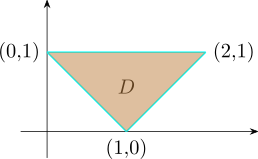
\begin {align*} Q & = \iint \limits _D xy\hspace {0.1cm}dA\\ & = \int ^1_0\int ^1_{1-x} xy\hspace {0.1cm}dy\hspace {0.1cm}dx\\\\ & = \frac {5}{24}\\\\\\ \end {align*}
Moments and Centre of Mass
Recall: Let the point masses \(m_1,m_2,\cdots \cdots \cdots , m_n\) be located at \((x_1,y_1), (x_2,y_2),\cdots \cdots \cdots , (x_n,y_n)\)
Moments about \(y-\) axis is \[m_y = m_1x_1 + m_2x_2 + \cdots \cdots \cdots + m_nx_n\]
Moments about \(x-\) axis is \[m_x = m_1y_1 + m_2y_2 + \cdots \cdots \cdots + m_ny_n\]
Centre of mass \(\big (\overline {x},\overline {y}\big )\) is given by \[\overline {x} = \frac {m_y}{m}\hspace {0.5cm} , \hspace {0.5cm} \overline {y} = \frac {m_x}{m}\] where \(m = \displaystyle {\sum ^n_{i=1} m_i}.\)
Suppose we have a lamina with variable \(\rho (x,y)\), then the moment of the entire lamina \begin {align*} M_x & = \iint \limits _D y \hspace {0.1cm} \rho (x,y)\hspace {0.1cm}dA\\\\ M_y & = \iint \limits _D x \hspace {0.1cm} \rho (x,y)\hspace {0.1cm}dA \end {align*}
Centre of mass \begin {align*} \overline {X} & = \frac {1}{M} \hspace {0.1cm} \iint \limits _D x \hspace {0.1cm} \rho (x,y)\hspace {0.1cm} dA\\\\ \overline {Y} & = \frac {1}{M} \hspace {0.1cm} \iint \limits _D y \hspace {0.1cm} \rho (x,y)\hspace {0.1cm} dA\\\\\\ \end {align*}
Find the mass and centre of mass of a triangular lamina with vertices \((0,0)\hspace {0.2cm} , \hspace {0.2cm} (1,0)\) and \((0,2)\). If \(\rho (x,y) = 1 + 3x + y\).
Solution.
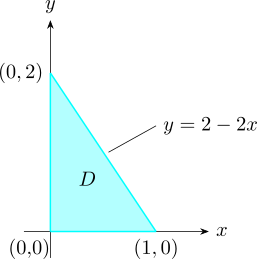
\begin {align*} M & = \iint \limits _D (1 + 3x + y)\hspace {0.1cm} dA\\ & = \int ^1_0 \int ^{2-2x}_0\big (1 + 3x + y\big )\hspace {0.1cm} dy \hspace {0.1cm} dx\\\\ & = \frac {8}{3}\\ \end {align*}
Centre of mass \begin {align*} \overline {X} & = \frac {1}{M} \iint \limits _D x \hspace {0.1cm} \rho (x,y)\hspace {0.1cm} dA\\ & = \frac {3}{8}\int ^1_0 \int ^{2 - 2x}_0 x \hspace {0.1cm} \big (1 + 3x + y\big ) \hspace {0.1cm}dy \hspace {0.1cm} dx = \frac {3}{8}\\ \end {align*}
\begin {align*} \overline {Y} & = \frac {1}{M} \iint \limits _D y \hspace {0.1cm} \rho (x,y)\hspace {0.1cm} dA\\ & = \frac {3}{8}\int ^1_0 \int ^{2 - 2x}_0 y \hspace {0.1cm} \big (1 + 3x + y\big ) \hspace {0.1cm}dy \hspace {0.1cm} dx = \frac {11}{16}\\ \end {align*}
\[\big (\overline {X},\overline {Y}\big ) = \Bigg ( \frac {3}{8},\frac {11}{16}\Bigg )\]
Questions on this section
Stuck on something here? Ask below and it stays attached to this topic.