2.3 Tangent Planes
Let \(S\) be the surface \(z = f(x,y)\) and \(P(x_0,y_0,z_0)\) a point of \(S\). The vertical planes \(y = y_0\) and \(x = x_0\) cut \(S\) in curves \(C_1\) and \(C_2\) through \(P\), whose slopes at \(P\) are \(f_x(x_0,y_0)\) and \(f_y(x_0,y_0)\).
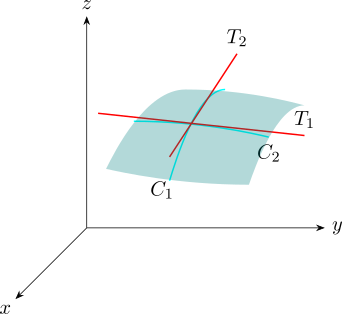
Let \(T_1\) and \(T_2\) be the tangent lines to \(C_1\) and \(C_2\) at \(P\). The tangent plane to \(S\) at \(P\) is the plane that contains \(T_1\) and \(T_2\). When \(f\) is differentiable it contains the tangent lines at \(P\) of every curve in \(S\) through \(P\), and it is the graph of the linear approximation of Definition 1.3.1.
Equation of Tangent Plane
Suppose \(f\) has continuous first partial derivatives. An equation of the tangent plane to the surface \(z = f(x,y)\) at the point \(P(x_0, y_0, z_0)\) is \[z -z_0 = f_x(x_0,y_0)(x-x_0) + f_y(x_0,y_0)(y-y_0) .\] Indeed, the plane through \(P\) with this equation contains \(T_1\), since setting \(y = y_0\) leaves the line of slope \(f_x(x_0,y_0)\) in the plane \(y = y_0\), and likewise it contains \(T_2\).
Example 2.3.1. Find the tangent plane to the elliptic paraboloid \(z = 2x^2 + y^2\) at the point \((1,1,3)\).
Solution. With \(f = 2x^2 + y^2\), \(f_x = 4x\) and \(f_y = 2y\), which are \(4\) and \(2\) at \((1,1)\). So the tangent plane is \[z - 3 = 4(x-1) + 2(y-1),\qquad \text {that is}\qquad z = 4x + 2y -3 .\]
Example 2.3.2. Find the tangent plane to \(z = xe^{xy}\) at \((1,0,1)\), and use it to approximate \(1.1e^{-0.11}\).
Solution. \(f_x = e^{xy} + xye^{xy}\) and \(f_y = x^2e^{xy}\), which are \(1\) and \(1\) at \((1,0)\). The tangent plane is \(z = 1 + (x - 1) + y = x + y\). The point \((1.1, -0.1)\) gives \(f = 1.1e^{-0.11}\), approximated by \(1.1 - 0.1 = 1\); the exact value is \(0.9854\).
Questions on this section
Stuck on something here? Ask below and it stays attached to this topic.