2.4 Parametric Surfaces
Suppose that \(\boxed {\displaystyle {r(u,v) = x(u,v)\,\textbf {i} + y(u,v)\,\textbf {j} + z(u,v)\,\textbf {k}}\hspace {0.3cm}\cdots \cdots \cdots \hspace {0.3cm}(1)}\) is a vector function defined on a region \(D\) in the \(uv-\) plane. \(x, y, z\) are the component functions of \(r\), are functions of \(uv\) with domain \(D\). The set of points \((x,y,z)\) in \(\mathbb {R}^3\) such that \[x = x(u,v)\hspace {0.4cm},\hspace {0.4cm} y = y(u,v)\hspace {0.4cm}, \hspace {0.4cm} z = z(u,v)\hspace {0.3cm}\cdots \cdots \cdots \hspace {0.3cm}(2)\] and \((u,v)\) varies throughout \(D\) , is called s parametric surface.
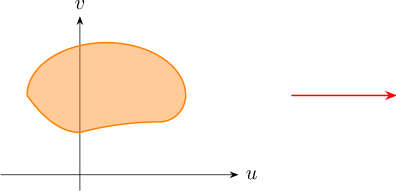 | 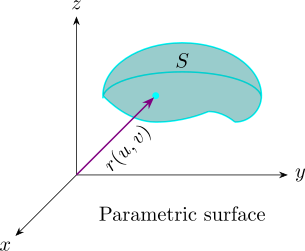 |
Given \(r(u,v) = 2\cos u\, \textbf {i} + v\,\textbf {j} + 2\sin u\, \textbf {k}\). Identify and sketch the surface with the given vector equation.
Solution.
\(x = 2\cos u \hspace {0.4cm}, \hspace {0.4cm} y =v\hspace {0.4cm} , \hspace {0.4cm} z = 2\sin u\)
\[x^2 + z^2 = 4\cos ^2 u + 4\sin ^2 u = 4\]
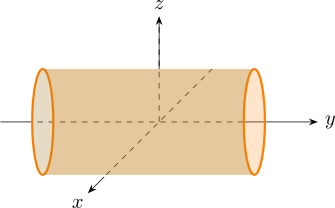
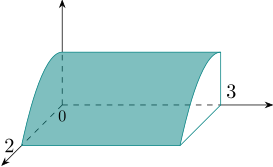
Suppose that \(0\leq u \leq \dfrac {\pi }{2}\hspace {0.4cm}, \hspace {0.4cm} 0 \leq v \leq 3\)
\[x\geq 0\hspace {0.5cm} , \hspace {0.5cm} y\leq y \leq 3\hspace {0.5cm} , \hspace {0.5cm} z \geq 0\]
Solution.
The sphere has a simple representation in spherical coordinates, with \(\phi \) and \(\theta \) as parameters.
We have that
\[x = a\sin \phi \cos \theta \hspace {0.5cm}, \hspace {0.5cm} y = a\sin \phi \sin \theta \hspace {0.5cm}, \hspace {0.5cm} z = a\cos \phi \]
\[\therefore \hspace {0.4cm} r(\phi , \theta ) = a\sin \phi \cos \theta \, \textbf {i} + a \sin \phi \cos \theta \, \textbf {j} + a\cos \phi \,\textbf {k}\]
\[0\leq \phi \leq \pi \hspace {0.5cm}, \hspace {0.5cm} 0\leq \theta \leq 2\pi \]
\[D = [0,\pi ]\times [0,2\pi ]\]
Questions on this section
Stuck on something here? Ask below and it stays attached to this topic.