3.13 Change of Variables
Recall: A change of variables can be useful in double integrals, just like substitution in one - dimensional calculus. \[\iint \limits _R f(x,y)\,dA = \iint \limits _S f(r\cos \theta , r \sin \theta )\, r\,dr\,d\theta \] where \(S\) is the region in the \(r\,\theta - \) plane that corresponds to the region \(R\) in the \(xy-\) plane.
More generally, we consider a change of variables that is given by a “ Transformation \(T\) ” from the \(uv -\) plane to the \(xy-\) plane \[T(uv) = (x,y)\] where \(x = g(u,v) \hspace {0.2cm} y = h(u,v)\) or \(x = x (u,v)\hspace {0.2cm} y = y(u,v)\)
We assume that \(T\) is a \(C^1\) transformation.
\(\implies \) \(h\) and \(g\) have first partial derivatives.
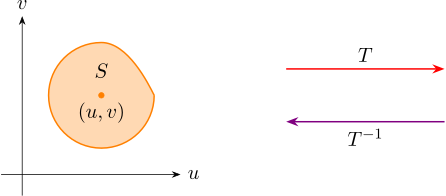 | 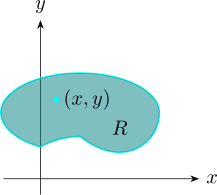 |
\(T\) transforms \(S\) into the region \(R\) called image of \(S\), consisting of all images of all points in \(S\). It \(T^{-1}\) exists \[u = G(x,y)\hspace {0.2cm}, \hspace {0.3cm} v = H(x,y)\]
 | 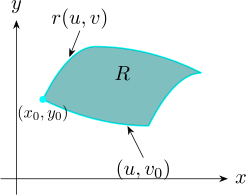 |
The vector \(\displaystyle {r(u,v) = g(u,v) \textbf {i} + h(u,v)\textbf {j}}\)
\begin {align*} r_u & = g_u(u_0,v_o)\textbf {i} + h_u ( u_0,v_0)\textbf {j}\\ & = \frac {\partial x}{\partial u}\textbf {i} + \frac {\partial y}{\partial u}\textbf {j}\\ \end {align*}
\begin {align*} r_v & = g_v(u_0,v_o)\textbf {i} + h_v ( u_0,v_0)\textbf {j}\\ & = \frac {\partial x}{\partial v}\textbf {i} + \frac {\partial y}{\partial v}\textbf {j} \end {align*}
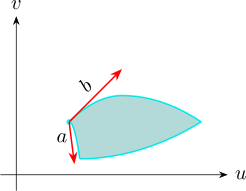
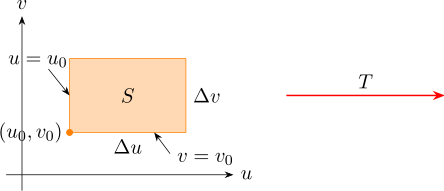
\(a = r(u_0 + \Delta u , v_0 ) - r(u_0, v_0)\)
\(b = r(u_0, v_0 + \Delta v) - r(u_0,v_0)\)
\[\text {But}\hspace {0.4cm} r_u = \lim _{\Delta u \rightarrow 0} \frac {r(u_0 + \Delta u, v_0) - r(u_0,v_0)}{\Delta u}\]
\[\therefore \hspace {0.3cm} r_u \Delta u \approx r(u_0 + \Delta u, v_0) - r(u_0,v_0)\]
\[||||_y \hspace {0.3cm} r_v \Delta v \approx r(u_0 , v_0 + \Delta v) - r(u_0,v_0)\]
We can approximate the area of \(R\) by the area of the parallelogram \[ \big | \big (r_u\Delta u\big ) \times \big ( r_v \Delta \big ) = \big | r_u \times r_v \big |\,\Delta v \,\Delta u\]
\begin {align*} r_u \times r_v & = \begin {vmatrix} \textbf {i} & \textbf {j} & \textbf {k}\\\\ \dfrac {\partial x}{\partial u} & \dfrac {\partial y}{\partial u} & 0\\\\ \dfrac {\partial x}{\partial v} & \dfrac {\partial y}{\partial v} & 0\\ \end {vmatrix}\\\\ & = k \begin {vmatrix} \dfrac {\partial x}{\partial u} & \dfrac {\partial x}{\partial v}\\\\ \dfrac {\partial y}{\partial u} & \dfrac {\partial y}{\partial v}\\ \end {vmatrix}\\\\\\\\\\ \end {align*}
Definition 3.13.1. Let \(T\) be the transformation \(x = g(u,v)\), \(y = h(u,v)\). Its Jacobian is the determinant \begin {align*} \frac {\partial (x,y)}{\partial (u,v)} = J(u,v) & = \begin {vmatrix} \dfrac {\partial x}{\partial u} & \dfrac {\partial x}{\partial v}\\\\ \dfrac {\partial y}{\partial u} & \dfrac {\partial y}{\partial v}\\ \end {vmatrix}\\\\ & = \frac {\partial x}{\partial u}\cdot \frac {\partial y}{\partial v} - \frac {\partial x}{\partial v}\cdot \frac {\partial y}{\partial u} . \end {align*}
The Jacobian is the two-variable answer to a question already familiar from one variable. In the substitution \(\int f(x)\,dx = \int f\big (g(u)\big )g'(u)\,du\) the factor \(g'(u)\) appears because a small interval \(\Delta u\) is stretched into an interval of length roughly \(\left |g'(u)\right |\Delta u\). In the plane a small rectangle \(\Delta u\,\Delta v\) is carried by \(T\) into a small parallelogram, and the factor by which its area is stretched is the absolute value of the Jacobian: \[\Delta A \approx \left |\frac {\partial ( x,y)}{\partial (u,v)}\right | \Delta u\, \Delta v ,\] the Jacobian being evaluated at \((u_0,v_0)\). It is an area magnification factor, and nothing more mysterious than that. Its sign records whether \(T\) preserves or reverses orientation, which is why the absolute value is taken.
Summing over the rectangles of a partition, \begin {align*} \iint \limits _R f(x,y)\, dA & \approx \sum ^m_{i=1}\sum ^n_{j = 1} f(x_i , y_j)\, \Delta A\\\\ & \approx \sum ^m_{i=1}\sum ^n_{j = 1}f\big (g(u,v), h(u,v)\big ) \left |\frac {\partial ( x,y)}{\partial (u,v)}\right |\, \Delta u \,\Delta v , \end {align*}
and the right-hand side is a Riemann sum for an integral over \(S\). Passing to the limit gives the result the whole construction was for.
Theorem 3.13.2 (Change of variables in a double integral). Let \(T\) be a one-to-one transformation with continuous partial derivatives carrying a region \(S\) in the \(uv-\)plane onto a region \(R\) in the \(xy-\)plane, and suppose \(J(u,v)\neq 0\) on \(S\). Then for \(f\) continuous on \(R\), \[\iint \limits _R f(x,y)\,dx\,dy = \iint \limits _S f\big (g(u,v),h(u,v)\big )\,\Big |J(u,v)\Big |\, du\, dv .\]
The condition \(J\neq 0\) is not decoration: where the Jacobian vanishes the transformation collapses area, and the formula has nothing to say.
Example 3.13.3. Show that integration in polar coordinates is the special case \(x = r\cos \theta \), \(y = r\sin \theta \).
Solution. \begin {align*} J(r,\theta ) & = \begin {vmatrix} \dfrac {\partial x}{\partial r} & \dfrac {\partial x}{\partial \theta }\\\\ \dfrac {\partial y}{\partial r} & \dfrac {\partial y}{\partial \theta }\\ \end {vmatrix} = \begin {vmatrix} \cos \theta & - r \sin \theta \\ \sin \theta & r \cos \theta \\ \end {vmatrix}\\\\ & = r \cos ^2 \theta + r \sin ^2 \theta = r . \end {align*}
Since \(r\geq 0\) the absolute value may be dropped, and the theorem gives \begin {align*} \iint \limits _R f(x,y)\, dx\,dy & = \iint \limits _S f\big ( r\cos \theta , r \sin \theta \big )\, \left |\frac {\partial (x,y)}{\partial (r, \theta )}\right | dr\, d\theta \\\\ & = \iint \limits _S f\big ( r\cos \theta , r \sin \theta \big )\ r\ dr\, d\theta . \end {align*}
The familiar extra \(r\) in polar integration is therefore not a rule to be memorised. It is this Jacobian, and it says that a polar rectangle of sides \(\Delta r\) and \(\Delta \theta \) has area about \(r\,\Delta r\,\Delta \theta \) — the further from the origin, the more area the same change of angle sweeps out.
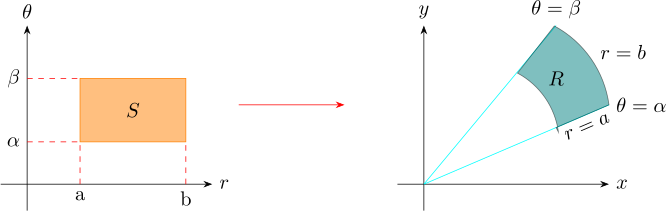
Use the change of variables \(x = u^2 - v^2 \hspace {0.2cm}, \hspace {0.2cm} y = 2uv\hspace {0.2cm}\) to evaluate the integral \[\iint \limits _R y\,dA\] , where \(R\) is the region bounded by the \(x-\) axis and the parabolas \(y^2 = 4 - 4x\) and \(y^2 = 4 + 4x\).
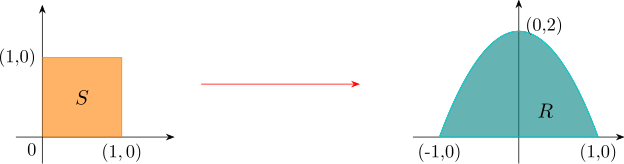
\(T(R) = S\) where \(S\) is the square \([0,1]\times [0,1]\hspace {0.3cm} S\) is a much easier region than \(R\).
\begin {align*} \iint \limits _R y\,dA & = \iint \limits _S 2uv \,\big |4u^2 + 4v^2\big |\, du\, dv\\ & =\int ^1_0\int ^1_0 \big (8u^3v + 8uv^3\big )\,du\,dv\\ & = 2 \end {align*}
\[ \text {Check}\hspace {0.5cm} \iint \limits _R y\, dA = \int ^0_{-1}\int ^{\sqrt {4 + 4x}}_0 \,y \,dy \,dx\]
Evaluate the integral \(\displaystyle {\iint \limits _ R e^{(x+y)/(x-y)}dA}\hspace {0.2cm}\) where \(R\) is the trapezoidal region with vertices \((1,0)\hspace {0.1cm}, \hspace {0.1cm} (2,0) \hspace {0.1cm},\hspace {0.1cm} (0,-2)\hspace {0.1cm}, \hspace {0.1cm} (0,-1)\).
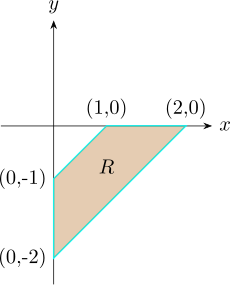
Let \(u = x + y \) and \(v = x - y\)
\(T^{-1}\) from the \(xy\) plane to the \(uv\) plane \(T:\hspace {0.3cm} x = \dfrac {1}{2}(u+ v) \hspace {0.4cm} y = \frac {1}{2}(u- v)\)
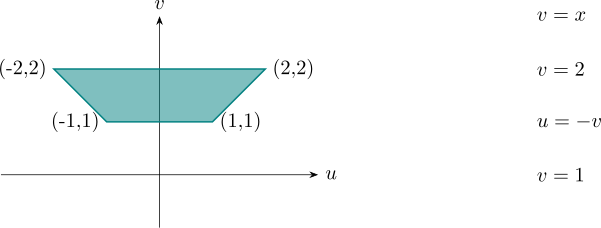
\[S = \big \{ (u,v)\hspace {0.1cm} \big | \hspace {0.1cm} 1\leq v \leq 2 \hspace {0.1cm}, \hspace {0.1cm} -v \leq u \leq v\big \}\]
\begin {align*} \iint \limits _ R e^{(x+y)/(x-y)}\,dA & = \iint \limits _S e^{u/v}\,\big |J(u,v)\big | \,du \,dv\\ & = \int ^2_1 \int ^v_{-v} e^{u/v} \cdot \frac {1}{2}\,du\, dv\\\\ & = \frac {1}{2}\int ^2_1 \Big ( e - e^{-1}\Big ) v \hspace {0.1cm}dv\\\\ & = \frac {3}{4}\Big ( e - e^{-1}\Big )\\ \end {align*}
Derive the formula for triple integration in spherical coordinates
\[\iiint \rho ^2 \sin \phi \hspace {0.1cm}d\rho \hspace {0.1cm} d\theta \hspace {0.1cm} d \phi \]
\[\iiint \limits _R f(x,y,z) dV = \iiint f\big ( x(\rho , \theta , \phi ), y(\rho , \theta , \phi ), z(\rho , \theta , \phi )\big )\hspace {0.1cm}\big |J(\rho , \theta , \phi )\big |\hspace {0.1cm}d\rho \hspace {0.1cm} d\theta \hspace {0.1cm} d\phi \]
\[J(\rho , \theta , \phi )=\begin {vmatrix} \dfrac {\partial x}{\partial \rho } & \dfrac {\partial x}{\partial \theta } & \dfrac {\partial x}{\partial \phi }\\\\ \dfrac {\partial y}{\partial \rho } & \dfrac {\partial y}{\partial \theta } & \dfrac {\partial y}{\partial \phi }\\\\ \dfrac {\partial z}{\partial \rho } & \dfrac {\partial z}{\partial \theta } & \dfrac {\partial z}{\partial \phi }\\\\ \end {vmatrix} \]
Questions on this section
Stuck on something here? Ask below and it stays attached to this topic.