1.7 Absolute Maximum and Minimum Values
Extreme value theorem for functions of two variables.
If \(f\) is continuous on a closed bounded set in \(D\) in \(\mathbb {R}^2\), then \(f\) attains an absolute maximum value \(f(x_1,y_1)\) and absolute minimum value at \(f(x_2,y_2)\) at some points in \(D\).
Closed Interval Method
- 1.
- Find the values of \(f\) at the critical point of \(f\) in \(D\).
- 2.
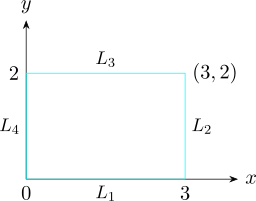
- Find the extreme points on the boundary.
- 3.
- Largest of the values of \(f\) from steps 1 and 2 is the absolute maximum value and the smallest of the values is the absolute minimum.
Find the absolute max and min values of the function \(f(x,y) = x^2 - 2xy + 2y\) of the rectangle \(D = \big \{(x,y)\hspace {0.1cm} \big | \hspace {0.1cm} 0\leq x \leq 3\hspace {0.1cm} , \hspace {0.1cm} 0 \leq y \leq 2 \big \}\).
Solution.
\(f\) is continuous on \(D\)
\(f_x = 2x -2y = 0 \implies x = y\)
\(f_y = -2x + 2 = 0 \implies x = 1\)
\((1,1)\) is the only critical point and \(f(1,1) = 1\).
Questions on this section
Stuck on something here? Ask below and it stays attached to this topic.