1.1 Level Curves
Another useful method of describing a function of two variables consists of sketching in the \(xy-\) plane, the
groups of \(f(x,y) = K\) (a constant) for various values of \(K\). The graphs so obtained are called level curves of
\(f\).
N.B As a point \((x,y)\) moves on a level curve the values of \(f(x,y)\) are constant.
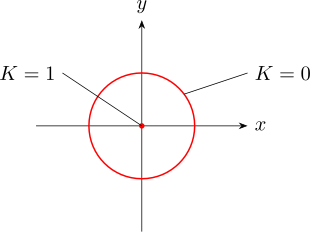
For the function \(z = \sqrt {1 - x^2 - y^2}\)
\begin {align*} \text {Let}\hspace {0.5cm} K & = \sqrt {1 - x^2 - y^2}\\ K^2 & = 1 - x^2 - y^2\\ x^2 + y^2 & = 1 - K^2 \end {align*}
\begin {align*} K & = 0 \hspace {1cm} x^2 + y^2 = 1\\ K & = 1 \hspace {1cm} x^2 + y^2 = 0\\ K & = 2 \hspace {1cm} x^2 + y^2 = -3\hspace {0.5cm}\text {undefined}\\ \end {align*}
Given a function \(g(x,y) = \sqrt {9 - x^2 - 2y^2}\)
- 1.
- Find the domain and range.
- 2.
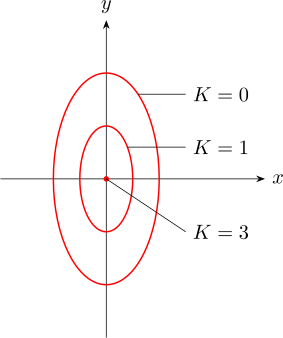
- Sketch the level curves of \(g\)
Solution.
- 1.
- \(\displaystyle {g(x,y)\geq 0\implies 9 - x^2 -2y^2\geq 0 \implies x^2 + 2y^2 \leq 9}\)
\begin {align*} \text {Domain}\hspace {0.5cm} D & = \big \{(x,y)\hspace {0.1cm} |\hspace {0.1cm} x^2 + 2y^2 \leq 9\big \}\\\\ \text {Range}\hspace {0.5cm} R & = \big \{z \hspace {0.1cm} |\hspace {0.1cm} 0\leq z \leq 3\big \}\\\\ \end {align*}
- 2.
- Level curves
\[K = \sqrt {9 - x^2 - 2y^2}\]
\[x^2 + 2y^2 = 9 - K^2\]
\begin {align*} K & = 0 \hspace {1cm} x^2 + 2y^2 = 9\\ K & = 1 \hspace {1cm} x^2 + 2y^2 = 8\\ \vdots &\\ K & = 3 \hspace {1cm} x^2 + 2y^2 = 0\\ \end {align*}
Solution.
\(\displaystyle {D = \big \{(x,y,z) \hspace {0.1cm} |\hspace {0.1cm} z - y > 0\big \}}\)
\(\displaystyle {R = \big \{\mathbb {R}\big \}}\)
Questions on this section
Stuck on something here? Ask below and it stays attached to this topic.