2.1 Surface of Revolution
A surface of revolution is obtained by revolving a plane \(C\) about a line (axis of revolution) in the
plane.
The graph of \(f(x,y)=0\) in the \(xy\) plane is a curve \(C\).
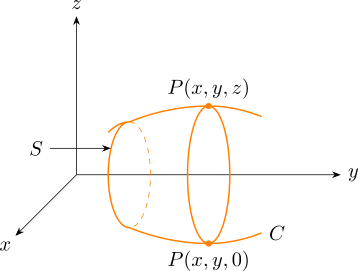
A point \(P(x,y,z)\) is on \(S\) if and only if \(Q(x,y,0)\) is on \(C\), and \(x_1 = \sqrt {x^2 + y^2}\). Consequently, \(P(x,y,z)\) is on \(S\) if and only if \(f\big (\sqrt {x^2 + y^2}, y\big ) = 0\).
Thus to find an equation for \(S\), we replace the variable \(x\) by \(\sqrt {x^2 + y^2}\).
Similarly, if the graph of \(f(x,y) =0\) is revolved about the \(x-\) axis then for the resulting surface may be found by replacing \(y\) by \(\sqrt {y^2 + z^2}\)
For curves that contain points \((x,y)\) with \(x\) or \(y\) negative can be extended by substituting \(\pm \sqrt {x^2 + y^2}\) for \(x\) or \(\pm \sqrt {y^2 + z^2}\) for \(y\).
The graph of \(9x^2 + 4y^2 = 36\) is revolved about the \(y-\) axis . Find an equation for the resulting surface.
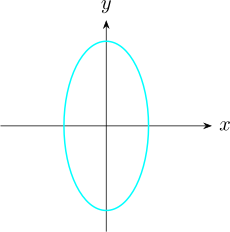
\[9x^2 + 4y^2 = 36\]
\[9\big (\sqrt {x^2 + y^2}\big )^2 + 4y^2 = 36\]
\[ 9x^2 + 9z^2 + 4y^2 = 36\]
Find a generating curve and the axis of revolution for the surface given by \(x^2 + 3y^2 + z^2 = 9\)
Solution.
Because the coefficients of \(x^2\) and \(z^2\) are equal we choose the form \[x^2 + z^2 = 9 - 3y^2\] The \(y-\) axis is the axis of revolution you can choose a generating curve from either of the following traces
\[x^2 = 9 -3y^2\]
\[z^2 = 9 - 3y^2\]
\begin {align*} f(x,y) = 0 \hspace {1cm} & x \hspace {0.5cm} \text {replace}\hspace {0.5cm} y \hspace {0.5cm} \text {by}\hspace {0.5cm} \sqrt {y^2 + z^2}\\ & y \hspace {0.5cm} \text {replace}\hspace {0.5cm} x \hspace {0.5cm} \text {by}\hspace {0.5cm} \sqrt {x^2 + z^2}\\ \end {align*}
\begin {align*} g(y,z) =0\hspace {1cm} & y \hspace {0.5cm} \text {replace}\hspace {0.5cm} z \hspace {0.5cm} \text {by}\hspace {0.5cm} \sqrt {y^2 + z^2}\\ & z \hspace {0.5cm} \text {replace}\hspace {0.5cm} y \hspace {0.5cm} \text {by}\hspace {0.5cm} \sqrt {y^2 + x^2}\\ \end {align*}
\begin {align*} h(x,z) = 0 \hspace {1cm} & x \hspace {0.5cm} \text {replace}\hspace {0.5cm} z \hspace {0.5cm} \text {by}\hspace {0.5cm} \sqrt {y^2 + z^2}\\ & z \hspace {0.5cm} \text {replace}\hspace {0.5cm} x \hspace {0.5cm} \text {by}\hspace {0.5cm} \sqrt {x^2 + y^2}\\\\ \end {align*}
Questions on this section
Stuck on something here? Ask below and it stays attached to this topic.