4.12 Oriented Surfaces
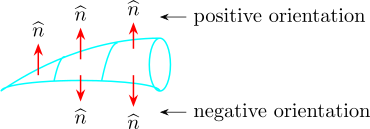
If it is possible to choose a unit normal vector \(\widehat {n}\) at every point \((x,y,z)\) on a surface \(S\), varying continuously over \(S\), then \(S\) is called an oriented surface, and that choice of \(\widehat {n}\) provides \(S\) with an orientation. There are two possible orientations for any oriented surface.
For a surface \(S\) given by \(z = g(x,y)\) , the natural orientation for the surface is given by \[\widehat {n} = \frac {-\dfrac {\partial g}{\partial x} \,\textbf {i} + \dfrac {\partial g}{\partial y}\,\textbf {j} + \textbf {k}}{\sqrt {1 + \Bigg (\dfrac {\partial g}{\partial x}\Bigg )^2 + \Bigg (\dfrac {\partial g}{\partial y}\Bigg )^2}}\]
Since \(\textbf {k}\) component is positive, this gives the upward orientation of the surface.
If \(S\) is a smooth orientable surface given by a vector function \(\overline {r}(u,v)\), then it is automatically supplied with the orientation of the unit normal vector \[\widehat {n}=\frac {\overline {r}_u \times \overline {r}_v}{\big |\overline {r}_u \times \overline {r}_v\big |}\]
For a closed surface, the convention is that the positive orientation is the one for which the normal vectors point outward from the surface and inward pointing normal give the negative orientation.
Questions on this section
Stuck on something here? Ask below and it stays attached to this topic.