2.6 Tangent Planes To Level Curves
Suppose \(S\) is a surface with equation \(F(x,y,z) = K\). Let \(C\) to be any curve that lies on \(S\) and pass through the point \(P\). \(C\) is described by a continuous vector function \[r(t) = \langle x(t) \, ,\, y(t)\, , \,z(t)\rangle \] since \(C\) lies on \(S\) , any point \((x(t), y(t),z(t))\) must satisfy the equation of \(S\) . i.e \[F(x(t)\, ,\, y(t)\, , \,z(t)) = K\]
If \(x,y,z\) are differentiable functions at \(t\)
\[\frac {\partial F}{\partial x}\hspace {0.1cm}\frac {dx}{dt} + \frac {\partial F}{\partial y}\hspace {0.1cm}\frac {dy}{dt} +\frac {\partial F}{\partial z}\hspace {0.1cm}\frac {dz}{dt} = 0 \]
But since \(\displaystyle {\nabla f = \langle F_x\, , \,F_y\, ,\, F_z}\rangle \,\) and \(\,\displaystyle {r'(t) = \langle x'(t)\, , \,y'(t)\, , \, z'(t) \rangle }\) \[ \nabla F \cdot r'(t) =0\]
In particular, when \(t=t_0\) we have \(\displaystyle {r(t_0) = \langle x_0, y_0, z_0 \rangle }\) \[\nabla F(x_0, y_0,z_0)\cdot r'(t_0) = 0\]
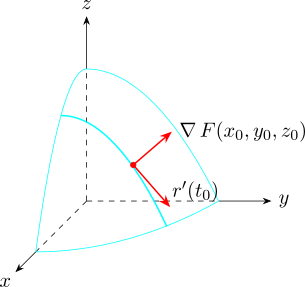
If \(\displaystyle {\nabla F(x_0, y_0, z_0) \neq 0}\), we define the tangent plane to the level surface \(F(x,y,z) = K\) as the plane through \(P\) and has normal \(\nabla F(x_0, y_0, z_0)\) and its equation is given by \[F_x(x_0, y_0, z_0)(x -x_0) + F_y(x_0, y_0, z_0)(y -y_0) + F_z(x_0, y_0, z_0)(z -z_0) = 0\]
The normal line to \(S\) at \(P\) has the equation.
\[ \frac {x - x_0}{F_x (x_0, y_0, z_0)} = \frac {y - y_0}{F_y (x_0, y_0, z_0)} = \frac {z - z_0}{F_z (x_0, y_0, z_0)} \]
called symmetric equations.
Find the equation of the tangent plane and normal line at the point \((-2,1,-3)\) to the ellipsoid \[\frac {x^2}{4} + y^2 + \frac {z^2}{9} =3 .\]
Solution.
Let \(\displaystyle {F = \frac {x^2}{4} + y^2 + \frac {z^2}{9}}\)
\[\nabla F = \frac {2}{4}x\,\textbf {i} + 2y\,\textbf {j} + \frac {2z}{9}\,\textbf {k}\]
\[\implies \hspace {1cm} \nabla F( -2,1,-3) = \frac {1}{2}(-2)\,\textbf {i} + 2(1)\,\textbf {j} + \frac {2(-3)}{9}\,\textbf {k}\] \(\therefore \) the tangent plane equation is \[-1(x+2) + 2(y-1) -\frac {2}{3}(z + 3) = 0\]
The symmetric equations for the normal line are \[\frac {x + 2}{-1} = \frac {y - 1}{2} = \frac {3}{-2}(z + 3)\]
Questions on this section
Stuck on something here? Ask below and it stays attached to this topic.