10.1 Basic ideas
Everyday speech describes uncertainty with vague phrases — “fairly certain”, “highly likely”, “there’s a chance”. Two people using the same phrase may mean quite different things by it. Probability replaces the phrase with a number, so that uncertainty can be compared and calculated with.
Definition 10.1. An experiment is any happening whose result is not known in advance. Its possible results are outcomes. The set of all possible outcomes is the sample space, written \(S\), and any subset of the sample space is an event, written \(E\).
When a coin is tossed, the sample space is \(\{H,T\}\) and the probability of heads is \(\frac {1}{2}\).
Example 10.2. Write down the sample space for each experiment: (a) a fair die is rolled; (b) two coins are tossed.
Solution. (a) A die has six faces, so \[S=\{1,2,3,4,5,6\},\qquad n(S)=6.\]
(b) Each coin can land two ways, and the outcomes combine: \[S=\{HH,\ HT,\ TH,\ TT\},\qquad n(S)=4.\]
A tree diagram sets out the same thing, one coin per stage:
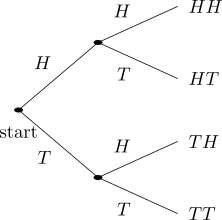
Note 10.3. \(HT\) and \(TH\) are listed separately, even though both describe “one head and one tail”. They are genuinely different outcomes — which coin showed the head differs — and treating them as one would give a sample space of three outcomes and every subsequent probability would be wrong. This is the commonest mistake with two coins.
Questions on this section
Stuck on something here? Ask below and it stays attached to this topic.