5.6 Practice Problems
Tutorial Sheet 7 in full. Work each question before opening the solution.
Problem 5.1. Find the quadrant containing the terminal side of \(\theta \) if (a) \(\sin \theta >0\) and \(\tan \theta <0\), (b) \(\sin \theta <0\) and \(\cos \theta <0\), (c) \(\cos \theta >0\) and \(\tan \theta <0\), (d) \(\tan \theta >0\) and \(\sec \theta <0\), (e) \(\sin \theta <0\) and \(\cot \theta <0\), (f) \(\csc \theta >0\) and \(\sec \theta >0\).
Show solution
Solution. The signs in each quadrant are worth having at hand:
| I | II | III | IV | |
| \(\sin \) (and \(\csc \)) | \(+\) | \(+\) | \(-\) | \(-\) |
| \(\cos \) (and \(\sec \)) | \(+\) | \(-\) | \(-\) | \(+\) |
| \(\tan \) (and \(\cot \)) | \(+\) | \(-\) | \(+\) | \(-\) |
Each condition names a set of two quadrants; the answer is the one they share.
\[\text {(a) } \sin >0:\ \text {I or II};\quad \tan <0:\ \text {II or IV} \quad \implies \quad \textbf {quadrant II}.\] \[\text {(b) } \sin <0:\ \text {III or IV};\quad \cos <0:\ \text {II or III} \quad \implies \quad \textbf {quadrant III}.\] \[\text {(c) } \cos >0:\ \text {I or IV};\quad \tan <0:\ \text {II or IV} \quad \implies \quad \textbf {quadrant IV}.\]
(d). \(\sec \theta <0\) means \(\frac {1}{\cos \theta }<0\), that is \(\cos \theta <0\): \[\tan >0:\ \text {I or III};\quad \cos <0:\ \text {II or III} \quad \implies \quad \textbf {quadrant III}.\]
(e). \(\cot \theta <0\) means \(\tan \theta <0\), since they are reciprocals and share a sign: \[\sin <0:\ \text {III or IV};\quad \tan <0:\ \text {II or IV} \quad \implies \quad \textbf {quadrant IV}.\]
(f). \(\csc >0\) means \(\sin >0\) and \(\sec >0\) means \(\cos >0\): \[\text {I or II};\quad \text {I or IV}\quad \implies \quad \textbf {quadrant I}.\]
Note 5.20. A reciprocal always has the same sign as the ratio it comes from, because \(\frac {1}{\text {positive}}\) is positive and \(\frac {1}{\text {negative}}\) is negative. So \(\sec \), \(\csc \) and \(\cot \) need no separate row in the table — convert them to \(\cos \), \(\sin \) and \(\tan \) first and the question becomes one of the first three.
Problem 5.2. Without a calculator, convert to radians: (a) \(-250^\circ \), (b) \(25^\circ \), (c) \(75^\circ \), (d) \(-330^\circ \), (e) \(570^\circ \), (f) \(635^\circ \).
Show solution
Solution. Multiply by \(\frac {\pi }{180}\) and cancel.
\[\text {(a) } -250\times \frac {\pi }{180}=-\frac {250\pi }{180}=-\frac {25\pi }{18} \qquad (\div 10)\] \[\text {(b) } 25\times \frac {\pi }{180}=\frac {25\pi }{180}=\frac {5\pi }{36}\qquad (\div 5)\] \[\text {(c) } 75\times \frac {\pi }{180}=\frac {75\pi }{180}=\frac {5\pi }{12}\qquad (\div 15)\] \[\text {(d) } -330\times \frac {\pi }{180}=-\frac {330\pi }{180}=-\frac {11\pi }{6} \qquad (\div 30)\] \[\text {(e) } 570\times \frac {\pi }{180}=\frac {570\pi }{180}=\frac {19\pi }{6} \qquad (\div 30)\] \[\text {(f) } 635\times \frac {\pi }{180}=\frac {635\pi }{180}=\frac {127\pi }{36} \qquad (\div 5)\]
Note 5.21. Cancel by the highest common factor in one step rather than repeatedly by \(2\) or \(5\). For (e), \(\gcd (570,180)=30\), giving \(\frac {19\pi }{6}\) immediately. An answer such as \(\frac {57\pi }{18}\) is not wrong but is not finished.
Problem 5.3. Without a calculator, convert to degrees: (a) \(\frac {7\pi }{3}\), (b) \(-\frac {3\pi }{5}\), (c) \(\frac {\pi }{13}\), (d) \(\frac {5\pi }{3}\), (e) \(\frac {7\pi }{6}\), (f) \(-\frac {11\pi }{4}\).
Show solution
Solution. Multiply by \(\frac {180}{\pi }\), so the \(\pi \) cancels and only the fraction is left.
\[\text {(a) } \frac {7\pi }{3}\times \frac {180}{\pi }=7\times 60=420^\circ \] \[\text {(b) } -\frac {3\pi }{5}\times \frac {180}{\pi }=-3\times 36=-108^\circ \] \[\text {(c) } \frac {\pi }{13}\times \frac {180}{\pi }=\frac {180}{13} \approx 13.85^\circ \] \[\text {(d) } \frac {5\pi }{3}\times \frac {180}{\pi }=5\times 60=300^\circ \] \[\text {(e) } \frac {7\pi }{6}\times \frac {180}{\pi }=7\times 30=210^\circ \] \[\text {(f) } -\frac {11\pi }{4}\times \frac {180}{\pi }=-11\times 45=-495^\circ \]
Note 5.22. Part (c) does not come out as a whole number of degrees, and that is not an error — \(\frac {180}{13}\) is the exact answer and should be left as a fraction unless a decimal is asked for. Most textbook angles are chosen so the division is exact, which makes the one that is not stand out.
Problem 5.4. Without a calculator, find the exact value of (a) \(\sin 75^\circ \), (b) \(\cos (-15^\circ )\), (c) \(\cos 150^\circ \), (d) \(\sin (-135^\circ )\), (e) \(\tan 315^\circ \), (f) \(\cos \frac {7\pi }{3}\), (g) \(\cot \left (-\frac {5\pi }{3}\right )\), (h) \(\sec \frac {7\pi }{6}\), (i) \(\csc \frac {\pi }{12}\).
Show solution
Solution. Three tools cover all of these: the addition formulae, the exact values at \(30^\circ \), \(45^\circ \) and \(60^\circ \), and the fact that adding or subtracting a full revolution changes nothing.
(a). \(75^\circ =45^\circ +30^\circ \): \[\sin 75^\circ =\sin 45^\circ \cos 30^\circ +\cos 45^\circ \sin 30^\circ =\frac {\sqrt {2}}{2}\cdot \frac {\sqrt {3}}{2}+\frac {\sqrt {2}}{2}\cdot \frac {1}{2} =\frac {\sqrt {6}+\sqrt {2}}{4}.\]
(b). Cosine is an even function, so \(\cos (-15^\circ )=\cos 15^\circ \), and \(15^\circ =45^\circ -30^\circ \): \[\cos 15^\circ =\cos 45^\circ \cos 30^\circ +\sin 45^\circ \sin 30^\circ =\frac {\sqrt {6}}{4}+\frac {\sqrt {2}}{4}=\frac {\sqrt {6}+\sqrt {2}}{4}.\] The same value as (a), because \(75^\circ \) and \(15^\circ \) are complementary.
(c). \(150^\circ \) is in quadrant II, where cosine is negative, with reference angle \(180^\circ -150^\circ =30^\circ \): \[\cos 150^\circ =-\cos 30^\circ =-\frac {\sqrt {3}}{2}.\]
(d). Sine is odd, so \(\sin (-135^\circ )=-\sin 135^\circ \). And \(135^\circ \) is in quadrant II with reference angle \(45^\circ \): \[\sin (-135^\circ )=-\sin 45^\circ =-\frac {\sqrt {2}}{2}.\]
(e). \(315^\circ \) is in quadrant IV, where tangent is negative, with reference angle \(360^\circ -315^\circ =45^\circ \): \[\tan 315^\circ =-\tan 45^\circ =-1.\]
(f). Subtract a full revolution, \(2\pi =\frac {6\pi }{3}\): \[\cos \frac {7\pi }{3}=\cos \left (\frac {7\pi }{3}-\frac {6\pi }{3}\right )=\cos \frac {\pi }{3} =\frac {1}{2}.\]
(g). Add a full revolution to make the angle positive: \[\cot \left (-\frac {5\pi }{3}\right )=\cot \left (-\frac {5\pi }{3}+2\pi \right ) =\cot \frac {\pi }{3}=\frac {1}{\tan \frac {\pi }{3}}=\frac {1}{\sqrt {3}}=\frac {\sqrt {3}}{3}.\]
(h). \(\frac {7\pi }{6}=210^\circ \), in quadrant III with reference angle \(30^\circ \), where cosine is negative: \[\cos \frac {7\pi }{6}=-\frac {\sqrt {3}}{2}\quad \implies \quad \sec \frac {7\pi }{6}=\frac {1}{-\frac {\sqrt {3}}{2}}=-\frac {2}{\sqrt {3}} =-\frac {2\sqrt {3}}{3}.\]
(i). \(\frac {\pi }{12}=15^\circ \), and \(\sin 15^\circ =\frac {\sqrt {6}-\sqrt {2}}{4}\) by the same addition formula as in (b). So \[\csc \frac {\pi }{12}=\frac {4}{\sqrt {6}-\sqrt {2}} =\frac {4\left (\sqrt {6}+\sqrt {2}\right )}{6-2} =\frac {4\left (\sqrt {6}+\sqrt {2}\right )}{4}=\sqrt {6}+\sqrt {2}.\]
Note 5.23. For a reciprocal ratio, always find the ordinary ratio first and invert at the end, as in (g), (h) and (i). Trying to work with \(\sec \) or \(\csc \) directly means remembering a second set of quadrant rules for no gain.
Note 5.24. The rationalisation in (i) is worth the extra line. \(\frac {4}{\sqrt {6}-\sqrt {2}}\) is correct but is not an acceptable final form, and it happens to simplify to something much tidier.
Problem 5.5. Given that \(\theta \) is in the third quadrant and \(\cos \theta =-\frac {4}{5}\), find \(\cot \theta \) and \(\csc \theta \).
Show solution
Solution. Step 1 — find \(\sin \theta \). From \(\sin ^2\theta +\cos ^2\theta =1\): \[\sin ^2\theta =1-\left (-\tfrac {4}{5}\right )^2=1-\tfrac {16}{25}=\tfrac {9}{25} \quad \implies \quad \sin \theta =\pm \tfrac {3}{5}.\] In the third quadrant sine is negative, so \[\sin \theta =-\tfrac {3}{5}.\]
Step 2 — form the two required ratios. \[\cot \theta =\frac {\cos \theta }{\sin \theta }=\frac {-\frac {4}{5}}{-\frac {3}{5}} =\frac {4}{3},\] \[\csc \theta =\frac {1}{\sin \theta }=\frac {1}{-\frac {3}{5}}=-\frac {5}{3}.\]
Note 5.25. The quadrant is the whole point of the question. The equation \(\sin ^2\theta =\frac {9}{25}\) offers two answers and only the stated quadrant picks between them. Note also that \(\cot \theta \) comes out positive, because a negative divided by a negative is positive — consistent with tangent and cotangent being positive in the third quadrant.
Problem 5.6. Simplify to a single trigonometric function or a constant. (a) \(\sec x-\sin x\tan x\), (b) \(\csc x-\cos x\cot x\), (c) \(\cos x+\tan x\sin x\), (d) \(\left (\sin ^2x-1\right )\left (\tan ^2x+1\right )\), (e) \(\frac {\sec \theta -\cos \theta }{\tan \theta }\), (f) \(\frac {\sec \theta +1}{\tan \theta +\sin \theta }\).
Show solution
Solution. The reliable method is to convert everything to sines and cosines, combine over a common denominator, and use \(\sin ^2+\cos ^2=1\).
(a). \[\sec x-\sin x\tan x=\frac {1}{\cos x}-\sin x\cdot \frac {\sin x}{\cos x} =\frac {1-\sin ^2x}{\cos x}=\frac {\cos ^2x}{\cos x}=\cos x.\]
(b). \[\csc x-\cos x\cot x=\frac {1}{\sin x}-\cos x\cdot \frac {\cos x}{\sin x} =\frac {1-\cos ^2x}{\sin x}=\frac {\sin ^2x}{\sin x}=\sin x.\]
(c). \[\cos x+\tan x\sin x=\cos x+\frac {\sin ^2x}{\cos x}=\frac {\cos ^2x+\sin ^2x}{\cos x} =\frac {1}{\cos x}=\sec x.\]
(d). Use \(\sin ^2x-1=-\cos ^2x\) and \(\tan ^2x+1=\sec ^2x\): \[\left (-\cos ^2x\right )\left (\sec ^2x\right )=-\cos ^2x\cdot \frac {1}{\cos ^2x}=-1.\]
(e). \[\frac {\sec \theta -\cos \theta }{\tan \theta } =\frac {\frac {1}{\cos \theta }-\cos \theta }{\frac {\sin \theta }{\cos \theta }} =\frac {\frac {1-\cos ^2\theta }{\cos \theta }}{\frac {\sin \theta }{\cos \theta }} =\frac {\sin ^2\theta }{\cos \theta }\cdot \frac {\cos \theta }{\sin \theta }=\sin \theta .\]
(f). \[\frac {\sec \theta +1}{\tan \theta +\sin \theta } =\frac {\frac {1}{\cos \theta }+1}{\frac {\sin \theta }{\cos \theta }+\sin \theta } =\frac {\frac {1+\cos \theta }{\cos \theta }} {\frac {\sin \theta +\sin \theta \cos \theta }{\cos \theta }} =\frac {1+\cos \theta }{\sin \theta (1+\cos \theta )}=\frac {1}{\sin \theta }=\csc \theta .\]
Note 5.26. Part (f) is the one that rewards patience: the factor \(1+\cos \theta \) appears on both top and bottom, but only after the denominator is factorised. Expanding it out instead leaves an expression that looks worse than the original.
Note 5.27. Every part here uses one of the three Pythagorean identities: \[\sin ^2+\cos ^2=1,\qquad 1+\tan ^2=\sec ^2,\qquad 1+\cot ^2=\csc ^2.\] The last two are the first divided through by \(\cos ^2\) and by \(\sin ^2\), so only the first has to be remembered.
Problem 5.7. Prove each identity. (a) \(\tan ^2x+1+\tan x\sec x=\frac {1+\sin x}{\cos ^2x}\), (b) \(\frac {\cos x+\sin x}{\cos x}=1+\tan x\), (c) \(\frac {\csc x-1}{\cot x}=\frac {\cot x}{\csc x+1}\), (d) \(\frac {1}{\tan x+\cot x}=\cos x\sin x\), (e) \(\frac {\tan x\left (1+\cot ^2x\right )}{1+\tan ^2x}=\cot x\), (f) \(\frac {1-\sin x}{1+\sin x}=(\tan x-\sec x)^2\), (g) \(\frac {1}{\sec x(1-\sin x)}=\sec x+\tan x\), (h) \(\frac {\tan x+\tan y}{\cot x+\cot y}=\tan y\tan x\).
Show solution
Solution.
Note 5.28. To prove an identity, work on one side only until it becomes the other. Never move terms across the equals sign — that assumes what is to be proved. The usual choice is to start from the more complicated side.
(a). Starting from the left and using \(\tan ^2x+1=\sec ^2x\): \[\sec ^2x+\tan x\sec x=\frac {1}{\cos ^2x}+\frac {\sin x}{\cos x}\cdot \frac {1}{\cos x} =\frac {1}{\cos ^2x}+\frac {\sin x}{\cos ^2x}=\frac {1+\sin x}{\cos ^2x}.\qquad \blacksquare \]
(b). Split the fraction: \[\frac {\cos x+\sin x}{\cos x}=\frac {\cos x}{\cos x}+\frac {\sin x}{\cos x} =1+\tan x.\qquad \blacksquare \]
(c). Both sides are fractions, so cross-multiply — legitimate here because we are showing the products are equal, not moving terms: \[(\csc x-1)(\csc x+1)=\csc ^2x-1=\cot ^2x=\cot x\cdot \cot x,\] using \(1+\cot ^2x=\csc ^2x\). The two cross-products agree, so the fractions are equal. \(\blacksquare \)
(d). Work on the left: \[\tan x+\cot x=\frac {\sin x}{\cos x}+\frac {\cos x}{\sin x} =\frac {\sin ^2x+\cos ^2x}{\sin x\cos x}=\frac {1}{\sin x\cos x},\] \[\therefore \quad \frac {1}{\tan x+\cot x}=\sin x\cos x.\qquad \blacksquare \]
(e). Replace \(1+\cot ^2x\) by \(\csc ^2x\) and \(1+\tan ^2x\) by \(\sec ^2x\): \[\frac {\tan x\csc ^2x}{\sec ^2x}=\frac {\sin x}{\cos x}\cdot \frac {1}{\sin ^2x} \cdot \cos ^2x=\frac {\cos x}{\sin x}=\cot x.\qquad \blacksquare \]
(f). Start from the right-hand side, which is the more complicated: \[(\tan x-\sec x)^2=\left (\frac {\sin x}{\cos x}-\frac {1}{\cos x}\right )^2 =\left (\frac {\sin x-1}{\cos x}\right )^2=\frac {(1-\sin x)^2}{\cos ^2x},\] since squaring removes the sign. Now use \(\cos ^2x=1-\sin ^2x=(1-\sin x)(1+\sin x)\): \[=\frac {(1-\sin x)^2}{(1-\sin x)(1+\sin x)}=\frac {1-\sin x}{1+\sin x}. \qquad \blacksquare \]
(g). Start from the left: \[\frac {1}{\sec x(1-\sin x)}=\frac {\cos x}{1-\sin x}.\] Multiply top and bottom by \(1+\sin x\): \[=\frac {\cos x(1+\sin x)}{(1-\sin x)(1+\sin x)}=\frac {\cos x(1+\sin x)}{1-\sin ^2x} =\frac {\cos x(1+\sin x)}{\cos ^2x}=\frac {1+\sin x}{\cos x}\] \[=\frac {1}{\cos x}+\frac {\sin x}{\cos x}=\sec x+\tan x.\qquad \blacksquare \]
(h). Work on the denominator of the left side: \[\cot x+\cot y=\frac {1}{\tan x}+\frac {1}{\tan y}=\frac {\tan y+\tan x}{\tan x\tan y}.\] Therefore \[\frac {\tan x+\tan y}{\cot x+\cot y} =(\tan x+\tan y)\cdot \frac {\tan x\tan y}{\tan x+\tan y}=\tan x\tan y. \qquad \blacksquare \]
Note 5.29. Parts (f) and (g) both use the same trick: multiply by the conjugate so that \((1-\sin x)(1+\sin x)=\cos ^2 x\) appears. Whenever \(1\pm \sin x\) sits in a denominator, that is the move to reach for — it is the same conjugate idea used to rationalise surds.
Problem 5.8. Verify each of the following. (a) \(\cos 2x=2\cos ^2x-1\), (b) \(\cos 2x=1-2\sin ^2x\), (c) \(\cos (\theta -\pi )=-\cos \theta \), (d) \(\cos \left (\theta +\frac {\pi }{2}\right )=-\sin \theta \), (e) \(\sin \left (\theta +\frac {\pi }{2}\right )=\cos \theta \), (f) \(\tan (\theta -\pi )=\tan \theta \).
Show solution
Solution. All six come from the addition formulae \[\cos (A\pm B)=\cos A\cos B\mp \sin A\sin B,\qquad \sin (A\pm B)=\sin A\cos B\pm \cos A\sin B.\]
(a). Take \(A=B=x\) in the cosine formula: \[\cos 2x=\cos x\cos x-\sin x\sin x=\cos ^2x-\sin ^2x.\] Replacing \(\sin ^2x\) by \(1-\cos ^2x\): \[=\cos ^2x-\left (1-\cos ^2x\right )=2\cos ^2x-1.\qquad \blacksquare \]
(b). From the same starting point, replace \(\cos ^2x\) by \(1-\sin ^2x\) instead: \[\cos 2x=\left (1-\sin ^2x\right )-\sin ^2x=1-2\sin ^2x.\qquad \blacksquare \]
(c). With \(\cos \pi =-1\) and \(\sin \pi =0\): \[\cos (\theta -\pi )=\cos \theta \cos \pi +\sin \theta \sin \pi =\cos \theta (-1)+0 =-\cos \theta .\qquad \blacksquare \]
(d). With \(\cos \frac {\pi }{2}=0\) and \(\sin \frac {\pi }{2}=1\): \[\cos \left (\theta +\tfrac {\pi }{2}\right )=\cos \theta \cdot 0-\sin \theta \cdot 1 =-\sin \theta .\qquad \blacksquare \]
(e). \[\sin \left (\theta +\tfrac {\pi }{2}\right )=\sin \theta \cdot 0+\cos \theta \cdot 1 =\cos \theta .\qquad \blacksquare \]
(f). Using \(\tan (A-B)=\frac {\tan A-\tan B}{1+\tan A\tan B}\) with \(\tan \pi =0\): \[\tan (\theta -\pi )=\frac {\tan \theta -0}{1+0}=\tan \theta .\qquad \blacksquare \]
Note 5.30. Parts (a) and (b) are the same identity written two ways, and both are used constantly. Together with \(\cos 2x=\cos ^2x-\sin ^2x\) they give three forms of the double-angle formula; which one to use depends on whether the surrounding expression contains sines or cosines.
Note 5.31. Part (f) says \(\tan \) repeats every \(\pi \), not every \(2\pi \) as \(\sin \) and \(\cos \) do. That shorter period is why \(\tan \) has twice as many solutions as one might expect in a given interval — something the next questions depend on.
Problem 5.9. Solve for \(0\leq x\leq 2\pi \), without a calculator. (a) \(2\sin x+1=0\), (b) \(\sec x=2\), (c) \(2\cos ^2x-\sqrt {3}\cos x=0\), (d) \(\sin x+2=3\), (e) \(2\cos ^2x+\cos x=\sin ^2x\), (f) \(\tan x=\cot x\).
Show solution
Solution. (a). \(\sin x=-\frac {1}{2}\). The reference angle is \(\frac {\pi }{6}\), and sine is negative in quadrants III and IV: \[x=\pi +\tfrac {\pi }{6}=\tfrac {7\pi }{6},\qquad x=2\pi -\tfrac {\pi }{6}=\tfrac {11\pi }{6}.\]
(b). \(\cos x=\frac {1}{2}\), reference angle \(\frac {\pi }{3}\), cosine positive in quadrants I and IV: \[x=\tfrac {\pi }{3},\qquad x=2\pi -\tfrac {\pi }{3}=\tfrac {5\pi }{3}.\]
(c). Factorise — do not divide by \(\cos x\): \[\cos x\left (2\cos x-\sqrt {3}\right )=0.\] \[\cos x=0\quad \implies \quad x=\tfrac {\pi }{2},\ \tfrac {3\pi }{2};\] \[\cos x=\tfrac {\sqrt {3}}{2}\quad \implies \quad x=\tfrac {\pi }{6},\ \tfrac {11\pi }{6}.\] \[\therefore \quad x=\tfrac {\pi }{6},\ \tfrac {\pi }{2},\ \tfrac {3\pi }{2},\ \tfrac {11\pi }{6}.\]
(d). \(\sin x=1\), which happens once in the interval: \[x=\tfrac {\pi }{2}.\]
(e). Replace \(\sin ^2x\) by \(1-\cos ^2x\): \[2\cos ^2x+\cos x=1-\cos ^2x\quad \implies \quad 3\cos ^2x+\cos x-1=0.\] This does not factorise, and the quadratic formula gives \[\cos x=\frac {-1\pm \sqrt {1+12}}{6}=\frac {-1\pm \sqrt {13}}{6} \approx 0.4343\ \text { or } -0.7676.\] Neither is a standard value, so the angles cannot be written exactly and the question cannot be finished “without a calculator” as instructed. To three decimal places, \[x\approx 1.121,\ 5.162,\ 2.447,\ 3.836.\]
Almost certainly the intended equation was \[2\cos ^2x+\cos x-1=0,\] which factorises as \((2\cos x-1)(\cos x+1)=0\), giving \[\cos x=\tfrac {1}{2}\ \implies \ x=\tfrac {\pi }{3},\ \tfrac {5\pi }{3};\qquad \cos x=-1\ \implies \ x=\pi .\]
(f). Since \(\cot x=\frac {1}{\tan x}\), \[\tan x=\frac {1}{\tan x}\quad \implies \quad \tan ^2x=1\quad \implies \quad \tan x=\pm 1.\] The reference angle is \(\frac {\pi }{4}\), and tangent takes each value twice in \([0,2\pi ]\): \[x=\tfrac {\pi }{4},\ \tfrac {3\pi }{4},\ \tfrac {5\pi }{4},\ \tfrac {7\pi }{4}.\]
Note 5.32. Part (c) is where marks are lost. Dividing both sides by \(\cos x\) gives \(2\cos x=\sqrt {3}\) and finds only two of the four solutions, because dividing by \(\cos x\) silently assumes \(\cos x\neq 0\) — and \(\cos x=0\) is exactly half the answer. Always factorise.
Note 5.33. Part (f) has four solutions rather than two because \(\tan ^2x=1\) allows \(\tan x\) to be either \(+1\) or \(-1\), and each occurs twice over a full revolution. Taking the square root of both sides of an equation always produces the \(\pm \).
Problem 5.10. Solve for \(0\leq x\leq 4\pi \), without a calculator. (a) \(2\tan x\sec x-\tan x=0\), (b) \(\sec ^2x-\sec x-2=0\), (c) \(\cos 2x+3\sin x-2=0\), (d) \(\sin x+\cos x=1\).
Show solution
Solution. The interval is two full revolutions, so every solution in \([0,2\pi )\) has a partner \(2\pi \) further on. Find the solutions in one revolution and then add \(2\pi \) to each, keeping any that still fall within \(4\pi \).
(a). Factorise: \[\tan x\left (2\sec x-1\right )=0.\] \[\tan x=0\quad \implies \quad x=0,\ \pi ,\ 2\pi ,\ 3\pi ,\ 4\pi .\] \[2\sec x=1\quad \implies \quad \sec x=\tfrac {1}{2}\quad \implies \quad \cos x=2,\] which is impossible, since \(\cos x\) never exceeds \(1\). That branch gives nothing. \[\therefore \quad x=0,\ \pi ,\ 2\pi ,\ 3\pi ,\ 4\pi .\]
(b). A quadratic in \(\sec x\): \[(\sec x-2)(\sec x+1)=0.\] \[\sec x=2\ \implies \ \cos x=\tfrac {1}{2}\ \implies \ x=\tfrac {\pi }{3},\ \tfrac {5\pi }{3},\ \tfrac {7\pi }{3},\ \tfrac {11\pi }{3};\] \[\sec x=-1\ \implies \ \cos x=-1\ \implies \ x=\pi ,\ 3\pi .\] \[\therefore \quad x=\tfrac {\pi }{3},\ \pi ,\ \tfrac {5\pi }{3},\ \tfrac {7\pi }{3},\ 3\pi ,\ \tfrac {11\pi }{3}.\]
(c). The equation mixes \(2x\) and \(x\), so use the double-angle form that leaves only sines, \(\cos 2x=1-2\sin ^2x\): \[1-2\sin ^2x+3\sin x-2=0\quad \implies \quad -2\sin ^2x+3\sin x-1=0 \quad \implies \quad 2\sin ^2x-3\sin x+1=0.\] \[(2\sin x-1)(\sin x-1)=0.\] \[\sin x=\tfrac {1}{2}\ \implies \ x=\tfrac {\pi }{6},\ \tfrac {5\pi }{6},\ \tfrac {13\pi }{6},\ \tfrac {17\pi }{6};\] \[\sin x=1\ \implies \ x=\tfrac {\pi }{2},\ \tfrac {5\pi }{2}.\] \[\therefore \quad x=\tfrac {\pi }{6},\ \tfrac {\pi }{2},\ \tfrac {5\pi }{6},\ \tfrac {13\pi }{6},\ \tfrac {5\pi }{2},\ \tfrac {17\pi }{6}.\]
(d). Combine the two terms into one. Since \(\sin x+\cos x=\sqrt {2}\sin \left (x+\frac {\pi }{4}\right )\), \[\sqrt {2}\sin \left (x+\tfrac {\pi }{4}\right )=1\quad \implies \quad \sin \left (x+\tfrac {\pi }{4}\right )=\frac {1}{\sqrt {2}}.\] Writing \(u=x+\frac {\pi }{4}\), which runs over \(\left [\frac {\pi }{4},\ 4\pi +\frac {\pi }{4}\right ]\): \[u=\tfrac {\pi }{4},\ \tfrac {3\pi }{4},\ \tfrac {9\pi }{4},\ \tfrac {11\pi }{4},\ \tfrac {17\pi }{4}.\] Subtracting \(\frac {\pi }{4}\) from each: \[\therefore \quad x=0,\ \tfrac {\pi }{2},\ 2\pi ,\ \tfrac {5\pi }{2},\ 4\pi .\]
Note 5.34. In (a) one branch had no solutions at all, and saying so explicitly is part of the answer. \(\sec x=\frac {1}{2}\) requires \(\cos x=2\), and since \(|\cos x|\leq 1\) always, that branch is empty rather than overlooked.
Note 5.35. Over \([0,4\pi ]\) the endpoints matter. In (a) and (d) both \(x=0\) and \(x=4\pi \) are solutions, and both must be listed — the interval is closed at each end.
Problem 5.11. Sketch, over the interval given. (a) \(f(x)=1+\sin x\), \(0\leq x\leq 2\pi \); (b) \(f(x)=1-\cos x\), \(0\leq x\leq 2\pi \); (c) \(f(x)=-\cos x\), \(0\leq x\leq \frac {2\pi }{3}\); (d) \(f(x)=\frac {1}{2}\sin \left (\frac {1}{2}x\right )\), \(0\leq x\leq 4\pi \).
Show solution
Solution. (a). The sine wave lifted one unit. It runs between \(0\) and \(2\) instead of \(-1\) and \(1\), touching \(0\) at \(x=\frac {3\pi }{2}\) and reaching \(2\) at \(x=\frac {\pi }{2}\). Starts and ends at \(1\).
(b). \(-\cos x\) is the cosine wave turned upside down, starting at \(-1\); adding \(1\) lifts it to start at \(0\). It runs between \(0\) and \(2\), peaking at \(2\) when \(x=\pi \), and returns to \(0\) at \(x=2\pi \).
(c). \(-\cos x\) starts at \(-1\), rises through \(0\) at \(x=\frac {\pi }{2}\), and at \(x=\frac {2\pi }{3}\) has reached \(-\cos \frac {2\pi }{3}=\frac {1}{2}\). Only this rising portion is drawn.
(d). Amplitude \(\frac {1}{2}\) and period \[\frac {2\pi }{\frac {1}{2}}=4\pi ,\] so exactly one complete wave fits the interval: up to \(\frac {1}{2}\) at \(x=\pi \), back through zero at \(x=2\pi \), down to \(-\frac {1}{2}\) at \(x=3\pi \), and back to zero at \(x=4\pi \).
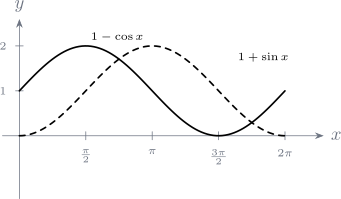
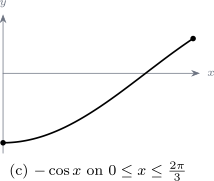
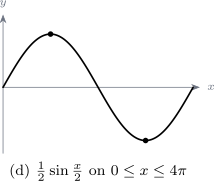
Note 5.36. A constant added outside the trigonometric function moves the wave vertically and changes neither its amplitude nor its period. In (a) and (b) the amplitude is still \(1\) — half the distance from lowest to highest, which is \(\frac {2-0}{2}=1\) — even though the curve no longer straddles the \(x\)-axis.
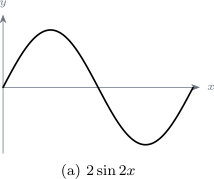
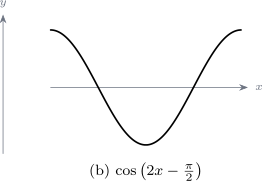
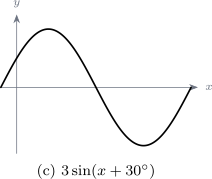
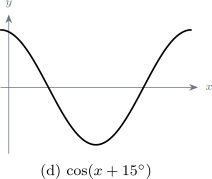
Problem 5.12. Find the period, amplitude and phase shift, and sketch one complete revolution for \(x\geq 0\). (a) \(f(x)=2\sin 2x\), (b) \(f(x)=\cos \left (2x-\frac {\pi }{2}\right )\), (c) \(f(x)=3\sin (x+30^\circ )\), (d) \(f(x)=\cos (x+15^\circ )\), (e) \(f(x)=-4\cos 3x\), (f) \(f(x)=\frac {2}{3}\sin 2(x-\pi )\), (g) \(f(x)=2+3\cos \left (2x-\frac {\pi }{2}\right )\).
Show solution
Solution. Write each in the standard form \[f(x)=a\sin \left [b(x-c)\right ]+d\qquad \text {or}\qquad f(x)=a\cos \left [b(x-c)\right ]+d,\] from which \[\text {amplitude}=|a|,\qquad \text {period}=\frac {2\pi }{b} \ \left (\text {or } \frac {360^\circ }{b}\right ),\qquad \text {phase shift}=c.\] A positive \(c\) shifts right and a negative \(c\) shifts left.
| Standard form | Amplitude | Period | Phase shift | |
| (a) | \(2\sin 2x\) | \(2\) | \(\pi \) | none |
| (b) | \(\cos 2\left (x-\frac {\pi }{4}\right )\) | \(1\) | \(\pi \) | \(\frac {\pi }{4}\) right |
| (c) | \(3\sin \left [x-(-30^\circ )\right ]\) | \(3\) | \(360^\circ \) | \(30^\circ \) left |
| (d) | \(\cos \left [x-(-15^\circ )\right ]\) | \(1\) | \(360^\circ \) | \(15^\circ \) left |
| (e) | \(-4\cos 3x\) | \(4\) | \(\frac {2\pi }{3}\) | none |
| (f) | \(\frac {2}{3}\sin 2(x-\pi )\) | \(\frac {2}{3}\) | \(\pi \) | \(\pi \) right |
| (g) | \(2+3\cos 2\left (x-\frac {\pi }{4}\right )\) | \(3\) | \(\pi \) | \(\frac {\pi }{4}\) right |
Two worth setting out.
(b). The bracket must be factorised before the shift can be read: \[2x-\frac {\pi }{2}=2\left (x-\frac {\pi }{4}\right ),\] so \(b=2\) and \(c=\frac {\pi }{4}\). The shift is \(\frac {\pi }{4}\), not \(\frac {\pi }{2}\).
(e). The amplitude is \(|-4|=4\), a positive number. The minus sign does not reduce the amplitude; it turns the curve upside down, so the wave starts at \(-4\) instead of \(+4\).
(g). This is (b) with amplitude tripled and the whole wave lifted \(2\) units. It therefore oscillates between \(2-3=-1\) and \(2+3=5\), with midline \(y=2\).
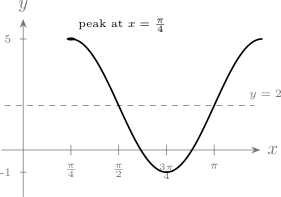
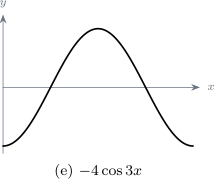
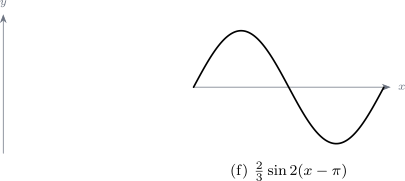
Note 5.37. The commonest error is reading the phase shift straight off the bracket. In (b) and (g) the expression \(2x-\frac {\pi }{2}\) must be factorised to \(2\left (x-\frac {\pi }{4}\right )\) first; the shift is what is subtracted from \(x\) after the \(b\) has been taken out, so it is \(\frac {\pi }{4}\) and not \(\frac {\pi }{2}\).
Note 5.38. Amplitude is always positive, being a distance. A negative coefficient, as in (e), reflects the curve but leaves the amplitude as \(|a|\).
Questions on this section
Stuck on something here? Ask below and it stays attached to this topic.