6.5 Practice Problems
Tutorial Sheet 6 in full. Work each question before opening the solution.
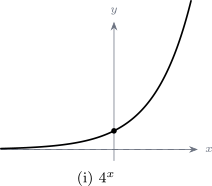
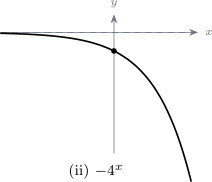
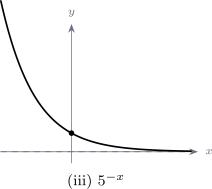
Problem 6.1. Sketch the graph of each of the following. (i) \(f(x)=4^x\), (ii) \(f(x)=-4^x\), (iii) \(f(x)=5^{-x}\), (iv) \(f(x)=3+e^x\), (v) \(f(x)=-3+e^x\), (vi) \(f(x)=\left (\frac {1}{3}\right )^x\), (vii) \(f(x)=2-\left (\frac {1}{3}\right )^x\), (viii) \(f(x)=2^{x-1}-3\), (ix) \(f(x)=2-2^{x+1}\).
Show solution
Solution. Every one of these is the basic curve \(y=a^x\) moved, flipped or both. The basic curve passes through \((0,1)\), is positive everywhere, and has the \(x\)-axis as a horizontal asymptote. Whether it rises or falls depends on the base: greater than \(1\) and it rises, between \(0\) and \(1\) and it falls.
| Built from | \(y\)-intercept | Asymptote and shape | |
| (i) | \(4^x\) itself | \(1\) | \(y=0\); rising |
| (ii) | \(4^x\) reflected in the \(x\)-axis | \(-1\) | \(y=0\); falling, entirely below the axis |
| (iii) | \(5^{-x}=\left (\frac {1}{5}\right )^x\) | \(1\) | \(y=0\); falling |
| (iv) | \(e^x\) raised by \(3\) | \(4\) | \(y=3\); rising |
| (v) | \(e^x\) lowered by \(3\) | \(-2\) | \(y=-3\); rising, crosses at \(x=\ln 3\) |
| (vi) | base \(\frac {1}{3}\) | \(1\) | \(y=0\); falling |
| (vii) | \(\left (\frac {1}{3}\right )^x\) flipped, raised by \(2\) | \(1\) | \(y=2\); rising |
| (viii) | \(2^x\) shifted right \(1\), down \(3\) | \(-\frac {5}{2}\) | \(y=-3\); rising |
| (ix) | \(2^{x+1}\) flipped, raised by \(2\) | \(0\) | \(y=2\); falling |
Two worth working through.
(iii). \(5^{-x}=\left (5^{-1}\right )^x=\left (\frac {1}{5}\right )^x\). A negative index in the exponent is the same as reflecting in the \(y\)-axis, so this is \(5^x\) read backwards — falling instead of rising, still through \((0,1)\).
(viii). \(f(x)=2^{x-1}-3\). The \(x-1\) shifts the curve one unit to the right, and the \(-3\) shifts it three units down, taking the asymptote with it to \(y=-3\). The \(y\)-intercept is \(f(0)=2^{-1}-3=\frac {1}{2}-3=-\frac {5}{2}\), and the curve crosses the \(x\)-axis where \(2^{x-1}=3\), that is \(x=1+\log _2 3\approx 2.58\).
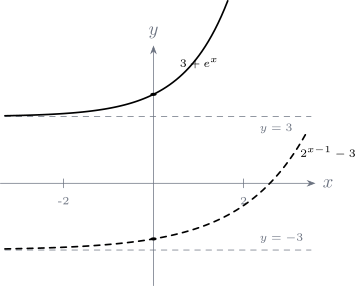
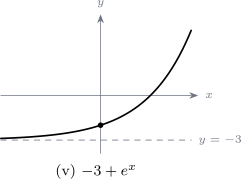
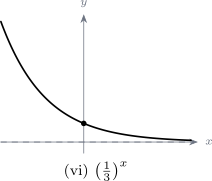
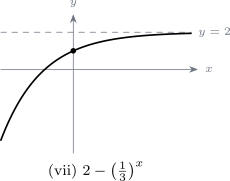
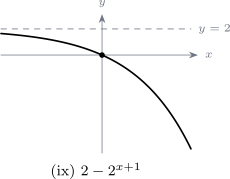
Note 6.14. The asymptote is the single most useful feature to mark first. A vertical shift moves it; a horizontal shift and a reflection in the \(x\)-axis do not. In (vii) and (ix) the minus sign flips the curve and the constant then lifts it, so the asymptote ends up at \(y=2\) and the curve approaches it from below.
Problem 6.2. Solve each equation. (i) \(4^x=256\), (ii) \(x^3=125\), (iii) \(\left (\frac {1}{2}\right )^x=\frac {1}{16}\), (iv) \(2^x=0.125\), (v) \(27^{4x}=9^{x+1}\), (vi) \(\left (\frac {1}{8}\right )^{-2t}=2^{t+3}\).
Show solution
Solution. The method is to write both sides as powers of the same base and then equate the indices.
(i). \(256=4^4\), so \[4^x=4^4\quad \implies \quad x=4.\]
(ii). This one is different — the unknown is in the base, not the index, so it is not an exponential equation at all. Take cube roots: \[x=\sqrt [3]{125}=5.\]
(iii). \(\frac {1}{16}=\left (\frac {1}{2}\right )^4\), so \[\left (\tfrac {1}{2}\right )^x=\left (\tfrac {1}{2}\right )^4\quad \implies \quad x=4.\]
(iv). \(0.125=\frac {1}{8}=2^{-3}\), so \[2^x=2^{-3}\quad \implies \quad x=-3.\]
(v). Write everything as a power of \(3\), using \(27=3^3\) and \(9=3^2\): \[\left (3^3\right )^{4x}=\left (3^2\right )^{x+1}\quad \implies \quad 3^{12x}=3^{2x+2},\] \[12x=2x+2\quad \implies \quad 10x=2\quad \implies \quad x=\tfrac {1}{5}.\]
(vi). Write everything as a power of \(2\), using \(\frac {1}{8}=2^{-3}\): \[\left (2^{-3}\right )^{-2t}=2^{t+3}\quad \implies \quad 2^{6t}=2^{t+3},\] \[6t=t+3\quad \implies \quad 5t=3\quad \implies \quad t=\tfrac {3}{5}.\]
Note 6.15. Part (ii) is there to catch people. In \(x^3=125\) the unknown is the base and the index is fixed, so the answer comes from a cube root; in every other part the base is fixed and the unknown is the index, so the answer comes from matching powers. Which position the \(x\) occupies decides the whole method.
Note 6.16. In (vi) two negatives multiply: \((-3)\times (-2t)=6t\). Getting \(-6t\) there gives \(t=-\frac {3}{7}\) and is the usual slip.
Problem 6.3. Solve each equation. (i) \(2^{2x}+3\left (2^x\right )-4=0\), (ii) \(4^x-2^{x+1}=48\), (iii) \(4^x-6\left (2^x\right )-16=0\), (iv) \(2^{2x+1}-2^{x+1}+1=2^x\).
Show solution
Solution. Each of these is a quadratic in disguise. The key identities are \[2^{2x}=\left (2^x\right )^2,\qquad 4^x=\left (2^2\right )^x=\left (2^x\right )^2,\qquad 2^{x+1}=2\cdot 2^x.\] So put \(u=2^x\) throughout, remembering that \(u>0\) always — a power of \(2\) is never zero or negative.
(i). With \(u=2^x\): \[u^2+3u-4=0\quad \implies \quad (u+4)(u-1)=0\quad \implies \quad u=-4 \text { or } u=1.\] Reject \(u=-4\), since \(2^x>0\). Then \[2^x=1\quad \implies \quad x=0.\]
(ii). Rewrite: \(4^x=u^2\) and \(2^{x+1}=2u\): \[u^2-2u=48\quad \implies \quad u^2-2u-48=0\quad \implies \quad (u-8)(u+6)=0.\] Reject \(u=-6\); then \(u=8\), so \[2^x=8=2^3\quad \implies \quad x=3.\]
(iii). \[u^2-6u-16=0\quad \implies \quad (u-8)(u+2)=0.\] Reject \(u=-2\); then \(2^x=8\), so \[x=3.\]
(iv). Here \(2^{2x+1}=2\cdot 2^{2x}=2u^2\) and \(2^{x+1}=2u\): \[2u^2-2u+1=u\quad \implies \quad 2u^2-3u+1=0\quad \implies \quad (2u-1)(u-1)=0,\] \[u=\tfrac {1}{2}\quad \text {or}\quad u=1.\] Both are positive, so both survive: \[2^x=\tfrac {1}{2}=2^{-1}\ \implies \ x=-1,\qquad 2^x=1\ \implies \ x=0.\] \[\therefore \quad x=-1 \text { or } x=0.\]
Note 6.17. The rejection step is not optional. In (i), (ii) and (iii) the quadratic has a negative root that has to be thrown out because \(2^x\) can never be negative, and writing \(2^x=-4\) and then trying to take logarithms is where the marks go. In (iv) both roots happen to be positive, so both are kept — the test has to be applied, not assumed one way or the other.
Note 6.18. \(2^{x+1}\) is \(2\cdot 2^x\) and not \(\left (2^x\right )^{\!2}\) or \(2^x+1\). Splitting the index correctly is what turns the equation into a quadratic; getting it wrong produces something that does not factorise at all, which is at least a signal that a step needs rechecking.
- (a).
- Write in logarithm form: (i) \(y=5^{x+2}\), (ii) \(\left (\frac {3}{4}\right )^{-2}=\frac {16}{9}\), (iii) \(y=e^x\), (iv) \(8^{-1}=0.125\).
- (b).
- Write in exponential form: (i) \(\log _2 32=5\), (ii) \(\log _2\left (\frac {1}{16}\right )=-4\), (iii) \(\log _{27}3=\frac {1}{3}\).
- (c).
- Evaluate: (i) \(\log _3 9\), (ii) \(\log _5 125\), (iii) \(\log _6\left (\frac {1}{36}\right )\).
Show solution
Solution. The two forms say the same thing: \[a^b=c\qquad \Longleftrightarrow \qquad \log _a c=b.\] In words: the logarithm is the index. The base stays the base, and the answer to the logarithm is the power.
(a). \[\text {(i) } y=5^{x+2}\quad \implies \quad \log _5 y=x+2\] \[\text {(ii) } \left (\tfrac {3}{4}\right )^{-2}=\tfrac {16}{9}\quad \implies \quad \log _{\frac {3}{4}}\left (\tfrac {16}{9}\right )=-2\] \[\text {(iii) } y=e^x\quad \implies \quad \log _e y=x,\ \text { usually written } \ln y=x\] \[\text {(iv) } 8^{-1}=0.125\quad \implies \quad \log _8(0.125)=-1\]
(b). \[\text {(i) } \log _2 32=5\quad \implies \quad 2^5=32\] \[\text {(ii) } \log _2\left (\tfrac {1}{16}\right )=-4\quad \implies \quad 2^{-4}=\tfrac {1}{16}\] \[\text {(iii) } \log _{27}3=\tfrac {1}{3}\quad \implies \quad 27^{\frac {1}{3}}=3\]
(c). Each asks: to what power must the base be raised? \[\text {(i) } 3^2=9\quad \implies \quad \log _3 9=2\] \[\text {(ii) } 5^3=125\quad \implies \quad \log _5 125=3\] \[\text {(iii) } 6^{-2}=\tfrac {1}{36}\quad \implies \quad \log _6\left (\tfrac {1}{36}\right )=-2\]
Note 6.19. A logarithm of a number smaller than \(1\) is negative, as in (a)(iv) and (c)(iii). A logarithm of a negative number does not exist at all, whatever the base — no power of a positive base is ever negative. That fact is what forces the domain checks in the next question.
Problem 6.5. Solve each equation. (i) \(\log _3 x=4\), (ii) \(\log _4 x=\frac {3}{2}\), (iii) \(\log _a 2=\frac {1}{2}\), (iv) \(\log _2(3x+4)=4\), (v) \(\ln x=-2\).
Show solution
Solution. Convert to exponential form and evaluate.
\[\text {(i) } \log _3 x=4\quad \implies \quad x=3^4=81.\]
\[\text {(ii) } \log _4 x=\tfrac {3}{2}\quad \implies \quad x=4^{\frac {3}{2}}=\left (\sqrt {4}\right )^3=2^3=8.\]
(iii). Here the unknown is the base: \[\log _a 2=\tfrac {1}{2}\quad \implies \quad a^{\frac {1}{2}}=2\quad \implies \quad \sqrt {a}=2\quad \implies \quad a=4.\]
\[\text {(iv) } \log _2(3x+4)=4\quad \implies \quad 3x+4=2^4=16\quad \implies \quad 3x=12\quad \implies \quad x=4.\] Check the argument is positive: \(3(4)+4=16>0\). \(\checkmark \)
\[\text {(v) } \ln x=-2\quad \implies \quad x=e^{-2}\approx 0.135.\]
Note 6.20. In (ii), a fractional index means root and power together: \(4^{3/2}\) is the square root of \(4\), cubed. Taking the \(\frac {3}{2}\) as multiplication and writing \(x=6\) is the error to avoid.
Problem 6.6. Solve each equation. (i) \(\log _5 x-\log _5 4=2\), (ii) \(\log _x 8+\log _x 4=5\), (iii) \(\log _3\left (x^2+2\right )=1+\log _3(x+2)\), (iv) \(\log _4\left (x^2+8x-1\right )=2+\log _4(x-1)\), (v) \(\log _3 x-\log _{\frac {1}{3}}x^2=6\), (vi) \(\log _2 x+\log _4 x+\log _{16}x=21\).
Show solution
Solution. The three laws needed throughout are \[\log _a M+\log _a N=\log _a(MN),\qquad \log _a M-\log _a N=\log _a\!\left (\frac {M}{N}\right ), \qquad \log _a\left (M^k\right )=k\log _a M.\]
(i). Combine the left side into one logarithm: \[\log _5\left (\frac {x}{4}\right )=2\quad \implies \quad \frac {x}{4}=5^2=25 \quad \implies \quad x=100.\]
(ii). The unknown is the base. Combining, \[\log _x(8\times 4)=\log _x 32=5\quad \implies \quad x^5=32\quad \implies \quad x=2.\]
(iii). Write the \(1\) as a logarithm to the same base: \(1=\log _3 3\). Then \[\log _3\left (x^2+2\right )=\log _3 3+\log _3(x+2)=\log _3\left [3(x+2)\right ].\] Since the logarithms have the same base, their arguments are equal: \[x^2+2=3x+6\quad \implies \quad x^2-3x-4=0\quad \implies \quad (x-4)(x+1)=0,\] giving \(x=4\) or \(x=-1\).
Check both against the domain. Every argument must be positive. At \(x=4\): \(x^2+2=18>0\) and \(x+2=6>0\). \(\checkmark \) At \(x=-1\): \(x^2+2=3>0\) and \(x+2=1>0\). \(\checkmark \) \[\therefore \quad x=4\ \text { or }\ x=-1.\]
(iv). Here \(2=\log _4 16\), so \[\log _4\left (x^2+8x-1\right )=\log _4\left [16(x-1)\right ],\] \[x^2+8x-1=16x-16\quad \implies \quad x^2-8x+15=0\quad \implies \quad (x-3)(x-5)=0,\] giving \(x=3\) or \(x=5\).
Check. At \(x=3\): \(x-1=2>0\) and \(x^2+8x-1=32>0\). \(\checkmark \) At \(x=5\): \(x-1=4>0\) and \(x^2+8x-1=64>0\). \(\checkmark \) \[\therefore \quad x=3\ \text { or }\ x=5.\]
(v). The second logarithm has base \(\frac {1}{3}\). Change it to base \(3\): \[\log _{\frac {1}{3}}x^2=\frac {\log _3 x^2}{\log _3\frac {1}{3}}=\frac {2\log _3 x}{-1} =-2\log _3 x,\] since \(\log _3\frac {1}{3}=\log _3 3^{-1}=-1\). Substituting, \[\log _3 x-\left (-2\log _3 x\right )=3\log _3 x=6\quad \implies \quad \log _3 x=2 \quad \implies \quad x=9.\]
(vi). Change every term to base \(2\), using \(4=2^2\) and \(16=2^4\): \[\log _4 x=\frac {\log _2 x}{\log _2 4}=\frac {\log _2 x}{2},\qquad \log _{16}x=\frac {\log _2 x}{\log _2 16}=\frac {\log _2 x}{4}.\] Writing \(L=\log _2 x\), \[L+\frac {L}{2}+\frac {L}{4}=21\quad \implies \quad \frac {4L+2L+L}{4}=\frac {7L}{4}=21 \quad \implies \quad L=12,\] \[\therefore \quad x=2^{12}=4096.\]
Note 6.21. The domain check in (iii) and (iv) is compulsory, not decoration. Combining logarithms can create solutions that satisfy the resulting polynomial while making one of the original arguments negative or zero, and those must be discarded. Here all four candidates happen to survive, but the check is what establishes that.
Note 6.22. Parts (v) and (vi) both come down to change of base. Once every logarithm is in one base it becomes a linear equation in \(\log _2 x\) or \(\log _3 x\), and the awkwardness disappears. Note \(\log _{1/a}M=-\log _a M\), which is worth remembering directly.
- (a).
- Sketch (i) \(f(x)=\log _7 x\), (ii) \(f(x)=\log _{\frac {1}{7}}x\), (iii) \(f(x)=-\log _3 x\), (iv) \(f(x)=\log _{\frac {1}{3}}x\).
- (b).
- Sketch \(f\) and \(g\) on the same axes: (i) \(f(x)=3^x\), \(g(x)=\log _3 x\); (ii) \(f(x)=\left (\frac {1}{2}\right )^x\), \(g(x)=\log _{\frac {1}{2}}x\); (iii) \(f(x)=e^x\), \(g(x)=\ln (x-3)\).
Show solution
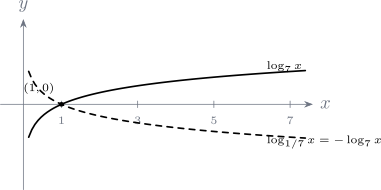
Solution. (a). Every logarithmic graph passes through \((1,0)\), has the \(y\)-axis as a vertical asymptote, and is defined only for \(x>0\). A base greater than \(1\) gives a rising curve; a base between \(0\) and \(1\) gives a falling one.
(i). \(\log _7 x\): rising, through \((1,0)\) and \((7,1)\).
(ii) and (iii) are the same curve. By change of base, \[\log _{\frac {1}{7}}x=\frac {\log _7 x}{\log _7\frac {1}{7}}=\frac {\log _7 x}{-1} =-\log _7 x,\] so (ii) is (i) reflected in the \(x\)-axis. And (iii), \(-\log _3 x\), is the same reflection applied to base \(3\) — which by the same identity equals \(\log _{\frac {1}{3}}x\), that is (iv).
\[\therefore \quad \text {(iii) and (iv) are identical functions.}\]
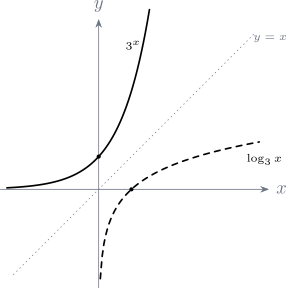
(b). In each of (i) and (ii), \(f\) and \(g\) are inverses of one another, so their graphs are reflections in the line \(y=x\). Where \(f\) passes through \((0,1)\), \(g\) passes through \((1,0)\); where \(f\) has the horizontal asymptote \(y=0\), \(g\) has the vertical asymptote \(x=0\).
(iii) is the exception. \(e^x\) and \(\ln x\) are inverses, but \(\ln (x-3)\) is \(\ln x\) shifted three units to the right, with vertical asymptote \(x=3\) and \(x\)-intercept at \(x=4\). So \(g\) is not the inverse of \(f\) here, and the two graphs are not reflections of each other in \(y=x\).
Note 6.23. The identity behind (a) is worth stating on its own: \[\log _{\frac {1}{a}}x=-\log _a x.\] It is why four apparently different sketches turn out to be only two curves.
- (a).
- The population of a town is modelled by \(p(t)=12500e^{0.015t}\). When will the population be \(25\,000\)?
- (b).
- The initial population of rabbits in a lab is \(20\). After \(100\) days the population is \(80\). When will it be \(200\)?
- (c).
- Wounds heal at a rate given by \(W=W_0e^{-0.25t}\), where \(W\) is the size of the wound after \(t\) days and \(W_0\) is its initial size. Initially the wound is \(25\) mm\(^2\). What is its size after \(4\) days?
Show solution
Solution. (a). Set the model equal to \(25\,000\): \[12500e^{0.015t}=25000\quad \implies \quad e^{0.015t}=2.\] Take natural logarithms of both sides, which is what undoes \(e\): \[0.015t=\ln 2\quad \implies \quad t=\frac {\ln 2}{0.015}=\frac {0.6931}{0.015} \approx 46.2.\] \[\therefore \quad \text {the population reaches } 25\,000 \text { after about } 46 \text { years}.\] Note this is the time to double, and it does not depend on the starting figure of \(12\,500\) — the \(12500\) cancelled at the first step.
(b). Here the growth rate is not given and must be found first. Write \[p(t)=20e^{kt}.\]
Find \(k\) from the information at \(t=100\): \[20e^{100k}=80\quad \implies \quad e^{100k}=4\quad \implies \quad 100k=\ln 4\] \[\implies \quad k=\frac {\ln 4}{100}=\frac {1.3863}{100}\approx 0.013863.\]
Now find \(t\) when \(p=200\): \[20e^{kt}=200\quad \implies \quad e^{kt}=10\quad \implies \quad kt=\ln 10\] \[\implies \quad t=\frac {\ln 10}{k}=\frac {2.3026}{0.013863}\approx 166.1.\] \[\therefore \quad \text {the population reaches } 200 \text { after about } 166 \text { days}.\]
(c). Substitute \(W_0=25\) and \(t=4\): \[W=25e^{-0.25(4)}=25e^{-1}=\frac {25}{2.7183}\approx 9.20.\] \[\therefore \quad \text {the wound is about } 9.2\text { mm}^2 \text { after } 4 \text { days}.\]
Note 6.24. Part (b) is a two-stage question and the first stage is easy to skip. The rate \(k\) has to be extracted from the pair of readings before the second question can be asked at all. Carry \(k\) at full accuracy into the second stage — rounding it to \(0.014\) gives \(164.5\) days instead of \(166.1\).
Note 6.25. The negative index in (c) is what makes it decay rather than growth: \(e^{-0.25t}\) falls towards zero as \(t\) increases, so the wound shrinks. It never quite reaches zero in the model, which is a limitation of the model rather than a statement about wounds.
Questions on this section
Stuck on something here? Ask below and it stays attached to this topic.