6.4 Graphs of logarithmic functions
\(y=\log _a x\) is the inverse of \(y=a^x\), so its graph is the exponential’s reflected in the line \(y=x\). Everything about it follows from that.
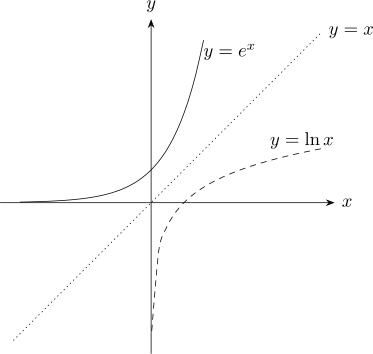
Note 6.13. Reflecting swaps the domain and range, so for \(y=\log _a x\) the domain is \((0,\infty )\) and the range is all of \(\mathbb {R}\). It passes through \((1,0)\), since \(\log _a 1=0\), and the \(y\)-axis is a vertical asymptote.
This is the same statement as “the logarithm of a negative number does not exist”, seen on a graph rather than in symbols: there is simply no curve to the left of the \(y\)-axis.
Questions on this section
Stuck on something here? Ask below and it stays attached to this topic.