7.8 Practice Problems
Tutorial Sheets 8, 9 and 10 in full. Work each question before opening the solution.
- (a).
- Find the second derivative of (i) \(y=\sqrt {x^2+1}\), (ii) \(y=\pi x^3-7x\), (iii) \(y=\frac {1}{x^2+1}\), (iv) \(y=\frac {x+1}{x-1}\).
- (b).
- Show that (i) if \(y=2\sec ^3x\) then \(\frac {dy}{dx}=6\sec ^3x\tan x\); (ii) if \(y=\sqrt [4]{x^2+1}\) then \(\frac {d^2y}{dx^2}=\frac {2-x^2}{4\left (x^2+1\right )^{7/4}}\).
Show solution
Solution. (a)(i). Write the root as a power and use the chain rule: \[y=\left (x^2+1\right )^{\frac {1}{2}},\qquad \frac {dy}{dx}=\tfrac {1}{2}\left (x^2+1\right )^{-\frac {1}{2}}\cdot 2x =x\left (x^2+1\right )^{-\frac {1}{2}}.\] Now the product rule, with a chain rule inside: \[\frac {d^2y}{dx^2}=1\cdot \left (x^2+1\right )^{-\frac {1}{2}} +x\cdot \left (-\tfrac {1}{2}\right )\left (x^2+1\right )^{-\frac {3}{2}}\cdot 2x =\left (x^2+1\right )^{-\frac {1}{2}}-x^2\left (x^2+1\right )^{-\frac {3}{2}}.\] Take out the lower power as a common factor: \[=\left (x^2+1\right )^{-\frac {3}{2}}\left [\left (x^2+1\right )-x^2\right ] =\frac {1}{\left (x^2+1\right )^{\frac {3}{2}}}.\]
(ii). Here \(\pi \) is just a number: \[\frac {dy}{dx}=3\pi x^2-7,\qquad \frac {d^2y}{dx^2}=6\pi x.\]
(iii). Write as a power: \[y=\left (x^2+1\right )^{-1},\qquad \frac {dy}{dx}=-\left (x^2+1\right )^{-2}\cdot 2x=\frac {-2x}{\left (x^2+1\right )^2}.\] Differentiating again by the product rule on \(-2x\left (x^2+1\right )^{-2}\): \[\frac {d^2y}{dx^2}=-2\left (x^2+1\right )^{-2} +(-2x)(-2)\left (x^2+1\right )^{-3}\cdot 2x =-2\left (x^2+1\right )^{-2}+8x^2\left (x^2+1\right )^{-3}\] \[=\left (x^2+1\right )^{-3}\left [-2\left (x^2+1\right )+8x^2\right ] =\frac {6x^2-2}{\left (x^2+1\right )^3}=\frac {2\left (3x^2-1\right )}{\left (x^2+1\right )^3}.\]
(iv). Quotient rule first: \[\frac {dy}{dx}=\frac {1(x-1)-(x+1)(1)}{(x-1)^2}=\frac {-2}{(x-1)^2}=-2(x-1)^{-2}.\] Then the chain rule on the power form: \[\frac {d^2y}{dx^2}=-2(-2)(x-1)^{-3}=\frac {4}{(x-1)^3}.\]
(b)(i). Write \(y=2\left (\sec x\right )^3\) and use the chain rule with \(\frac {d}{dx}\sec x=\sec x\tan x\): \[\frac {dy}{dx}=2\cdot 3\left (\sec x\right )^2\cdot \sec x\tan x =6\sec ^3x\tan x.\qquad \blacksquare \]
(b)(ii). With \(y=\left (x^2+1\right )^{\frac {1}{4}}\), \[\frac {dy}{dx}=\tfrac {1}{4}\left (x^2+1\right )^{-\frac {3}{4}}\cdot 2x =\tfrac {1}{2}x\left (x^2+1\right )^{-\frac {3}{4}}.\] Product rule again: \[\frac {d^2y}{dx^2}=\tfrac {1}{2}\left (x^2+1\right )^{-\frac {3}{4}} +\tfrac {1}{2}x\left (-\tfrac {3}{4}\right )\left (x^2+1\right )^{-\frac {7}{4}}\cdot 2x\] \[=\tfrac {1}{2}\left (x^2+1\right )^{-\frac {3}{4}} -\tfrac {3}{4}x^2\left (x^2+1\right )^{-\frac {7}{4}}.\] Factor out \(\frac {1}{4}\left (x^2+1\right )^{-\frac {7}{4}}\): \[=\tfrac {1}{4}\left (x^2+1\right )^{-\frac {7}{4}} \left [2\left (x^2+1\right )-3x^2\right ] =\frac {2-x^2}{4\left (x^2+1\right )^{\frac {7}{4}}}.\qquad \blacksquare \]
Note 7.44. In (a)(i), (a)(iii) and (b)(ii) the same manoeuvre finishes the job: after the second differentiation, factor out the lowest power of the bracket. Trying to combine the two terms over a common denominator instead works, but takes twice as long and introduces more chances to slip.
Note 7.45. Converting a quotient into an index form before the second differentiation, as in (iv), turns a second quotient rule into a one-line chain rule.
- (a).
- Find the gradient at the value of \(x\) given. (i) \(f(x)=\sqrt {x^2+16}\) at \(x=3\), (ii) \(f(x)=\frac {x+3}{x-4}\) at \(x=-3\), (iii) \(f(x)=(\ln x)^2\) at \(x=1\).
- (b).
- Find the point at which (i) the gradient of \(f(x)=5+3x-x^3\) is \(3\); (ii) the gradient of \(f(x)=\sin x\) is \(-1\), for \(0\leq x\leq 2\pi \); (iii) the gradient of \(f(x)=\cos x\) is \(\frac {1}{2}\), for \(0\leq x\leq 2\pi \).
Show solution
Solution. (a)(i). \[f'(x)=\tfrac {1}{2}\left (x^2+16\right )^{-\frac {1}{2}}\cdot 2x =\frac {x}{\sqrt {x^2+16}},\qquad f'(3)=\frac {3}{\sqrt {9+16}}=\frac {3}{5}.\]
(ii). By the quotient rule, \[f'(x)=\frac {1(x-4)-(x+3)(1)}{(x-4)^2}=\frac {-7}{(x-4)^2},\] \[f'(-3)=\frac {-7}{(-7)^2}=\frac {-7}{49}=-\frac {1}{7}.\]
(iii). Chain rule with \(\frac {d}{dx}\ln x=\frac {1}{x}\): \[f'(x)=2\ln x\cdot \frac {1}{x}=\frac {2\ln x}{x},\qquad f'(1)=\frac {2\ln 1}{1}=\frac {0}{1}=0.\]
(b)(i). \[f'(x)=3-3x^2=3\quad \implies \quad -3x^2=0\quad \implies \quad x=0.\] The \(y\)-coordinate is \(f(0)=5\), so the point is \((0,5)\).
(ii). \[f'(x)=\cos x=-1\quad \implies \quad x=\pi \ \text { (the only value in } [0,2\pi ]).\] Then \(f(\pi )=\sin \pi =0\), so the point is \((\pi ,0)\).
(iii). \[f'(x)=-\sin x=\tfrac {1}{2}\quad \implies \quad \sin x=-\tfrac {1}{2}.\] Sine is negative in quadrants III and IV, with reference angle \(\frac {\pi }{6}\): \[x=\tfrac {7\pi }{6}\quad \text {or}\quad x=\tfrac {11\pi }{6}.\] The corresponding \(y\)-values are \[\cos \tfrac {7\pi }{6}=-\tfrac {\sqrt {3}}{2},\qquad \cos \tfrac {11\pi }{6}=\tfrac {\sqrt {3}}{2},\] so the points are \(\left (\frac {7\pi }{6},-\frac {\sqrt {3}}{2}\right )\) and \(\left (\frac {11\pi }{6},\frac {\sqrt {3}}{2}\right )\).
Note 7.46. The question asks for the point, so both coordinates are needed. Stopping at the \(x\)-value answers only half of it — a mistake that costs marks in (b) far more often than the calculus does.
Note 7.47. Part (a)(iii) gives gradient zero, because \(\ln 1=0\). That means \(y=(\ln x)^2\) has a horizontal tangent at \(x=1\); it is in fact the minimum of the function, since a square cannot be negative.
Problem 7.3. A curve has equation \(y=e^{2x}\cos x+1\). Find the equations of the tangent and the normal at the point \(P(0,2)\).
Show solution
Solution. Step 1 — confirm \(P\) is on the curve. \[y(0)=e^0\cos 0+1=1\cdot 1+1=2.\ \checkmark \]
Step 2 — differentiate. A product, with a chain rule in the first factor: \[\frac {dy}{dx}=\frac {d}{dx}\left (e^{2x}\right )\cos x +e^{2x}\frac {d}{dx}(\cos x)=2e^{2x}\cos x-e^{2x}\sin x =e^{2x}\left (2\cos x-\sin x\right ).\]
Step 3 — evaluate at \(x=0\). \[\left .\frac {dy}{dx}\right |_{x=0}=e^0\left (2\cos 0-\sin 0\right )=1(2-0)=2.\]
Step 4 — write down the two lines. Both pass through \((0,2)\).
Tangent, gradient \(2\): \[y-2=2(x-0)\quad \implies \quad y=2x+2.\]
Normal, gradient \(-\frac {1}{2}\): \[y-2=-\tfrac {1}{2}(x-0)\quad \implies \quad y=-\tfrac {1}{2}x+2, \quad \text {or}\quad x+2y=4.\]
Note 7.48. The derivative of the constant \(1\) is zero, so it plays no part in the gradient — but it does affect the point, which is why \(P\) is at height \(2\) rather than \(1\). Constants matter for position and not for slope.
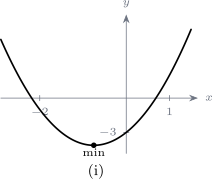
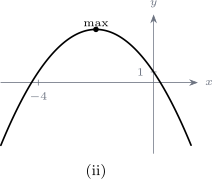
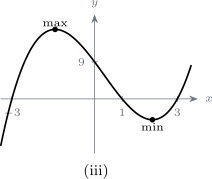
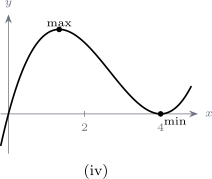
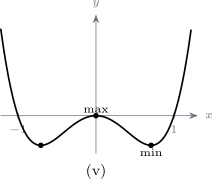
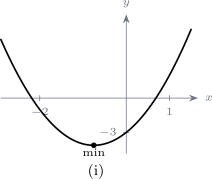
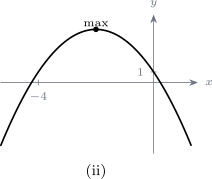
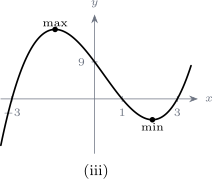
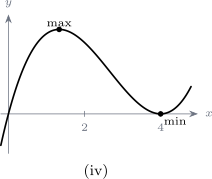
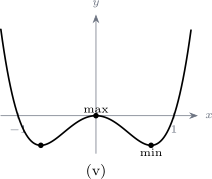
Problem 7.4. Find where \(f\) is increasing and where it is decreasing, and hence sketch the graph. (i) \(f(x)=2x^2+3x-3\), (ii) \(f(x)=-x^2-4x+1\), (iii) \(f(x)=x^3-x^2-9x+9\), (iv) \(f(x)=2x(4-x)^2\), (v) \(f(x)=x^4-x^2\).
Show solution
Solution. (i). \(f'(x)=4x+3\), zero at \(x=-\frac {3}{4}\). It is negative to the left of that and positive to the right: \[\text {decreasing for } x<-\tfrac {3}{4},\qquad \text {increasing for } x>-\tfrac {3}{4}.\] An upward parabola with minimum at \(x=-\frac {3}{4}\).
(ii). \(f'(x)=-2x-4=-2(x+2)\), zero at \(x=-2\): \[\text {increasing for } x<-2,\qquad \text {decreasing for } x>-2.\] A downward parabola with maximum at \(x=-2\).
(iii). \(f'(x)=3x^2-2x-9\), which does not factorise. By the quadratic formula, \[x=\frac {2\pm \sqrt {4+108}}{6}=\frac {2\pm \sqrt {112}}{6}=\frac {1\pm 2\sqrt {7}}{3} \approx -1.43 \text { and } 2.10.\] Since \(f'\) is an upward parabola it is positive outside these values: \[\text {increasing for } x<\tfrac {1-2\sqrt {7}}{3} \text { and } x>\tfrac {1+2\sqrt {7}}{3},\qquad \text {decreasing between them}.\] For the sketch, note \(f(x)=x^2(x-1)-9(x-1)=(x-1)\left (x^2-9\right )=(x-1)(x-3)(x+3)\), so the roots are \(-3\), \(1\) and \(3\), and \(f(0)=9\).
(iv). Expand before differentiating: \[f(x)=2x\left (16-8x+x^2\right )=2x^3-16x^2+32x,\] \[f'(x)=6x^2-32x+32=2\left (3x^2-16x+16\right )=2(3x-4)(x-4),\] zero at \(x=\frac {4}{3}\) and \(x=4\). As an upward parabola \(f'\) is positive outside: \[\text {increasing for } x<\tfrac {4}{3} \text { and } x>4,\qquad \text {decreasing for } \tfrac {4}{3}<x<4.\]
(v). \(f'(x)=4x^3-2x=2x\left (2x^2-1\right )\), zero at \[x=0,\qquad x=\pm \tfrac {1}{\sqrt {2}}=\pm \tfrac {\sqrt {2}}{2}\approx \pm 0.707.\] Testing the sign in each of the four intervals:
| \(x<-\frac {\sqrt {2}}{2}\) | \(-\frac {\sqrt {2}}{2}<x<0\) | \(0<x<\frac {\sqrt {2}}{2}\) | \(x>\frac {\sqrt {2}}{2}\) | |
| \(2x\) | \(-\) | \(-\) | \(+\) | \(+\) |
| \(2x^2-1\) | \(+\) | \(-\) | \(-\) | \(+\) |
| \(f'(x)\) | \(-\) | \(+\) | \(-\) | \(+\) |
| decreasing | increasing | decreasing | increasing | |
A W-shape, with two minima at \(x=\pm \frac {\sqrt {2}}{2}\) and a local maximum at the origin.
Note 7.49. In (iv) it is much quicker to multiply out first. Differentiating \(2x(4-x)^2\) by the product and chain rules gives the same answer, but the factorising afterwards is messier.
Note 7.50. Part (iii) is a reminder that a derivative need not factorise. When it does not, the quadratic formula gives the critical values exactly, and \(\frac {1\pm 2\sqrt {7}}{3}\) is a perfectly acceptable final answer — decimals are only for the sketch.
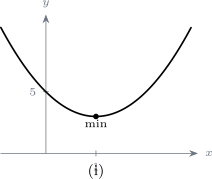
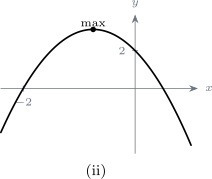
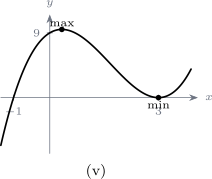
Problem 7.5. Find the \(x\)-value(s) of the stationary point(s), determine their nature by the second derivative test, and hence sketch the graph. (i) \(f(x)=2x^2-4x+5\), (ii) \(f(x)=-2x^2-3x+2\), (iii) \(f(x)=4x^3+9x^2-x-6\), (iv) \(f(x)=x^3-5x^2-22x+56\), (v) \(f(x)=x^3-5x^2+3x+9\), (vi) \(f(x)=x^4+4x^3-12x^2\).
Show solution
Solution. (i). \(f'(x)=4x-4=0\) gives \(x=1\); \(f''(x)=4>0\), so a minimum, at \(f(1)=2-4+5=3\). Point \((1,3)\).
(ii). \(f'(x)=-4x-3=0\) gives \(x=-\frac {3}{4}\); \(f''(x)=-4<0\), so a maximum, at \[f\left (-\tfrac {3}{4}\right )=-2\left (\tfrac {9}{16}\right )+\tfrac {9}{4}+2 =-\tfrac {9}{8}+\tfrac {18}{8}+\tfrac {16}{8}=\tfrac {25}{8}.\] Point \(\left (-\frac {3}{4},\frac {25}{8}\right )\).
(iii). \(f'(x)=12x^2+18x-1=0\), which does not factorise: \[x=\frac {-18\pm \sqrt {324+48}}{24}=\frac {-18\pm \sqrt {372}}{24} =\frac {-9\pm \sqrt {93}}{12}\approx 0.054 \text { and } -1.554.\] \(f''(x)=24x+18\). At \(x=\frac {-9+\sqrt {93}}{12}\), \(f''=2\sqrt {93}>0\), a minimum; at \(x=\frac {-9-\sqrt {93}}{12}\), \(f''=-2\sqrt {93}<0\), a maximum. From Sheet 4 the roots are \(-2\), \(-1\) and \(\frac {3}{4}\), and \(f(0)=-6\).
(iv). \(f'(x)=3x^2-10x-22=0\): \[x=\frac {10\pm \sqrt {100+264}}{6}=\frac {10\pm \sqrt {364}}{6}=\frac {5\pm \sqrt {91}}{3} \approx -1.51 \text { and } 4.85.\] \(f''(x)=6x-10\). At \(x=\frac {5+\sqrt {91}}{3}\), \(f''=2\sqrt {91}>0\), a minimum; at \(x=\frac {5-\sqrt {91}}{3}\), \(f''=-2\sqrt {91}<0\), a maximum. From Sheet 4 the roots are \(-4\), \(2\) and \(7\), and \(f(0)=56\).
(v). \(f'(x)=3x^2-10x+3=(3x-1)(x-3)=0\), giving \(x=\frac {1}{3}\) and \(x=3\). \(f''(x)=6x-10\): \[f''\left (\tfrac {1}{3}\right )=2-10=-8<0\quad \implies \quad \textbf {maximum},\] \[f''(3)=18-10=8>0\quad \implies \quad \textbf {minimum}.\] The values are \[f\left (\tfrac {1}{3}\right )=\tfrac {1}{27}-\tfrac {5}{9}+1+9=\tfrac {256}{27} \approx 9.48,\qquad f(3)=27-45+9+9=0.\] Note \(f(3)=0\) is a repeated root — from Sheet 4, \(f(x)=(x-3)^2(x+1)\) — so the minimum sits exactly on the \(x\)-axis.
(vi). \(f'(x)=4x^3+12x^2-24x=4x\left (x^2+3x-6\right )=0\), giving \[x=0\qquad \text {and}\qquad x=\frac {-3\pm \sqrt {9+24}}{2}=\frac {-3\pm \sqrt {33}}{2} \approx 1.37 \text { and } -4.37.\] \(f''(x)=12x^2+24x-24=12\left (x^2+2x-2\right )\): \[f''(0)=-24<0\quad \implies \quad \textbf {maximum at } x=0,\ f(0)=0.\] For the other two, \(x^2=-3x+6\) from the first-derivative equation, so \[f''=12\left (-3x+6+2x-2\right )=12(4-x),\] giving \(f''\approx 12(2.63)>0\) and \(f''\approx 12(8.37)>0\): both minima. From Sheet 4, \(f(x)=x^2(x+6)(x-2)\), so the roots are \(-6\), \(0\) (twice) and \(2\).
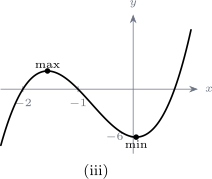
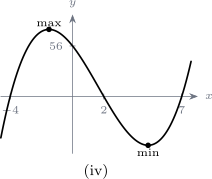
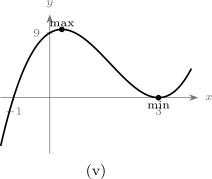
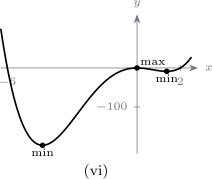
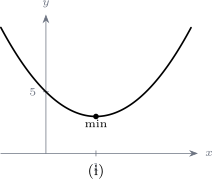
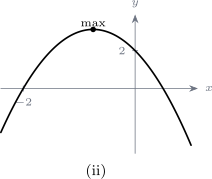
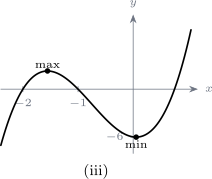
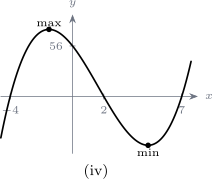
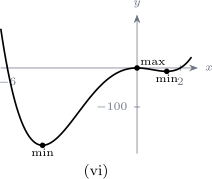
Note 7.51. Part (vi) shows a shortcut worth having. Rather than substituting an awkward surd into \(f''\), use the equation \(f'=0\) itself to replace \(x^2\), which reduced \(f''\) to the linear \(12(4-x)\) and made both signs obvious at a glance.
Note 7.52. In (v) the minimum lies on the \(x\)-axis because \(x=3\) is a repeated root of \(f\). A repeated root always produces a stationary point there, since the curve touches the axis and turns — so factorising first can tell you where one of the turning points is before any differentiation.
- (a).
- Find the equations of the tangent and normal to \(y=\frac {x^3}{5}\) at \((-1,-0.2)\).
- (b).
- Let \(P(x)=-0.01x^2+550x-10\,000\) be a monopolist’s profit function. Find the value of \(x\) that maximises the profit, and the corresponding profit.
- (c).
- A lidless box with square ends is to be made from thin sheet metal. Determine the least area of metal for which the box has volume \(3.5\) m\(^3\).
Show solution
Solution. (a). Check the point: \(\frac {(-1)^3}{5}=-\frac {1}{5}=-0.2\). \(\checkmark \) \[\frac {dy}{dx}=\frac {3x^2}{5},\qquad \left .\frac {dy}{dx}\right |_{x=-1}=\frac {3}{5}.\]
Tangent, gradient \(\frac {3}{5}\) through \((-1,-0.2)\): \[y+\tfrac {1}{5}=\tfrac {3}{5}(x+1)\quad \implies \quad y=\tfrac {3}{5}x+\tfrac {3}{5} -\tfrac {1}{5}=\tfrac {3}{5}x+\tfrac {2}{5}.\]
Normal, gradient \(-\frac {5}{3}\): \[y+\tfrac {1}{5}=-\tfrac {5}{3}(x+1)\quad \implies \quad y=-\tfrac {5}{3}x-\tfrac {5}{3}-\tfrac {1}{5}=-\tfrac {5}{3}x-\tfrac {28}{15}.\]
(b). \[P'(x)=-0.02x+550=0\quad \implies \quad x=\frac {550}{0.02}=27\,500.\] \[P''(x)=-0.02<0,\] so this is a maximum. The profit there is \[P(27\,500)=-0.01(27\,500)^2+550(27\,500)-10\,000\] \[=-7\,562\,500+15\,125\,000-10\,000=7\,552\,500.\] \[\therefore \quad \text {producing } 27\,500 \text { units gives a maximum profit of } 7\,552\,500.\]
(c). Step 1 — name the dimensions. The ends are square, so let each end be \(x\times x\) and let the length be \(y\).
Step 2 — use the volume to eliminate \(y\). \[x^2y=3.5\quad \implies \quad y=\frac {3.5}{x^2}.\]
Step 3 — write down the area. The box has two square ends, a base and two sides, but no lid: \[A=2x^2+3xy.\] Substituting for \(y\), \[A=2x^2+3x\cdot \frac {3.5}{x^2}=2x^2+\frac {10.5}{x}=2x^2+10.5x^{-1}.\]
Step 4 — minimise. \[\frac {dA}{dx}=4x-10.5x^{-2}=0\quad \implies \quad 4x=\frac {10.5}{x^2} \quad \implies \quad x^3=\frac {10.5}{4}=2.625,\] \[x=\sqrt [3]{2.625}\approx 1.3795.\]
Step 5 — confirm it is a minimum. \[\frac {d^2A}{dx^2}=4+21x^{-3},\] which is positive for every \(x>0\), so the stationary point is a minimum.
Step 6 — find the area. \[A=2(1.3795)^2+\frac {10.5}{1.3795}=3.807+7.611\approx 11.42.\] \[\therefore \quad \text {the least area of metal is about } 11.42\text { m}^2,\] with the box measuring about \(1.38\) m \(\times \ 1.38\) m \(\times \ 1.84\) m.
Note 7.53. Everything in (c) turns on Step 3: counting the faces correctly. “Lidless” removes one of the two \(x\times y\) faces, giving \(2x^2+3xy\) and not \(2x^2+4xy\). Using the closed-box formula gives \(x\approx 1.19\) and an area of about \(12.9\) m\(^2\) — a plausible-looking answer to a different question.
Problem 7.7. A taxi is driven between Matero and Chelstone. In a simple model, the cost of the journey in kwacha when the taxi is driven at a steady \(v\) kilometres per hour is \[C(v)=\frac {1500}{v}+\frac {2v}{11}+60.\]
- (a).
- Find (i) the value of \(v\) that minimises the cost, and (ii) the minimum cost.
- (b).
- Prove, using \(\frac {d^2C}{dv^2}\), that the cost is minimised at that speed.
Show solution
Solution. (a)(i). Write the first term as a power before differentiating: \[C(v)=1500v^{-1}+\tfrac {2}{11}v+60,\] \[\frac {dC}{dv}=-1500v^{-2}+\tfrac {2}{11}=0\quad \implies \quad \frac {1500}{v^2}=\frac {2}{11}.\] Cross-multiplying, \[2v^2=16\,500\quad \implies \quad v^2=8250\quad \implies \quad v=\sqrt {8250}=5\sqrt {330}\approx 90.83.\] Only the positive root is meaningful, since \(v\) is a speed. \[\therefore \quad v\approx 90.8\text { km/h}.\]
(ii). \[C(90.83)=\frac {1500}{90.83}+\frac {2(90.83)}{11}+60=16.51+16.51+60=93.03.\] \[\therefore \quad \text {the minimum cost is about K}93.03.\]
(b). Differentiating \(\frac {dC}{dv}=-1500v^{-2}+\frac {2}{11}\) again: \[\frac {d^2C}{dv^2}=3000v^{-3}=\frac {3000}{v^3}.\] For any speed \(v>0\) this is positive, and in particular \[\left .\frac {d^2C}{dv^2}\right |_{v=90.83}=\frac {3000}{(90.83)^3}\approx 0.004>0,\] so the stationary point is a minimum. \(\blacksquare \)
Note 7.54. The two contributions to the cost happen to be equal at the optimum — \(16.51\) each. That is not a coincidence. Setting \(\frac {1500}{v}=\frac {2v}{11}\) gives exactly the same equation as \(C'(v)=0\), and whenever a cost is the sum of a term in \(\frac {1}{v}\) and a term in \(v\), the minimum is where the two balance.
Note 7.55. Part (b) asks for a proof using the second derivative, so it is not enough to observe that the cost is higher on either side. Note also that \(\frac {3000}{v^3}>0\) for all \(v>0\), which shows the curve bends upward everywhere in the sensible range — so there is only one turning point and it is the minimum.
Problem 7.8. Determine whether the limit exists at the given value of \(x\).
- (a).
- \(f(x)=\begin {cases}10 & x\geq 0\\ -10 & x<0\end {cases}\) at \(x=0\)
- (b).
- \(f(x)=\begin {cases}7x-2 & x\geq 2\\ 3x^2+5 & x<2\end {cases}\) at \(x=2\)
- (c).
- \(f(x)=\begin {cases}x+2 & x<2\\ 2x+2 & x\geq 2\end {cases}\) at \(x=2\)
- (d).
- \(f(x)=\begin {cases}x^2 & x<-2\\ -3x & x\geq -2\end {cases}\) at \(x=-2\)
- (e).
- \(f(x)=\begin {cases}x-1 & x<1\\ -x+1 & x\geq 1\end {cases}\) at \(x=1\)
- (f).
- \(f(x)=\frac {x^2-x-2}{x-2}\), \(x\neq 2\), at \(x=2\)
Show solution
Solution. The limit exists exactly when the two one-sided limits agree.
| Left-hand limit | Right-hand limit | Conclusion | |
| (a) | \(-10\) | \(10\) | do not agree; limit does not exist |
| (b) | \(3(4)+5=17\) | \(7(2)-2=12\) | do not agree; does not exist |
| (c) | \(2+2=4\) | \(2(2)+2=6\) | do not agree; does not exist |
| (d) | \((-2)^2=4\) | \(-3(-2)=6\) | do not agree; does not exist |
| (e) | \(1-1=0\) | \(-1+1=0\) | agree; limit exists and equals \(0\) |
| (f) | \(3\) | \(3\) | agree; limit exists and equals \(3\) |
Two worth setting out.
(e). From the left the first rule applies, from the right the second: \[\lim _{x\to 1^-}(x-1)=0,\qquad \lim _{x\to 1^+}(-x+1)=0.\] They agree, so \(\lim _{x\to 1}f(x)=0\). The two pieces meet, and the graph has a corner there but no break.
(f). Substituting gives \(\frac {0}{0}\), so factorise: \[\frac {x^2-x-2}{x-2}=\frac {(x-2)(x+1)}{x-2}=x+1\quad (x\neq 2),\] \[\lim _{x\to 2}f(x)=\lim _{x\to 2}(x+1)=3.\] Note \(f(2)\) itself does not exist, yet the limit does.
Note 7.56. Parts (e) and (f) are the two ways a limit can behave well. In (e) the function is defined at the point and the limit matches it. In (f) the function is not defined at the point at all, and the limit exists anyway. A limit describes where the function is heading, not where it arrives.
Problem 7.9. Evaluate each limit. (a) \(\lim _{x\to 5}\frac {x^2-x-5}{x-5}\), (b) \(\lim _{x\to 3}\frac {2x}{x-3}\), (c) \(\lim _{x\to 3}\frac {x^2-3}{x^2-9}\), (d) \(\lim _{x\to 0}\frac {2(-3+x)^2-18}{x}\), (e) \(\lim _{x\to 2}\sqrt {\frac {x^2-3x+2}{x^2-4}}\), (f) \(\lim _{x\to 1}\frac {x^3-1}{x-1}\).
Show solution
Solution.
Note 7.57. Before doing anything, substitute and see which of three things happens. A finite answer is the answer. \(\frac {0}{0}\) means factorise. And a non-zero number over zero means the limit does not exist — the function is blowing up, and no amount of algebra will change that.
(a). At \(x=5\) the numerator is \(25-5-5=15\) and the denominator is \(0\). This is \(\frac {15}{0}\), not \(\frac {0}{0}\): \[\lim _{x\to 5^-}\frac {x^2-x-5}{x-5}=-\infty ,\qquad \lim _{x\to 5^+}\frac {x^2-x-5}{x-5}=+\infty ,\] since the numerator stays near \(15\) while the denominator is small and negative on the left, small and positive on the right. \[\therefore \quad \text {the limit \textbf {does not exist}}.\]
(b). At \(x=3\) the numerator is \(6\) and the denominator \(0\). Same situation: \[\therefore \quad \text {the limit \textbf {does not exist}} \text { (}-\infty \text { from the left, } +\infty \text { from the right)}.\]
(c). At \(x=3\) the numerator is \(9-3=6\) and the denominator \(9-9=0\). Again \(\frac {6}{0}\): \[\therefore \quad \text {the limit \textbf {does not exist}}.\]
(d). Substituting gives \(\frac {2(9)-18}{0}=\frac {0}{0}\), so expand: \[2(-3+x)^2-18=2\left (9-6x+x^2\right )-18=18-12x+2x^2-18=2x^2-12x=x(2x-12).\] \[\therefore \quad \lim _{x\to 0}\frac {x(2x-12)}{x}=\lim _{x\to 0}(2x-12)=-12.\]
(e). Inside the root, substituting gives \(\frac {4-6+2}{4-4}=\frac {0}{0}\), so factorise: \[\frac {x^2-3x+2}{x^2-4}=\frac {(x-1)(x-2)}{(x-2)(x+2)}=\frac {x-1}{x+2}\quad (x\neq 2).\] \[\therefore \quad \lim _{x\to 2}\sqrt {\frac {x-1}{x+2}}=\sqrt {\frac {1}{4}}=\frac {1}{2}.\]
(f). \(\frac {0}{0}\), and \(x^3-1\) is a difference of cubes: \[\frac {x^3-1}{x-1}=\frac {(x-1)\left (x^2+x+1\right )}{x-1}=x^2+x+1,\] \[\therefore \quad \lim _{x\to 1}\left (x^2+x+1\right )=1+1+1=3.\]
Note 7.58. The first three parts all have the answer “does not exist”, and the last three are all \(\frac {0}{0}\) with genuine limits. The sheet is contrasting the two situations deliberately. The test is simply whether the numerator is also zero: if it is, there is a common factor to cancel; if it is not, the function is heading to infinity.
Problem 7.10. Evaluate each limit. (a) \(\lim _{x\to -\infty }\left (3x^4-x^2+x-7\right )\), (b) \(\lim _{x\to \infty }\frac {2x+5}{x^2-7x+3}\), (c) \(\lim _{x\to \infty }\frac {3x^3-4x+2}{7x^3+5}\), (d) \(\lim _{x\to \infty }\frac {2x-1}{x-1}\), (e) \(\lim _{x\to \infty }\frac {4x^5-1}{3x^3+7}\), (f) \(\lim _{x\to \infty }\left (2x^{11}-5x^6+3x^2+1\right )\).
Show solution
Solution. For a polynomial, the highest power decides everything. For a rational function, divide top and bottom by the highest power in the denominator and use \(\frac {1}{x^n}\to 0\).
(a). The leading term is \(3x^4\). As \(x\to -\infty \), \(x^4\) is positive and grows without bound: \[\lim _{x\to -\infty }\left (3x^4-x^2+x-7\right )=+\infty .\]
(b). Divide by \(x^2\): \[\frac {\frac {2}{x}+\frac {5}{x^2}}{1-\frac {7}{x}+\frac {3}{x^2}} \longrightarrow \frac {0+0}{1-0+0}=0.\]
(c). Divide by \(x^3\): \[\frac {3-\frac {4}{x^2}+\frac {2}{x^3}}{7+\frac {5}{x^3}}\longrightarrow \frac {3}{7}.\]
(d). Divide by \(x\): \[\frac {2-\frac {1}{x}}{1-\frac {1}{x}}\longrightarrow \frac {2}{1}=2.\]
(e). Divide by \(x^3\): \[\frac {4x^2-\frac {1}{x^3}}{3+\frac {7}{x^3}}\longrightarrow \frac {4x^2}{3},\] and \(4x^2\) grows without bound, so the limit is \(+\infty \) — it does not exist as a finite number.
(f). The leading term is \(2x^{11}\), which grows without bound as \(x\to \infty \): \[\lim _{x\to \infty }\left (2x^{11}-5x^6+3x^2+1\right )=+\infty .\]
Note 7.59. For rational functions the three outcomes can be predicted from the degrees alone: top degree lower gives \(0\), as in (b); equal gives the ratio of leading coefficients, as in (c) and (d); top degree higher gives no finite limit, as in (e). Doing the division afterwards confirms it, and is what the working should show.
Note 7.60. In (a) the direction matters and the even power saves it. \(x^4\) is positive whether \(x\) is large positive or large negative, so both one-sided answers are \(+\infty \). Had the leading term been \(3x^3\), the answer as \(x\to -\infty \) would have been \(-\infty \).
Problem 7.11. Discuss the continuity of each function at the given value of \(x\).
- (a).
- \(f(x)=\begin {cases}x^2 & x\geq 0\\ x & x<0\end {cases}\) at \(x=0\)
- (b).
- \(f(x)=\begin {cases}1 & x\geq 0\\ -1 & x<0\end {cases}\) at \(x=0\)
- (c).
- \(f(x)=\frac {x^2-4}{x+2}\), \(x\neq 2\), at \(x=-2\)
- (d).
- \(f(x)=\begin {cases}2x-1 & 1<x<2\\ x-1 & x\leq 1\end {cases}\) at \(x=1\) and \(x=2\)
Show solution
Solution. Recall the three conditions: \(f(a)\) defined, the limit existing, and the two being equal.
(a). \(f(0)=0^2=0\), defined. The one-sided limits are \[\lim _{x\to 0^-}x=0,\qquad \lim _{x\to 0^+}x^2=0,\] which agree, so the limit is \(0\) and equals \(f(0)\). All three conditions hold: \(f\) is continuous at \(x=0\).
(b). \(f(0)=1\), defined. But \[\lim _{x\to 0^-}(-1)=-1,\qquad \lim _{x\to 0^+}1=1,\] which disagree, so the limit does not exist. The second condition fails: \(f\) is discontinuous at \(x=0\), with a jump of size \(2\).
(c). At \(x=-2\) the denominator is zero, so \(f(-2)\) is not defined and the first condition fails outright: \(f\) is discontinuous at \(x=-2\). The limit nevertheless exists, \[\lim _{x\to -2}\frac {(x-2)(x+2)}{x+2}=\lim _{x\to -2}(x-2)=-4,\] so the graph has a hole at \((-2,-4)\) rather than a break. Defining \(f(-2)=-4\) would repair it.
(d). At \(x=1\): \(f(1)=1-1=0\), defined. The one-sided limits are \[\lim _{x\to 1^-}(x-1)=0,\qquad \lim _{x\to 1^+}(2x-1)=1,\] which disagree, so \(f\) is discontinuous at \(x=1\).
At \(x=2\): the definition covers \(x\leq 1\) and \(1<x<2\) but says nothing about \(x\geq 2\), so \(f(2)\) is not defined and \(f\) is discontinuous at \(x=2\) on the first condition.
Note 7.61. Three different failures appear here, and naming which condition fails is the substance of the answer: (b) fails because the limit does not exist, (c) and (d) at \(x=2\) fail because the function is not defined there, and (a) fails nothing at all.
Problem 7.12. Differentiate from first principles. (a) \(y=7x\), (b) \(y=3x^2+5\), (c) \(y=\frac {1}{x^2+2}\), (d) \(y=\sqrt {x-1}\), (e) \(y=\frac {1}{\sqrt {2x+1}}\), (f) \(y=\sqrt {2x}\).
Show solution
Solution. Throughout, \[f'(x)=\lim _{h\to 0}\frac {f(x+h)-f(x)}{h}.\]
(a). \[\frac {7(x+h)-7x}{h}=\frac {7h}{h}=7\quad \implies \quad f'(x)=7.\]
(b). \[\frac {3(x+h)^2+5-\left (3x^2+5\right )}{h}=\frac {6xh+3h^2}{h}=6x+3h \quad \implies \quad f'(x)=6x.\]
(c). Combine over a common denominator first: \[\frac {1}{(x+h)^2+2}-\frac {1}{x^2+2} =\frac {\left (x^2+2\right )-\left ((x+h)^2+2\right )}{\left [(x+h)^2+2\right ]\left (x^2+2\right )} =\frac {-2xh-h^2}{\left [(x+h)^2+2\right ]\left (x^2+2\right )}.\] Dividing by \(h\) cancels one factor of \(h\): \[\frac {-2x-h}{\left [(x+h)^2+2\right ]\left (x^2+2\right )} \longrightarrow \frac {-2x}{\left (x^2+2\right )^2}.\]
(d). A difference of surds, so rationalise the numerator: \[\frac {\sqrt {x+h-1}-\sqrt {x-1}}{h} \times \frac {\sqrt {x+h-1}+\sqrt {x-1}}{\sqrt {x+h-1}+\sqrt {x-1}} =\frac {(x+h-1)-(x-1)}{h\left (\sqrt {x+h-1}+\sqrt {x-1}\right )}\] \[=\frac {h}{h\left (\sqrt {x+h-1}+\sqrt {x-1}\right )} =\frac {1}{\sqrt {x+h-1}+\sqrt {x-1}}\longrightarrow \frac {1}{2\sqrt {x-1}}.\]
(e). Combine, then rationalise: \[\frac {1}{\sqrt {2x+2h+1}}-\frac {1}{\sqrt {2x+1}} =\frac {\sqrt {2x+1}-\sqrt {2x+2h+1}}{\sqrt {2x+2h+1}\sqrt {2x+1}}.\] Multiplying top and bottom by \(\sqrt {2x+1}+\sqrt {2x+2h+1}\) turns the numerator into \((2x+1)-(2x+2h+1)=-2h\), so after dividing by \(h\), \[\frac {-2}{\sqrt {2x+2h+1}\sqrt {2x+1}\left (\sqrt {2x+1}+\sqrt {2x+2h+1}\right )} \longrightarrow \frac {-2}{(2x+1)\cdot 2\sqrt {2x+1}}=-\frac {1}{(2x+1)^{\frac {3}{2}}}.\]
(f). Rationalise as in (d): \[\frac {\sqrt {2x+2h}-\sqrt {2x}}{h}=\frac {2h}{h\left (\sqrt {2x+2h}+\sqrt {2x}\right )} =\frac {2}{\sqrt {2x+2h}+\sqrt {2x}}\longrightarrow \frac {2}{2\sqrt {2x}} =\frac {1}{\sqrt {2x}}=\frac {\sqrt {2}}{2\sqrt {x}}.\]
Note 7.62. The whole method rests on making the \(h\) cancel. A fraction is combined over a common denominator, as in (c) and (e); a difference of surds is rationalised, as in (d), (e) and (f). Until the \(h\) has gone from the denominator, letting \(h\to 0\) gives \(\frac {0}{0}\) and nothing can be concluded.
Problem 7.13. Differentiate. (a) \(y=x+\frac {1}{x}\), (b) \(y=x^2-\frac {8}{\sqrt {x}}\), (c) \(y=(x+2)^2\), (d) \(y=\frac {3x^7+5x^5-2x^4+x-3}{x^4}\).
Show solution
Solution. Each becomes a sum of powers once rewritten, after which the power rule is enough.
(a). \(y=x+x^{-1}\), so \[\frac {dy}{dx}=1-x^{-2}=1-\frac {1}{x^2}.\]
(b). \(\frac {8}{\sqrt {x}}=8x^{-\frac {1}{2}}\), so \(y=x^2-8x^{-\frac {1}{2}}\) and \[\frac {dy}{dx}=2x-8\left (-\tfrac {1}{2}\right )x^{-\frac {3}{2}} =2x+4x^{-\frac {3}{2}}=2x+\frac {4}{x^{\frac {3}{2}}}.\]
(c). Expand: \[y=x^2+4x+4\quad \implies \quad \frac {dy}{dx}=2x+4.\]
(d). Divide each term by \(x^4\): \[y=3x^3+5x-2+x^{-3}-3x^{-4},\] \[\frac {dy}{dx}=9x^2+5-3x^{-4}+12x^{-5}=9x^2+5-\frac {3}{x^4}+\frac {12}{x^5}.\]
Note 7.63. Part (d) can only be split term by term because the denominator is a single term. If it were \(x^4+1\), no such division would be allowed and the quotient rule would be needed.
Problem 7.14. Differentiate. (a) \(f(x)=\left (x^3-4x+\frac {1}{x}\right )^4\), (b) \(f(x)=\sin ^3(2x+5)\), (c) \(s(t)=\frac {2t+1}{2t-1}\), (d) \(h(x)=\sin x+\sqrt {\sin x}\), (e) \(f(x)=(4x+2)^5\left (3x^2-x\right )\), (f) \(f(x)=x^2e^{-2x}\), (g) \(f(x)=\ln (\sin 4x)\), (h) \(f(x)=\frac {\ln \left (e^x\cdot 2x\right )}{\ln (x+1)}\), (i) \(h(x)=\sin (2x+1)\cos (2x+1)\), (j) \(k(x)=\frac {\sin x^2}{x^2}\).
Show solution
Solution. (a). Chain rule, with the inner derivative \(3x^2-4-\frac {1}{x^2}\): \[f'(x)=4\left (x^3-4x+\tfrac {1}{x}\right )^3\left (3x^2-4-\tfrac {1}{x^2}\right ).\]
(b). Chain rule twice: \[f'(x)=3\sin ^2(2x+5)\cdot \cos (2x+5)\cdot 2=6\sin ^2(2x+5)\cos (2x+5).\]
(c). Quotient rule: \[s'(t)=\frac {2(2t-1)-(2t+1)(2)}{(2t-1)^2}=\frac {4t-2-4t-2}{(2t-1)^2} =\frac {-4}{(2t-1)^2}.\]
(d). Write \(\sqrt {\sin x}=(\sin x)^{\frac {1}{2}}\): \[h'(x)=\cos x+\tfrac {1}{2}(\sin x)^{-\frac {1}{2}}\cos x =\cos x\left (1+\frac {1}{2\sqrt {\sin x}}\right ).\]
(e). Product rule, with a chain rule on the first factor: \[f'(x)=5(4x+2)^4\cdot 4\cdot \left (3x^2-x\right )+(4x+2)^5(6x-1)\] \[=(4x+2)^4\left [20\left (3x^2-x\right )+(4x+2)(6x-1)\right ] =(4x+2)^4\left (84x^2-14x-2\right ).\]
(f). Product rule with a chain rule on \(e^{-2x}\): \[f'(x)=2xe^{-2x}+x^2\left (-2e^{-2x}\right )=2xe^{-2x}(1-x).\]
(g). Chain rule with \(\frac {d}{dx}\ln u=\frac {u'}{u}\): \[f'(x)=\frac {4\cos 4x}{\sin 4x}=4\cot 4x.\]
(h). Simplify the numerator before differentiating — this is the whole question: \[\ln \left (e^x\cdot 2x\right )=\ln e^x+\ln 2x=x+\ln 2+\ln x.\] So with \(u=x+\ln 2+\ln x\) and \(v=\ln (x+1)\), giving \(u'=1+\frac {1}{x}\) and \(v'=\frac {1}{x+1}\), \[f'(x)=\frac {\left (1+\frac {1}{x}\right )\ln (x+1) -\left (x+\ln 2+\ln x\right )\cdot \frac {1}{x+1}}{\left [\ln (x+1)\right ]^2}.\]
(i). Use the double-angle identity first: \[\sin A\cos A=\tfrac {1}{2}\sin 2A\quad \implies \quad h(x)=\tfrac {1}{2}\sin (4x+2),\] \[h'(x)=\tfrac {1}{2}\cos (4x+2)\cdot 4=2\cos (4x+2).\]
(j). Quotient rule, with a chain rule on \(\sin x^2\): \[k'(x)=\frac {2x\cos \left (x^2\right )\cdot x^2-\sin \left (x^2\right )\cdot 2x}{x^4} =\frac {2x^2\cos \left (x^2\right )-2\sin \left (x^2\right )}{x^3}.\]
Note 7.64. Parts (h) and (i) both become far shorter after a simplification that has nothing to do with calculus — the log laws in (h), the double-angle identity in (i). Look at the expression before reaching for a rule.
Problem 7.15. Use implicit differentiation to find \(\frac {dy}{dx}\). (a) \(3y-x^2+\ln xy=2\), (b) \(y^3+x^2\ln y=5x+3\), (c) \(x\ln y-y\ln x=1\), (d) \(e^{xy}-x^3+3y^2=11\), (e) \(xe^y+2x-\ln (y+1)=3\), (f) \(2x+3y^2+3x^2y+12=0\).
Show solution
Solution. Differentiate every term with respect to \(x\), remembering that each \(y\) contributes a factor \(\frac {dy}{dx}\), then collect and factor.
(a). Note \(\ln xy=\ln x+\ln y\), which avoids a product rule: \[3\frac {dy}{dx}-2x+\frac {1}{x}+\frac {1}{y}\frac {dy}{dx}=0,\] \[\frac {dy}{dx}\left (3+\frac {1}{y}\right )=2x-\frac {1}{x}\quad \implies \quad \frac {dy}{dx}=\frac {2x-\frac {1}{x}}{3+\frac {1}{y}} =\frac {y\left (2x^2-1\right )}{x(3y+1)}.\]
(b). The middle term needs the product rule: \[3y^2\frac {dy}{dx}+2x\ln y+x^2\cdot \frac {1}{y}\frac {dy}{dx}=5,\] \[\frac {dy}{dx}\left (3y^2+\frac {x^2}{y}\right )=5-2x\ln y\quad \implies \quad \frac {dy}{dx}=\frac {y\left (5-2x\ln y\right )}{3y^3+x^2}.\]
(c). Both terms are products: \[\ln y+\frac {x}{y}\frac {dy}{dx}-\left (\frac {dy}{dx}\ln x+\frac {y}{x}\right )=0,\] \[\frac {dy}{dx}\left (\frac {x}{y}-\ln x\right )=\frac {y}{x}-\ln y \quad \implies \quad \frac {dy}{dx}=\frac {y\left (y-x\ln y\right )}{x\left (x-y\ln x\right )}.\]
(d). The exponent \(xy\) needs the product rule inside the chain rule: \[e^{xy}\left (y+x\frac {dy}{dx}\right )-3x^2+6y\frac {dy}{dx}=0,\] \[\frac {dy}{dx}\left (xe^{xy}+6y\right )=3x^2-ye^{xy}\quad \implies \quad \frac {dy}{dx}=\frac {3x^2-ye^{xy}}{xe^{xy}+6y}.\]
(e). \[e^y+xe^y\frac {dy}{dx}+2-\frac {1}{y+1}\frac {dy}{dx}=0,\] \[\frac {dy}{dx}\left (xe^y-\frac {1}{y+1}\right )=-e^y-2\quad \implies \quad \frac {dy}{dx}=\frac {-\left (e^y+2\right )(y+1)}{x e^y(y+1)-1}.\]
(f). \[2+6y\frac {dy}{dx}+6xy+3x^2\frac {dy}{dx}=0,\] \[\frac {dy}{dx}\left (6y+3x^2\right )=-2-6xy\quad \implies \quad \frac {dy}{dx}=\frac {-(2+6xy)}{3x^2+6y}.\]
Note 7.65. In (a) the log law \(\ln xy=\ln x+\ln y\) turns a product rule into two simple terms. In (b), (c), (d) and (e) no such simplification is available and the product rule is unavoidable — the giveaway is a term where both factors involve the variables.
Problem 7.16. Find the value of the derivative at the point given. (a) \(x^2-xy+y^2=3\) at \((1,2)\), (b) \(x^3y^2=2\) at \(x=-5\), (c) \(x^2+y^2=25\) at \((5,0)\), (d) \(x^2+3xy^2-y^3=9\) at \(x=2\), (e) \(2x^2+3y^2-x+6xy=0\) at \((1,-2)\), (f) \((x+y)^3=x^2+y\) at \((1,0)\).
Show solution
Solution. (a). Differentiating, \[2x-y-x\frac {dy}{dx}+2y\frac {dy}{dx}=0\quad \implies \quad \frac {dy}{dx}=\frac {y-2x}{2y-x}.\] At \((1,2)\): \(\frac {2-2}{4-1}=\frac {0}{3}=0\). The tangent is horizontal there.
(c). Differentiating \(x^2+y^2=25\) gives \[2x+2y\frac {dy}{dx}=0\quad \implies \quad \frac {dy}{dx}=-\frac {x}{y}.\] At \((5,0)\) this is \(-\frac {5}{0}\), which is undefined. The point \((5,0)\) is the right-hand end of the circle of radius \(5\), where the tangent is vertical — and a vertical line has no gradient. The answer is that \(\frac {dy}{dx}\) does not exist there, not that it is zero or infinite.
(e). Differentiating, \[4x+6y\frac {dy}{dx}-1+6y+6x\frac {dy}{dx}=0\quad \implies \quad \frac {dy}{dx}=\frac {1-4x-6y}{6y+6x}.\] At \((1,-2)\): \[\frac {1-4+12}{-12+6}=\frac {9}{-6}=-\frac {3}{2}.\]
(f). Differentiating, \[3(x+y)^2\left (1+\frac {dy}{dx}\right )=2x+\frac {dy}{dx},\] \[\frac {dy}{dx}\left [3(x+y)^2-1\right ]=2x-3(x+y)^2\quad \implies \quad \frac {dy}{dx}=\frac {2x-3(x+y)^2}{3(x+y)^2-1}.\] At \((1,0)\), \((x+y)^2=1\): \[\frac {2-3}{3-1}=-\frac {1}{2}.\]
(b). From \(x^3y^2=2\), at \(x=-5\) we need \(y\) first: \[-125y^2=2\quad \implies \quad y^2=-\tfrac {2}{125},\] which has no real solution. There is no point on the curve with \(x=-5\), so the question has no answer over the real numbers.
(d). At \(x=2\), \(4+6y^2-y^3=9\), that is \(y^3-6y^2+5=0\). Testing the divisors of \(5\) gives \(y=1\): \(1-6+5=0\). Dividing, \[y^3-6y^2+5=(y-1)\left (y^2-5y-5\right ),\] so \(y=1\) or \(y=\frac {5\pm \sqrt {45}}{2}\). Taking the convenient point \((2,1)\) and differentiating the original, \[2x+3y^2+6xy\frac {dy}{dx}-3y^2\frac {dy}{dx}=0\quad \implies \quad \frac {dy}{dx}=\frac {-2x-3y^2}{6xy-3y^2}.\] At \((2,1)\): \[\frac {-4-3}{12-3}=-\frac {7}{9}.\]
Note 7.66. Part (c) is the one to remember. A derivative of the form \(\frac {\text {non-zero}}{0}\) means the tangent is vertical, and a vertical line has an undefined gradient. Writing \(\frac {dy}{dx}=\infty \) is not an acceptable answer.
Note 7.67. Parts (b) and (d) both need the missing coordinate to be found first. In (b) it turns out not to exist, which is itself the answer; in (d) there are three, and the question is only answerable once one is chosen.
Problem 7.17. Find the maximum and minimum values on the interval given. (a) \(y=2x^2-4x+2\) on \([0,3]\), (b) \(y=x^3-3x+1\) on \([0,2]\), (c) \(y=x^3+3x^2-9x+2\) on \([-4,4]\), (d) \(y=\frac {1-x}{x^2+3x}\) on \([1,4]\).
Show solution
Solution. Find the stationary points inside the interval, then compare the function’s value there with its value at both endpoints.
(a). \(y'=4x-4=0\) gives \(x=1\), inside \([0,3]\). \[y(0)=2,\qquad y(1)=0,\qquad y(3)=18-12+2=8.\] \[\therefore \quad \text {maximum } 8 \text { at } x=3,\qquad \text {minimum } 0 \text { at } x=1.\]
(b). \(y'=3x^2-3=0\) gives \(x=\pm 1\), but only \(x=1\) lies in \([0,2]\). \[y(0)=1,\qquad y(1)=1-3+1=-1,\qquad y(2)=8-6+1=3.\] \[\therefore \quad \text {maximum } 3 \text { at } x=2,\qquad \text {minimum } -1 \text { at } x=1.\]
(c). \(y'=3x^2+6x-9=3(x+3)(x-1)=0\) gives \(x=-3\) and \(x=1\), both inside \([-4,4]\). \[y(-4)=-64+48+36+2=22,\qquad y(-3)=-27+27+27+2=29,\] \[y(1)=1+3-9+2=-3,\qquad y(4)=64+48-36+2=78.\] \[\therefore \quad \text {maximum } 78 \text { at } x=4,\qquad \text {minimum } -3 \text { at } x=1.\]
(d). By the quotient rule, \[y'=\frac {-\left (x^2+3x\right )-(1-x)(2x+3)}{\left (x^2+3x\right )^2} =\frac {x^2-2x-3}{\left (x^2+3x\right )^2}=\frac {(x-3)(x+1)}{\left (x^2+3x\right )^2}.\] The numerator is zero at \(x=3\) and \(x=-1\); only \(x=3\) lies in \([1,4]\). \[y(1)=\frac {0}{4}=0,\qquad y(3)=\frac {-2}{18}=-\frac {1}{9},\qquad y(4)=\frac {-3}{28}.\] Since \(-\frac {1}{9}\approx -0.111\) and \(-\frac {3}{28}\approx -0.107\), \[\therefore \quad \text {maximum } 0 \text { at } x=1,\qquad \text {minimum } -\tfrac {1}{9} \text { at } x=3.\]
Note 7.68. In (a), (b) and (c) the maximum occurs at an endpoint and is not a turning point at all. In (d) so does the maximum. Finding the stationary points and stopping there gives the wrong answer in every one of these four parts — which is precisely why the question specifies an interval.
- (a).
- If \(C(x)\) is the cost of producing \(x\) units, the average cost per unit is \(c(x)=\frac {C(x)}{x}\). Show that when the average cost is a minimum, the marginal cost equals the average cost.
- (b).
- If \(C(x)=16\,000+200x+4x^{3/2}\), find (i) the cost, average cost and marginal cost at a production level of \(1000\) units; (ii) the production level that minimises the average cost; (iii) the minimum average cost.
Show solution
Solution. (a). The marginal cost is \(C'(x)\). Differentiate the average cost by the quotient rule: \[c(x)=\frac {C(x)}{x}\quad \implies \quad c'(x)=\frac {C'(x)\cdot x-C(x)\cdot 1}{x^2}.\] At a minimum of the average cost, \(c'(x)=0\), so the numerator is zero: \[xC'(x)-C(x)=0\quad \implies \quad C'(x)=\frac {C(x)}{x}=c(x).\] That is, marginal cost equals average cost. \(\blacksquare \)
(b)(i). With \(C(x)=16\,000+200x+4x^{3/2}\) and \(x=1000\), using \(1000^{3/2}=1000\sqrt {1000}\approx 31\,622.78\): \[C(1000)=16\,000+200\,000+4(31\,622.78)\approx 342\,491.1,\] \[c(1000)=\frac {342\,491.1}{1000}\approx 342.49\ \text {per unit}.\] The marginal cost is \[C'(x)=200+6x^{\frac {1}{2}}\quad \implies \quad C'(1000)=200+6\sqrt {1000} \approx 200+189.74=389.74.\]
(ii). The average cost is \[c(x)=\frac {16\,000}{x}+200+4x^{\frac {1}{2}}=16\,000x^{-1}+200+4x^{\frac {1}{2}}.\] \[c'(x)=-16\,000x^{-2}+2x^{-\frac {1}{2}}=0\quad \implies \quad \frac {2}{\sqrt {x}}=\frac {16\,000}{x^2}\quad \implies \quad 2x^2=16\,000\sqrt {x}.\] Dividing by \(2\sqrt {x}\), \[x^{\frac {3}{2}}=8000\quad \implies \quad x=8000^{\frac {2}{3}}=\left (20^3\right )^{2/3} =400.\]
(iii). \[c(400)=\frac {16\,000}{400}+200+4\sqrt {400}=40+200+80=320.\] \[\therefore \quad \text {the minimum average cost is } 320 \text { per unit, at } 400 \text { units}.\]
Check against part (a). The marginal cost at \(x=400\) is \[C'(400)=200+6\sqrt {400}=200+120=320,\] which equals the average cost of \(320\), exactly as part (a) predicts. \(\checkmark \)
Note 7.69. Note the contrast with (b)(i): at \(1000\) units the marginal cost of \(389.74\) is well above the average of \(342.49\), which is the signal that producing more is pulling the average up — the firm is past its efficient scale. The two are equal only at the minimum.
Problem 7.19. If \(C(x)=16\,000+500x-1.6x^2+0.004x^3\) is the cost function and \(p(x)=1700-7x\) the demand function, find the production level that maximises the profit.
Show solution
Solution. Step 1 — build the revenue. The demand function gives the price at which \(x\) units sell, so \[R(x)=x\,p(x)=x(1700-7x)=1700x-7x^2.\]
Step 2 — build the profit. \[P(x)=R(x)-C(x)=\left (1700x-7x^2\right ) -\left (16\,000+500x-1.6x^2+0.004x^3\right )\] \[=-0.004x^3-5.4x^2+1200x-16\,000.\]
Step 3 — differentiate and solve. \[P'(x)=-0.012x^2-10.8x+1200=0.\] Dividing through by \(-0.012\): \[x^2+900x-100\,000=0\quad \implies \quad (x+1000)(x-100)=0,\] \[x=100\quad \text {or}\quad x=-1000.\] A negative output is meaningless, so \(x=100\).
Step 4 — confirm it is a maximum. \[P''(x)=-0.024x-10.8,\qquad P''(100)=-2.4-10.8=-13.2<0,\] so the profit is greatest at \(x=100\).
Step 5 — the profit. \[P(100)=-0.004(10^6)-5.4(10^4)+1200(100)-16\,000\] \[=-4000-54\,000+120\,000-16\,000=46\,000.\]
\[\therefore \quad \text {producing } 100 \text { units maximises profit, at } 46\,000.\]
Note 7.70. Step 1 is the one that is skipped. The demand function is a price, not a revenue; it has to be multiplied by \(x\) before it can be compared with the cost. Setting \(p(x)-C(x)\) and differentiating gives a different, wrong answer.
Questions on this section
Stuck on something here? Ask below and it stays attached to this topic.