4.4 Rational functions
Definition 4.23. A rational function is a quotient of two polynomials, \[f(x)=\frac {P(x)}{Q(x)},\qquad Q(x)\neq 0.\]
Its domain excludes any value making the denominator zero, and those excluded values are where the interesting behaviour is.
Note 4.24. Vertical asymptotes occur where the denominator is zero and the numerator is not: the graph shoots off towards \(\pm \infty \) there.
Horizontal asymptotes describe what happens as \(x\) grows large. Comparing the degrees of numerator and denominator:
- (i).
- numerator degree lower: the asymptote is \(y=0\);
- (ii).
- degrees equal: the asymptote is \(y=\frac {\text {leading coefficient of }P}{\text {leading coefficient of }Q}\);
- (iii).
- numerator degree higher: there is no horizontal asymptote.
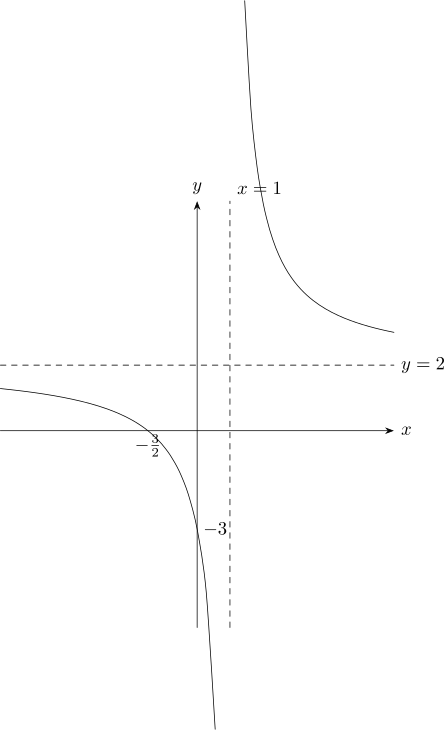
Example 4.25. For \(f(x)=\frac {2x+3}{x-1}\), state the domain, find the asymptotes and the intercepts, and sketch the graph.
Solution. Domain. The denominator vanishes at \(x=1\), so the domain is \(\mathbb {R}\setminus \{1\}\).
Vertical asymptote. At \(x=1\) the denominator is zero and the numerator is \(2(1)+3=5\neq 0\), so \(x=1\) is a vertical asymptote.
Horizontal asymptote. Numerator and denominator both have degree \(1\), so the asymptote is the ratio of leading coefficients: \[y=\frac {2}{1}=2.\]
Intercepts. Setting \(y=0\) needs the numerator to vanish: \(2x+3=0\) gives \(x=-\frac {3}{2}\). Setting \(x=0\) gives \(f(0)=\frac {3}{-1}=-3\).
Questions on this section
Stuck on something here? Ask below and it stays attached to this topic.