5.2 The trigonometric ratios
For a right-angled triangle with an acute angle \(\theta \): \[\sin \theta =\frac {\text {opposite}}{\text {hypotenuse}},\qquad \cos \theta =\frac {\text {adjacent}}{\text {hypotenuse}},\qquad \tan \theta =\frac {\text {opposite}}{\text {adjacent}}.\] The other three are their reciprocals: \[\sec \theta =\frac {1}{\cos \theta },\qquad \csc \theta =\frac {1}{\sin \theta },\qquad \cot \theta =\frac {1}{\tan \theta }.\]
Note 5.4. Notice the pairing is not what the names suggest: \(\sec \) goes with \(\cos \), and \(\csc \) (cosecant) goes with \(\sin \). Reading “secant pairs with sine” is a common and costly slip.
5.2.1 Angles beyond the first quadrant
A right-angled triangle cannot have an angle above \(90^\circ \), so for larger angles we use a point \((x,y)\) on a circle of radius \(r\) and define \[\sin \theta =\frac {y}{r},\qquad \cos \theta =\frac {x}{r},\qquad \tan \theta =\frac {y}{x}.\] Since \(r>0\) always, the signs are decided entirely by the signs of \(x\) and \(y\) — that is, by the quadrant.
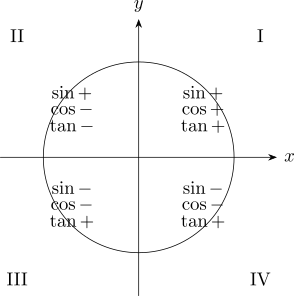
Note 5.5. The pattern is remembered as All, Sine, Tangent, Cosine — reading anticlockwise from the first quadrant — and names the one ratio that stays positive in each.
To evaluate a ratio for \(\theta >90^\circ \), find the associated acute angle \(\alpha \), take the ratio of that, then attach the sign belonging to the quadrant.
| Quadrant | Range of \(\theta \) | Associated acute angle |
| II | \(90^\circ <\theta <180^\circ \) | \(\alpha =180^\circ -\theta \) |
| III | \(180^\circ <\theta <270^\circ \) | \(\alpha =\theta -180^\circ \) |
| IV | \(270^\circ <\theta <360^\circ \) | \(\alpha =360^\circ -\theta \) |
5.2.2 The exact values
Reducing an angle to an acute one only helps if the acute values are known. At the five angles below they are exact, and they are worth being able to write down without hesitating.
There is no need to memorise ten separate surds. Write \(0,1,2,3,4\) under the five angles and take \(\sqrt {\frac {n}{4}}\) — that is the sine. The cosine is the same list read backwards.
| \(\theta \) | \(0^\circ \) | \(30^\circ \) | \(45^\circ \) | \(60^\circ \) | \(90^\circ \) |
| \(n\) | \(0\) | \(1\) | \(2\) | \(3\) | \(4\) |
| \(\sin \theta =\sqrt {\frac {n}{4}}\) | \(\sqrt {\frac {0}{4}}\) | \(\sqrt {\frac {1}{4}}\) | \(\sqrt {\frac {2}{4}}\) | \(\sqrt {\frac {3}{4}}\) | \(\sqrt {\frac {4}{4}}\) |
| \(0\) | \(\frac {1}{2}\) | \(\frac {\sqrt {2}}{2}\) | \(\frac {\sqrt {3}}{2}\) | \(1\) | |
| \(\cos \theta =\sqrt {\frac {4-n}{4}}\) | \(1\) | \(\frac {\sqrt {3}}{2}\) | \(\frac {\sqrt {2}}{2}\) | \(\frac {1}{2}\) | \(0\) |
| \(\tan \theta =\frac {\sin \theta }{\cos \theta }\) | \(0\) | \(\frac {\sqrt {3}}{3}\) | \(1\) | \(\sqrt {3}\) | undefined |
Note 5.6. The tangent row is not a third thing to learn — it is the first row divided by the second. At \(30^\circ \), \[\tan 30^\circ =\frac {\sin 30^\circ }{\cos 30^\circ } =\frac {\frac {1}{2}}{\frac {\sqrt {3}}{2}}=\frac {1}{\sqrt {3}}=\frac {\sqrt {3}}{3},\] rationalising at the end. At \(90^\circ \) the cosine is zero, so the division cannot be carried out and \(\tan 90^\circ \) does not exist.
Note 5.7. That the cosine row is the sine row reversed is not a coincidence. The angles pair off from the ends inwards — \(0^\circ \) with \(90^\circ \), \(30^\circ \) with \(60^\circ \) — and each pair adds to \(90^\circ \), because \[\cos \theta =\sin \left (90^\circ -\theta \right ).\] So \(\cos 30^\circ =\sin 60^\circ =\frac {\sqrt {3}}{2}\). Knowing one row gives the other.
Solution. \(\cos 210^\circ \). The angle lies in the third quadrant, where cosine is negative. The associated acute angle is \(210^\circ -180^\circ =30^\circ \), and \(\cos 30^\circ =\frac {\sqrt {3}}{2}\). So \[\cos 210^\circ =-\frac {\sqrt {3}}{2}.\]
\(\sin 300^\circ \). Fourth quadrant, where sine is negative. The associated acute angle is \(360^\circ -300^\circ =60^\circ \), and \(\sin 60^\circ =\frac {\sqrt {3}}{2}\). So \[\sin 300^\circ =-\frac {\sqrt {3}}{2}.\]
Work out the size first and the sign second. Trying to do both at once is where errors creep in.
Questions on this section
Stuck on something here? Ask below and it stays attached to this topic.