5.5 Graphs, amplitude and period
The graphs of \(\sin \) and \(\cos \) are waves of height \(1\) repeating every \(360^\circ \); \(\tan \) behaves differently, repeating every \(180^\circ \) with vertical asymptotes.
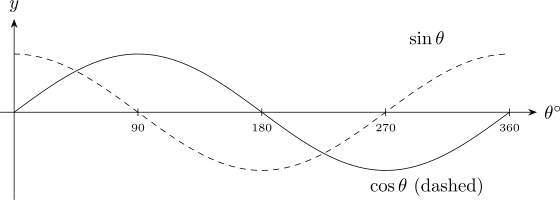
Definition 5.17. For \(y=a\sin (b\theta )\) or \(y=a\cos (b\theta )\):
- (i).
- the amplitude is \(|a|\), half the distance from lowest to highest;
- (ii).
- the period is \(\frac {360^\circ }{b}\), the horizontal length of one complete cycle.
Example 5.18. State the amplitude and period of \(y=3\sin 2\theta \), and of \(y=\frac {1}{2}\cos \frac {\theta }{3}\).
Solution. \(y=3\sin 2\theta \). Here \(a=3\) and \(b=2\): \[\text {amplitude}=3,\qquad \text {period}=\frac {360^\circ }{2}=180^\circ .\] The wave is three times as tall and repeats twice as often as \(\sin \theta \).
\(y=\frac {1}{2}\cos \frac {\theta }{3}\). Here \(a=\frac {1}{2}\) and \(b=\frac {1}{3}\): \[\text {amplitude}=\frac {1}{2},\qquad \text {period}=\frac {360^\circ }{\frac {1}{3}}=1080^\circ .\]
Note 5.19. A larger \(b\) gives a shorter period, because \(b\) divides. It is natural to expect the opposite, so check the direction of the effect against the formula rather than against intuition.
Questions on this section
Stuck on something here? Ask below and it stays attached to this topic.