6.2 Exponential functions
Definition 6.2. For a positive real \(a\neq 1\), the exponential function with base \(a\) is \[f(x)=a^x.\]
The base must be positive (otherwise \(a^{1/2}\) has no real value) and not \(1\) (since \(1^x\) is the constant \(1\), which is not interesting).
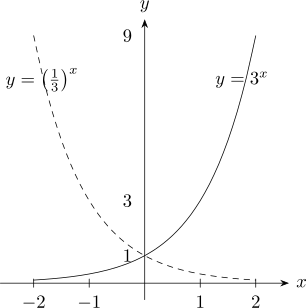
Note 6.3. Every exponential graph passes through \((0,1)\), because \(a^0=1\) whatever \(a\) is. The domain is all of \(\mathbb {R}\) and the range is \((0,\infty )\) — an exponential is never zero or negative, however far left you go. The \(x\)-axis is a horizontal asymptote it approaches but never reaches.
6.2.1 Exponential equations
If both sides can be written with the same base, the indices can be equated.
Solution. (a) Write \(256\) as a power of \(4\): \(4^1=4\), \(4^2=16\), \(4^3=64\), \(4^4=256\). \[4^x=4^4\quad \implies \quad x=4.\]
(b) First turn the decimal into a fraction: \(0.125=\frac {1}{8}\). Then \[\frac {1}{8}=\frac {1}{2^3}=2^{-3},\] so \[2^x=2^{-3}\quad \implies \quad x=-3.\]
(c) \(27=3^3\), so \[3^{2x-1}=3^3\quad \implies \quad 2x-1=3\quad \implies \quad 2x=4\quad \implies \quad x=2.\]
Check. \(3^{2(2)-1}=3^3=27\). \(\relax \amscheckmark \)
Solution. This looks unlike the others, but notice \(2^{2x}=\left (2^x\right )^2\). Substituting \(u=2^x\) turns it into a quadratic: \[u^2-6u+8=0\quad \implies \quad (u-2)(u-4)=0\quad \implies \quad u=2 \text { or } u=4.\]
Now go back to \(x\) — the substitution must always be undone. \[2^x=2\ \implies \ x=1,\qquad 2^x=4=2^2\ \implies \ x=2.\] \[\therefore \quad x=1 \text { or } x=2.\]
Check. At \(x=2\): \(2^4-6(2^2)+8=16-24+8=0\). \(\relax \amscheckmark \)
Note 6.6. Had a root come out negative or zero — say \(u=-3\) — it would have to be discarded, since \(2^x\) is never negative. Always check that each value of \(u\) is actually attainable before solving for \(x\).
Questions on this section
Stuck on something here? Ask below and it stays attached to this topic.