6.6 The Cauchy Integral Formula
Theorem 6.22 (Cauchy Integral Formula). If \(f(z)\) is analytic in a simply connected domain \(D\) containing a simple closed contour \(C\) and \(z_0\) is any point in the interior of \(C\), then \[ f(z_0) = \frac {1}{2\pi i} \int _C \frac {f(z)}{z - z_0}dz\]
Proof. Let \(C_\rho \) be the circle \(\left |z-z_0\right |=\rho \), small enough to lie inside \(C\). The function \(\dfrac {f(z)}{z-z_0}\) is analytic in the region between \(C\) and \(C_\rho \), so by the deformation result above \[\int _C\frac {f(z)}{z-z_0}\,dz=\int _{C_\rho }\frac {f(z)}{z-z_0}\,dz\] for every such \(\rho \). Split the right-hand side: \[\int _{C_\rho }\frac {f(z)}{z-z_0}\,dz =f(z_0)\int _{C_\rho }\frac {dz}{z-z_0} +\int _{C_\rho }\frac {f(z)-f(z_0)}{z-z_0}\,dz .\] The first integral is \(2\pi i\), by direct computation with \(z=z_0+\rho e^{i\theta }\).
For the second, continuity of \(f\) at \(z_0\) gives, for any \(\varepsilon >0\), a \(\rho \) small enough that \(\left |f(z)-f(z_0)\right |<\varepsilon \) on \(C_\rho \). The \(ML\) estimate then bounds it by \[\frac {\varepsilon }{\rho }\cdot 2\pi \rho =2\pi \varepsilon .\] Since the left-hand side does not depend on \(\rho \) and \(\varepsilon \) was arbitrary, that term is zero. Hence \[\int _C\frac {f(z)}{z-z_0}\,dz=2\pi i f(z_0),\] which rearranges to the formula.
The content is remarkable and worth stating plainly: the values of an analytic function on a contour determine its value at every interior point. □
Example 6.23. Evaluate \(\displaystyle {\int _C \frac {ze^{-z}}{z - \frac {i \pi }{2}}dz},\,\) where \(C\) is the triangle with vertices \(\, -1-i, \, 1 - i, \, 2i\)
Solution
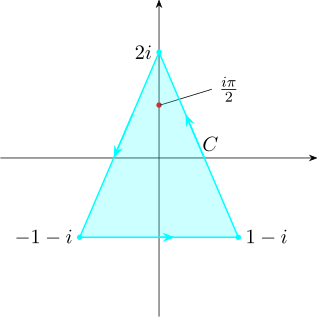
Take \(f(z) = z e^{-z}, \quad z_0 = \frac {i\pi }{2}\) \begin {align*} \int _C \frac {ze^{-z}}{z - \frac {i \pi }{2}}dz & = 2\pi i \cdot ze^{-z}\Big |_{z = i\frac {\pi }{2}}\\ & = 2\pi i \cdot \frac {i \pi }{2}e^{-i\pi / 2}\\ & = -\pi ^2\\\\ \end {align*}
Example 6.24. Evaluate \(\displaystyle {\int _C \frac {e^{-z}}{z^3 + 2z^2 - 3z - 10}\,dz}\), where \(C\) is the triangle with vertices \(i\), \(-i\) and \(3\).
Solution.
Locate the singularities
Testing \(z=2\) in the denominator gives \(8+8-6-10=0\), so \(z-2\) is a factor: \[z^3+2z^2-3z-10=(z-2)\left (z^2+4z+5\right ),\] and the quadratic has roots \(-2\pm i\). There are three simple poles: \(z=2\) and \(z=-2\pm i\).
Decide which lie inside \(C\)
The triangle has vertices \((0,1)\), \((0,-1)\), \((3,0)\); its upper edge is \(y=1-\frac {x}{3}\) and its lower edge \(y=-1+\frac {x}{3}\). At \(x=2\) these give \(y=\pm \frac 13\), so \(z=2\) is inside. The poles \(-2\pm i\) have real part \(-2\) and lie well to the left, outside.
Apply the residue theorem
For a simple pole the residue of \(\dfrac {e^{-z}}{(z-2)q(z)}\) is \(\dfrac {e^{-2}}{q(2)}\), and \(q(2)=4+8+5=17\). Hence \[\int _C \frac {e^{-z}}{z^3+2z^2-3z-10}\,dz=2\pi i\cdot \frac {e^{-2}}{17} =\frac {2\pi i}{17e^{2}}\approx 0.0500\,i .\] The two poles outside contribute nothing, which is the whole economy of the method.
Example 6.25. Evaluate \(\displaystyle {\int _C \frac {e^{iz}}{z^2 + a^2}dz\,, \,}\) where \(C\) is the circle \(\left |z - ia\right | = a, \quad a\in \mathbb {R}\).
Solution
\(z^2 + a^2 = (z - ia) (z + ia)\), hence singular points at \(z = ia\) and \(z = -ia\)
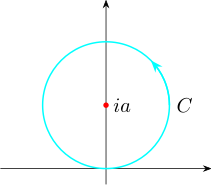
\(ia\) lies in the interior of \(C\), \begin {align*} \int _C \frac {e^{iz}}{z^2 + a^2}dz & = \int _C \frac {e^{iz}}{(z - ia)(z + ia)}dz\\\\ & = \int _C \frac {e^{iz}/z + ia}{z - ia} dz\\\\ & = 2\pi i \cdot \frac {e^{iz}}{z + ia}\Bigg |_{z = ia}\\\\ & = \frac {2\pi i \cdot e^{-a}}{2ia}\\\\ & = \frac {\pi }{ae^a}\\\\ \end {align*}
Suppose we used the Cauchy Goursat \begin {align*} \int _C \frac {e^{iz}}{z^2 + a^2}dz & = \int _c \frac {e^{iz}}{(z - ia) (z + ia)}dz\\\\ & = \int _C \frac {A}{z - ia}dz + \int _C \frac {B}{z + ia}dz\\ \end {align*}
\[e^{iz} = A(z + ia) + B(z - ia)\]
Let \(z = ia, \quad e^{-a} = 2aiA \implies A= \frac {1}{2iae^a}\)
Let \(z = - ia, \quad e^a = -2iaB \implies B = \frac {-e^a}{2ia}\)
\begin {align*} \int _C \frac {e^{iz}}{z^2 + a^2}dz & = \int _C \frac {e^{iz}/2iae^a}{z - ia}dz + \underbrace {\int _C \frac {-e^{a}/2ia}{z + ia}dz}_0\quad \text {since}\,\frac {e^{-a}/2ia}{z + ia}\quad \text {is analytic inside}\,C\\\\ & = \frac {1}{2iae^a}\int _C \frac {1}{z - ia}dz\\\\ & = \frac {1}{2iae^a}\cdot 2\pi i\\\\ & = \frac {\pi }{ae^a}\\\\ \end {align*}
- 1.
- Locate the singular points and state their nature:
- (a)
- \(\displaystyle {f(z) = \frac {1}{\sinh \big (\frac {1}{z}\big )}}\)
- (b)
- \(\displaystyle {f(z) = \frac {1 + z}{\big (z^2 + 4\big )\sin z}}\)
- 2.
- Evaluate \(\displaystyle {\int _C \frac {4z^2 + 9iz + 27}{z \big ( z^2 + 9\big )}\,dz}\), where \(C\) is either of the circles \(\left |z - 3\right | = 4\) or \(\left |z + 2\right | = 3\).
Solution.
- (1a)
- \(f\) fails to exist where \(\sinh \frac 1z=0\), that is where \(\frac 1z=n\pi i\) for a non-zero integer \(n\), giving
\[z_n=\frac {1}{n\pi i}=-\frac {i}{n\pi },\qquad n=\pm 1,\pm 2,\dots \]
Each \(z_n\) is a simple pole, since \(\sinh \) has a simple zero there.
The interesting point is \(z=0\). It is a singularity, but the \(z_n\) accumulate at it — \(z_n\rightarrow 0\) as \(n\rightarrow \infty \) — so every punctured disc about \(0\) contains infinitely many poles. Hence \(z=0\) is a non-isolated singularity, and no Laurent expansion about it exists. It is neither a pole nor an essential singularity; those terms apply only to isolated singularities.
- (1b)
- The denominator vanishes where \(z^2+4=0\), giving \(z=\pm 2i\), and where \(\sin z=0\), giving \(z=n\pi \) for \(n\in \mathbb {Z}\). All are simple zeros of the denominator, and the numerator \(1+z\) vanishes only at \(z=-1\), which is not among them. So every one of \[z=\pm 2i,\qquad z=n\pi \ (n\in \mathbb {Z})\] is a simple pole. Note \(z=0\) is included: the numerator there is \(1\), so nothing cancels.
- (2)
- The integrand has simple poles at \(z=0\) and \(z=\pm 3i\). Check which lie inside each circle: \[\left |0-3\right |=3<4,\qquad \left |\pm 3i-3\right |=3\sqrt 2\approx 4.24>4,\] \[\left |0+2\right |=2<3,\qquad \left |\pm 3i+2\right |=\sqrt {13}\approx 3.61>3 .\] So both circles enclose \(z=0\) and neither encloses \(\pm 3i\) — which is why the same answer serves for either contour. The residue at \(0\) is \[\left .\frac {4z^2+9iz+27}{z^2+9}\right |_{z=0}=\frac {27}{9}=3 ,\] so \[\int _C \frac {4z^2+9iz+27}{z(z^2+9)}\,dz=2\pi i\cdot 3=6\pi i .\]
The Cauchy Integral Formula Applied to Integrals of Trigonometric Functions
One of the applications of the Cauchy integral formula is the evaluation of real integrals of the
form
\[I = \int ^{2\pi }_0 F\big (\sin x, \cos x\big ) dx\]
In which the integrad is the quotient of two polynomials in \(\sin x\) and \(\cos x\), i.e
\[\int \frac {1}{2 + \cos x}\,dx \quad , \quad \int \frac {1}{a^2 + \sin ^2 x}\,dx\]
The approach is as follows:
- 1.
- Set
- \(\displaystyle {\sin x = \frac {1}{2i} \Bigg ( w - \frac {1}{w}\Bigg )}\)
- \(\displaystyle {\cos x = \frac {1}{2} \Bigg ( w + \frac {1}{w}\Bigg )}\)
where \(w = e^{ix}\)
- 2.
- Substitute \(\sin x\) and \(\cos x\) in \(F(\sin x, \cos x)\) to obtain a function (polynomial) \(Q(w)\) in \(w\).
- 3.
- Replace \(dx\) by \(\, \frac {1}{iw}\,dw\)
- 4.
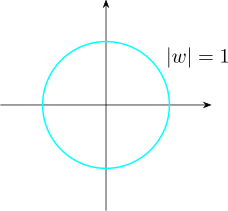
- Then \(\displaystyle {\int _0^{2\pi } F(\cos x , \sin x ) dx = \int _C \frac {Q(w)}{iw}dw},\,\) where \(C\) is \(\left |w\right | = 1\)
- 5.
- Use the Cauchy Integral formula to evaluate the contour integral in 4.
Example 6.27. Use the Cauchy integral formula to evaluate \(\displaystyle {I = \int ^{2\pi }_0 \frac {dx}{3 + 2\sin x}}\)
Solution
Step 1 to 3: Substitute \(\,\displaystyle { \sin x = \frac {1}{2i}\Big (w - \frac {1}{w}\Big )\quad , \quad dx = \frac {1}{wi}\,dw}\)
\begin {align*} \therefore \quad \int _C \frac {1/wi \,dw}{3 + 2\Big [\frac {1}{2i}\Big (w - \frac {1}{w}\Big )\Big ]} & = \int _C \frac {dw}{wi\Big [3 + 2\Big [\frac {1}{2i}\Big (w - \frac {1}{w}\Big )\Big ]\Big ]}\\\\\ & = \int _C \frac {dw}{w^2 + 3iw - 1}\\\\ & = \int _C \frac {dw}{\Big [w + \frac {1}{2}\Big (3 + \sqrt {5}\Big )i\Big ]\Big [w + \frac {1}{2}\Big ( 3 - \sqrt {5}\Big )i\Big ]}\\ \end {align*}
The zeros of the denominator are at \(w = -\frac {1}{2}(3 + \sqrt {5})i\) and \(w = -\frac {1}{2}(3 - \sqrt {5})i\)
But only \(-\frac {1}{2}\big (3 - \sqrt {5}\big )i\) is inside \(\left |w\right | = 1\).
\begin {align*} \therefore \quad I & = \int _C \frac {1}{\Big [3 + \frac {1}{2}\Big (3 + \sqrt {5}\Big )i\Big ]\Big [w + \frac {1}{2}\Big (3 - \sqrt {5}\Big )i\Big ]}\\\\ & = \int _C \frac {1/\Big [w + \frac {1}{2}\Big (3 + \sqrt {5}\Big )i\Big ]}{w + \frac {1}{2}\Big (3 - \sqrt {5}\Big )i}\\\\ & = 2\pi i\cdot \frac {1}{w + \frac {1}{2}\Big (3 - \sqrt {5}\Big )i}\Bigg |_{w = -\frac {1}{2}\Big (3 + \sqrt {5}\Big )}i\\\\ & = 2\pi i\cdot \frac {1}{-\frac {1}{2}\Big (3- \sqrt {5}\Big )i + \frac {1}{2}\Big (3 + \sqrt {5}\Big )i}\\\\ & = \frac {2\pi }{\sqrt {5}}\\\\ \end {align*}
Example 6.28. Evaluate by contour integration:
- (a)
- \(\displaystyle {\int ^{2\pi }_0 \frac {dx}{2 + \cos x}}\) (c) \(\displaystyle {\int ^{\pi }_{-\pi }\frac {dx}{a + \cos x}},\ a> 1\)
- (b)
- \(\displaystyle {\int ^{\pi }_0 \frac {dx}{a^2 + \sin ^2x}}\) (d) \(\displaystyle {\int ^{2\pi }_0 \frac {dx}{1 -2a\cos x + a^2}},\ |a| < 1\)
Solution. Each is handled by the substitution introduced above: put \(w=e^{ix}\), so that as \(x\) runs over a period \(w\) traverses the unit circle once, and \[\cos x=\frac {1}{2}\left (w+\frac 1w\right ),\qquad \sin x=\frac {1}{2i}\left (w-\frac 1w\right ),\qquad dx=\frac {dw}{iw}.\] The integral becomes a contour integral over \(\left |w\right |=1\), evaluated by residues; only the poles inside the unit circle count.
- (a)
- The substitution gives \[\int _{\left |w\right |=1}\frac {2\,dw}{i\left (w^2+4w+1\right )} .\] The roots of \(w^2+4w+1\) are \(-2\pm \sqrt 3\), of which only \(-2+\sqrt 3\approx -0.268\) lies inside. Its residue is \(\frac {2}{i\left (2w+4\right )}\) evaluated there, namely \(\frac {2}{i\cdot 2\sqrt 3}\), and multiplying by \(2\pi i\), \[\int ^{2\pi }_0 \frac {dx}{2+\cos x}=\frac {2\pi }{\sqrt 3}\approx 3.6276 .\]
- (c)
- Identical in form with \(2\) replaced by \(a\): the quadratic is \(w^2+2aw+1\) with roots \(-a\pm \sqrt {a^2-1}\), one inside for \(a>1\), and \[\int ^{\pi }_{-\pi }\frac {dx}{a+\cos x}=\frac {2\pi }{\sqrt {a^2-1}} .\] Checking at \(a=3\): \(\frac {2\pi }{\sqrt 8}\approx 2.2214\), which matches numerical integration.
- (b)
- Here \(\sin ^2x=\frac {1-\cos 2x}{2}\), so the integrand has period \(\pi \) and the same method applies after doubling the angle. The result is \[\int ^{\pi }_0 \frac {dx}{a^2+\sin ^2x}=\frac {\pi }{a\sqrt {a^2+1}} .\] At \(a=2\) this is \(\frac {\pi }{2\sqrt 5}\approx 0.7025\), confirmed numerically.
- (d)
- Note \(1-2a\cos x+a^2=\left (1-ae^{ix}\right )\left (1-ae^{-ix}\right )\), so the substitution gives a single pole at \(w=a\) inside the unit circle when \(\left |a\right |<1\), and \[\int ^{2\pi }_0 \frac {dx}{1-2a\cos x+a^2}=\frac {2\pi }{1-a^2} .\] At \(a=\frac 12\) this is \(\frac {2\pi }{0.75}\approx 8.3776\), again confirmed.
Each answer is a real number, as it must be: the \(i\) from \(dw/(iw)\) cancels against the \(2\pi i\) of the residue theorem.
Theorem 6.29 ((The Cauchy Integral Formula for Derivatives). Let \(f(z)\) be analytic inside a smooth domain \(D\) and let \(C\) be a simple closed contour inside \(D\). Then if \(z_0\) lies within \(C\), then \[f^n(z_0) = \frac {n!}{2\pi i}\int _C \frac {f(z)}{\big (z - z_0\big )^{n+1}}\,dz\]
Proof. We first prove that for \( n =1\), this holds. Starting from the Cauchy integral formula, \[f(z_0) = \frac {1}{2\pi i}\int _C\frac {f(z)}{z - z_0}dz\]
The differential gives the following \begin {align*} \frac {f(z_0 + h) - f(z_0)}{h} & = \frac {1}{2\pi i h}\Bigg [ \int _C \frac {f(z)}{z - z_0 - h}dz - \int _C \frac {f(z)}{z - z_0}dz\Bigg ]\\\\ & = \frac {1}{2\pi i}\int _C \frac {f(z)}{h}\,\Bigg [\frac {1}{z - z_0 - h}- \frac {1}{z - z_0}\Bigg ]dz\\\\ & = \frac {1}{2\pi i}\int _C \frac {f(z)}{\big [z - z_0 - h\big ]\big [z-z_0\big ]}dz \end {align*}
\(f(z)\) is analytic, so its derivatives exist. We have \[\lim \limits _{h\rightarrow 0}\Bigg [\frac {f(z_0 + h) - f(z_0)}{h}\Bigg ] = \lim \limits _{h\rightarrow 0}\Bigg [\frac {1}{2\pi i}\int _C \frac {f(z)}{\big (z - z_0 - h\big )\big (z - z_0\big )}\,dz\Bigg ]\]
Hence \(\displaystyle {f'(z_0) = \frac {1}{2\pi i}\int _C \frac {f(z)}{\big (z - z_0\big )^2}\,dz}\)
Assume it is true for \(n=k\), and then use the case for \(n = 1\) and our assumption to show that it holds for \(n=k + 1\) \[f^k(z_0) = \lim \limits _{h\rightarrow 0} \frac {f^{k-1}(z_0 + h) - f^{k-1}(z_0)}{h}\]
\begin {align*} \text {Hence},\quad \frac {f^k(z_0 + h) = f^k(z_0)}{h} & = \frac {k!}{2\pi hi}\Bigg [\int _C \frac {f(z)\,dz}{\big (z - z_0 - h\big )^{k+1}} - \int _C \frac {f(z)\,dz}{\big (z - z_0\big )^{k+1}}\Bigg ]\\\\ & = \frac {k!}{2\pi i}\Bigg [\int _C\frac {f(z)}{h}\Bigg (\frac {1}{\big (z - z_0 -h\big )^{k+}} - \frac {1}{\big (z -z_0\big )^{k+1}}\Bigg )dz\Bigg ] \end {align*}
Now for small \(\left |h\right |\) using the binomial theorem, we have \begin {align*} \frac {1}{\big [z - z_0 - h\big ]^{k+1}} -\frac {1}{\big [z - z_0\big ]^{k+1}} & = \frac {\big [z - z_0\big ]^{k+1} - \big [z - z_0 - h\big ]^{k+1}}{\big [z - z_0 -h\big ]^{k+1}\big [z- z_0\big ]^{k+1}}\\\\ & = \frac {\big [z - z_0\big ]^{k+1} - \Big (\big [z - z_0\big ]^{k+1}- \big (k+1\big )\big (z - z_0\big )^kh + \cdots }{\big [z - z_0 -h\big ]^{k+1}\big [z- z_0\big ]^{k+1}}\\\\ & = \frac {\big (k+1\big )h + Q(h^2)}{\big [z - z_0 -h\big ]^{k+1}\big [z- z_0\big ]^{k+1}}\\ \end {align*}
\begin {align*} \text {Thus}\quad \lim \limits _{h\rightarrow 0 } \frac {f^k(z_0 + h) - f^k(z_0)}{h} & = \lim \limits _{h\rightarrow 0}\frac {k!}{2\pi i}\Bigg [\frac {1}{h}\int _C f(z)\Bigg ( \frac {\big (k+1\big )h + Q(h^2)}{\big [z - z_0 -h\big ]^{k+1}\big [z- z_0\big ]^{k+1}}\Bigg )dz\Bigg ]\\\\ & = \frac {k!}{2\pi i}\int _C\frac {(k+1)\,f(z)}{\big (z - z_0\big )^{k + 2}}\,dz\\\\ & = \frac {(k+1)!}{2\pi i}\int _C\frac {f(z)}{\big (z - z_0\big )^{k+2}}\,dz\\\\ & = \frac {(k+1)!}{2\pi i}\int _C \frac {f(z)}{\big (z - z_0\big )^{k+2}}\,dz = f^{k+1}(z_0) \end {align*}
Thus it is true for \(n = k+ 1\). Hence true for all \(n\) □
Example 6.30. Find \(\displaystyle {I = \int _C \frac {\sin ^2z\,dz}{\Big (z^2 - \frac {\pi ^2}{36}\Big )\Big (z+\frac {\pi }{6}\Big )}}\) where \(C\) is \(\left |z\right |= 4\).
The singular points are at \(\, z = \frac {\pi }{6},\quad \frac {-\pi }{6}\)
Now, \(\quad \frac {1}{\Big (z^2 - \frac {\pi ^2}{36}\Big )\Big (z - \frac {\pi }{6}\Big )} = \frac {A}{\Big (z + \frac {\pi }{6}\Big )} + \frac {B}{\Big (z - \frac {\pi }{6}\Big )} + \frac {C}{\Big (z - \frac {\pi }{6}\Big )^2}\)
\begin {align*} \text {Hence}\quad I & = \int _C \sin ^2z\Bigg (\frac {A}{z + \frac {\pi }{6}} + \frac {B}{z - \frac {\pi }{6}} + \frac {C}{\Big (z - \frac {\pi }{6}\Big )^2}\Bigg )dz\\\\ & = A\int _C\frac {\sin ^2z\,dz}{z + \frac {\pi }{6} } + B\int _C\frac {\sin ^2z\,dz}{z -\frac {\pi }{6}} + C\int _C\frac {\sin ^2z\,dz}{\Big (z-\frac {\pi }{6}\Big )^2}\\\\ & = A\cdot 2\pi i \, \sin ^2\Big (\frac {-\pi }{6}\Big ) + B\cdot 2\pi i\,\sin ^2\big (\frac {\pi }{6}\big ) + \frac {C}{1!}\cdot 2\pi i\cdot \Big (\sin ^2z\Big )'\Bigg |_{z = \frac {\pi }{6}}\\\\ & = 2\pi i A\cdot \frac {1}{4} + 2\pi i B \frac {1}{4} + C\frac {\sqrt {3}}{2}\cdot 2\pi i\\\\ & = \pi i\Bigg (\frac {A}{2} + \frac {B}{2} + \sqrt {3} C\Bigg )\\\\ \end {align*}
Example 6.31. Evaluate each of the following.
- 1.
- \(\displaystyle {I = \int _C \frac {z e^{-z}}{\big ( z + i\frac {\pi }{2}\big )^3}\,dz}\), \(C:\ \left |z\right | = 2\);
- 2.
- \(\displaystyle {I =\int _C \frac {\cos z}{z^3}\,dz}\), \(C:\ \left |z\right | = 2\);
- 3.
- \(\displaystyle {I = \int _C \frac {\sin 2z}{\big (z - \frac {\pi }{4}\big )^3\big (z^2 + 9\big )}\,dz}\), \(C:\ \left |z - \frac {\pi }{4}\right | = 1\).
Solution. All three are the Cauchy integral formula for derivatives, \[\int _C\frac {h(z)}{(z-z_0)^{n+1}}\,dz=\frac {2\pi i}{n!}\,h^{(n)}(z_0),\] with \(n=2\) throughout. The work is to identify \(h\), confirm \(z_0\) lies inside \(C\) and that \(h\) is analytic there, and differentiate twice.
- 1.
- \(h(z)=ze^{-z}\), \(z_0=-\frac {\pi }{2}i\), which is inside \(\left |z\right |=2\) since \(\frac {\pi }{2}\approx 1.571<2\). Differentiating, \[h'(z)=(1-z)e^{-z},\qquad h''(z)=(z-2)e^{-z}.\] Using \(e^{\frac {\pi }{2}i}=i\), \[I=\pi i\,h''\!\left (-\tfrac {\pi }{2}i\right ) =\pi i\left (-\tfrac {\pi }{2}i-2\right )i=\frac {\pi (4+i\pi )}{2}.\]
- 2.
- \(h(z)=\cos z\), \(z_0=0\), inside \(C\). Since \(h''(0)=-\cos 0=-1\), \[I=\pi i\,(-1)=-\pi i .\]
- 3.
- \(z_0=\frac {\pi }{4}\) and \(C\) has radius \(1\) about it. The other singularities are at \(z=\pm 3i\), at distance \(\left |\pm 3i-\frac {\pi }{4}\right |>3\) from the centre, so they lie outside and \[h(z)=\frac {\sin 2z}{z^2+9}\] is analytic on and inside \(C\). Then \(I=\pi i\,h''\!\left (\frac {\pi }{4}\right )\), obtained by differentiating the quotient twice; numerically \(I\approx -0.594\,i\).
The pattern is worth naming: a pole of order \(n+1\) costs \(n\) differentiations, and everything analytic inside simply rides along inside \(h\).
Proof.
-
- (a)
- Using the Cauchy integral formula, \(\,\displaystyle {f(z_0) = \frac {1}{2\pi i}\int _C \frac {f(z)}{z - z_0}\,dz}\)
On \(C\), we have \(z - z_0 = Re^{i\theta }\), \(\, 0\leq \theta \leq 2\pi \) so that \(dz = iRe^{i\theta }d\theta \). Thus \begin {align*} f(z_0) & = \frac {1}{2\pi i} \int _0^{2\pi } \frac {f\Big (z_0 + Re^{i\theta }\Big )\, iRe^{i\theta }d\theta }{Re^{i\theta }}\\\\ & = \frac {1}{2\pi }\int _0^{2\pi }f\Big (z_0 + Re^{i\theta }\Big )d\theta \\\\ & = \frac {1}{2\pi R} \int _C f\Big (z_0 + Re^{i\theta }\Big )ds\\ \end {align*}
- (b)
- If \(u(x,y)\) is harmonic and it has continuous second order partial derivatives. It has a harmonic conjugate \(v(x,y)\) and so may be regarded as the real part of an analytic function \(f(z) = u(x,y) + iv(x,y)\) with \(z = x + iy\). Identifying \(z_0 = x_0 + iy_0\), \begin {align*} f(z_0) & = u(x_0, y_0) + i v(x_0,y_0)\\ & = \frac {1}{2\pi R}\int _C f\Big (x_0 + R\cos \theta , y_0+R\sin \theta \Big )ds\\\\ & = \frac {1}{2\pi R}\int _C\Big [u\Big (x_0 + R\cos \theta , y_0+R\sin \theta \Big ) + i v\Big (x_0 + R\cos \theta , y_0+R\sin \theta \Big )\Big ]ds\\\\ \implies \quad u(x_0,y_0) & = \frac {1}{2\pi R}\int _Cu\Big (x_0 + R\cos \theta , y_0+R\sin \theta \Big )ds\\\\ \end {align*}
Questions on this section
Stuck on something here? Ask below and it stays attached to this topic.