5.9 Paths and Smooth Paths
A path in a region \(G\subset \mathbb {C}\) is a continuous function \(\, \gamma : [a,b] \longrightarrow G\,\) for some interval \([a,b]\) in \(\mathbb {R}\).
If \(\gamma '(t)\) exists for each \(t\in [a,b]\) and \(\gamma '(t): [a,b]\longrightarrow \mathbb {C}\) is continuous, we say that \(\gamma \) is a smooth path.
Also \(\gamma \) is said to be piece wise smooth if there is a partition of \([a,b]\), say
\(\, a = t_0 < t_1< \cdots < t_n = b\) such that \(\gamma \) is smooth one each sub interval of \([t_{i-1},ti]\).
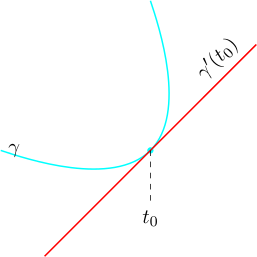
Suppose that \(\, \gamma : [a,b] \longrightarrow G\,\) is a differentiable path(smooth) and that for some
\(t_0 \in (a,b),\, \gamma '(t_0) \neq 0\).
Then \(\gamma \) has a tangent at the point \(\gamma (t_0)\). The slope of the tangent line is \(\tan (arg\gamma '(t_0))\).
If \(\gamma _1\) and \(\gamma _2\) are two paths with \(\gamma _1(t_1) = \gamma _2 (t_2) = z_0\,\) (say) and \(\, \gamma '_1 (t_1) \neq 0 \neq \gamma '_2(t_2),\,\) then we define the angle between \(\gamma _1\) and \(\gamma _2\) at \(z_0\) to
be
\[\boxed {arg\gamma '_2(t_2) - arg\gamma '_1(t_1)}\]
Suppose \(\gamma \) is a path in \(G\) and \(f: G \longmapsto \mathbb {C}\) is analytic. Then
\[\boxed { \rho = fo\gamma \, \text {is also a path and} \, \rho '(t) = f'(\gamma (t))\cdot \gamma '(t)\,\text { by chain rule}}\]
Let \(\, z_0 = \gamma (t_0)\,\) and suppose \(\, \gamma '(t_0) \neq 0\,\) and \(\, f'(z_0) \neq 0,\, \rho '(t_0) \neq 0\).
\[\boxed {arg \rho '(t_0) = argf'(z_0) + arg \gamma '(t_0)}\]
This gives \[arg \rho '(t_0) - arg \gamma '(t_0) = arg f'(z_0)\quad \cdots \quad (1)\]
Now let \(\gamma _1\) and \(\gamma _2\) be paths with \(\, \gamma _1 (t_1) = \gamma _2(t_2) = z_0\,\) and \(\, \gamma '_1(t_1) \neq 0 \neq \gamma '_2(t_2)\).
Let \(\, \rho _1 = fo\gamma _1\,\) and \(\, \rho _2 = fo\gamma _2\).
Suppose also that the paths \(\gamma _1\) and \(\gamma _2\) are not tangents to each other at \(z_0\). i.e \(\, \gamma '(t_1) \neq \gamma '(t_2)\).
From equation \((1)\) we get \[arg \gamma '_2(t_2) - arg\gamma '_1(t_1) = arg \rho '_2(t_2) - arg \rho '_1(t_1)\]
Thus given any two paths through \(z_0\,f\) maps these paths onto two paths through \(\, w_0 = f(z_0)\,\) and when \(\, f'(z_0) \neq 0,\,\) the
angles between the curves are preserved both in magnitude and direction. We have thus
proved.
Theorem 5.11. Let \(\, f: G \longmapsto \mathbb {C}\,\) be analytic. Then \(f\) preserves angles at each point \(z_0\) of \(G\) when \(\, f'(z_0) \neq 0.\,\) In other words \(f\) is a conformal mapping.
Proof. Let \(z_0\) be a point with \(f'(z_0)\neq 0\), and let \(C_1\) and \(C_2\) be smooth curves through \(z_0\) with tangent directions \(\theta _1\) and \(\theta _2\).
Parametrise \(C_k\) by \(z_k(t)\) with \(z_k(0)=z_0\) and \(z_k'(0)\neq 0\), so that \(\arg z_k'(0)=\theta _k\). The image curve is \(f(z_k(t))\), and by the chain rule its tangent at \(t=0\) is \[\frac {d}{dt}f\big (z_k(t)\big )\Big |_{t=0}=f'(z_0)\,z_k'(0).\] Taking arguments, and using \(\arg (ab)=\arg a+\arg b\), \[\arg \Big [f'(z_0)z_k'(0)\Big ]=\arg f'(z_0)+\theta _k .\] So every direction at \(z_0\) is turned through the same angle \(\arg f'(z_0)\). The angle between the image curves is therefore \[\big (\arg f'(z_0)+\theta _2\big )-\big (\arg f'(z_0)+\theta _1\big ) =\theta _2-\theta _1 ,\] unchanged in size and in sense. Lengths are scaled by the common factor \(\left |f'(z_0)\right |\), which is why the map looks locally like a rotation followed by a magnification.
The hypothesis \(f'(z_0)\neq 0\) is essential: \(\arg 0\) is undefined, and at such a point angles are genuinely distorted. For \(f(z)=z^2\) at the origin, where \(f'(0)=0\), angles are doubled. □
Definition 5.12. Let \(\, f: G \longmapsto \mathbb {C}\) be such that which preserves angles and \(\, \lim \limits _{z \rightarrow z_0} \frac {\left |f(z) - f(z_0)\right | }{\left |z - z_0\right | }\,\) exists, then \(f\) is called a
conformal mapping if \(f\) is analytic and \(\, f'(z) \neq 0\,\) for any \(z\), then \(f\) is conformal.
The converse is also true.
Example 5.13. The mapping \(\, w = f(z) = e^z\,\) is conformal throughout \(\mathbb {C}\).
\(f(z)\) is analytic and \(\, f'(z) \neq 0\,\) for all \(z\). But \(\, z = c + iy\,\) where \(c\) is fixed then \(\, f(z) = re^{iy}\,\) where \(r = e^c\).
This shows that the map \(\, w = e^z\,\) sends the straight line \(\, x = c\,\) onto a circle with centre origin and radius \(e^c\).
Also, \(f\) maps the line \(\, y = d\,\) onto the infinite ray \(\quad \{re^{id}:\, 0 < r< \infty \}\)
\[y = d\iff z = x + id\]
Example 5.14. Verify by talking the curve \(\, y = x - 1\)
\[\text {i.e}\, z(x) = x + i(x -1)\,, \, -\infty < x < \infty \]
the angle of rotation under the transformation \(\, w = z^2\,\) at the point \(\, 2 +i\).
Solution
By definition the angle of rotation for \(\, f(z) = z^2\,\) at \(\, 2 + i\,\) given by \begin {align*} \operatorname {arg}( f'(2+i)) & = \operatorname {arg} (4 + 2i)\\ & = \tan ^{-1}\Big (\frac {1}{2}\Big ) + 2n\pi \end {align*}
The line \(\, y = x - 1\,\) makes an angle \(\, \theta = \frac {\pi }{4}\,\) with the \(x-\)axis.
The image of \(\, y = x - 1\,\) under the map \(\, w = z^2\,\) is given by using the relations.
\[ u = x^2 - y^2 \quad \text {and}\quad v = 2xy\]
as \(\, v = \frac {u^2 - 1}{2}.\,\) The image of \(\, 2 + i\,\) is \(\, 3 + 4i\,\) in the \(w-\)plane.
Now, for the image curve \(\, v = \frac {u^2 - 1}{2}\) \[ w = u +iv = u + i\Big (\frac {u^2 - 1}{2}\Big )\] \begin {align*} \phi & = arg \Bigg (w'\Bigg |_{w = 3 + 4i}\Bigg )\\\\ & = \operatorname {arg}( 1 +i4)\\ & = \operatorname {arg}( 1 + 3i)\\ & = \tan ^{-1}(3) \end {align*}
Thus the angle of rotation in \(w-\)plane is \begin {align*} \phi - \theta & = \tan ^{-1}(3) - \frac {\pi }{4}\\ & = \tan ^{-1}(3) - \tan ^{-1}(1)\\ & = \tan ^{-1}\Big (\frac {3 - 1}{1 + 3}\Big )\\ & = \tan ^{-1}\Big (\frac {1}{2}\Big )\\\\ \end {align*}
Questions on this section
Stuck on something here? Ask below and it stays attached to this topic.