5.10 Linear Fractional Transformations
Let \(a, b,c\) and \(d\) be any real or complex constants. Then the linear fractional transformation (LTF) \(\, w = T(z)\,\) is defined to be the analytic function of the form \[\boxed {w = T(z) = \frac {az + b}{cz + d}\quad \cdots \quad (1)\quad \text {with}\quad ad - bc \neq 0}\]
This transformation is also called the Mobuis transformation or the Bi linear transformation. This
transformation defines \(w\) uniquely in terms of \(z\), except when \(\, z = \frac {-d}{c}\,\) or \(z\) is a point at infinity.
Conversely, \(\quad z = T^{-1}(w) = \frac {-dw + b}{cw - a}\quad \cdots \quad (2)\)
and is also a LFT. It defines \(z\) uniquely in terms of \(w\), except at the point \(\, w = \frac {a}{c}\,\) which is a point at
infinity.
write (1) as \(\quad T(z) = \frac {a + \frac {b}{z}}{c + \frac {d}{z}}\,, \,\) and then define \(\quad T(\infty ) = \lim \limits _{z \rightarrow \infty } T(z) = \frac {a}{c}\quad \cdots \quad (3)\)
So it follows that \(\, T^{-1}\Big (\frac {a}{c}\Big ) = \infty \).
Similarly, from (2) we get \(\quad T^{-1}(\infty ) = \frac {-d}{c} \quad \cdots \quad (4)\)
So that \(\, T\Big (\frac {-d}{c}\Big ) = \infty .\,\) In terms of (3) and (4) the LFT \(\, w = T(z)\,\) then provides a one-one correspondence between every point
in the extended complex \(z-\)plane and every point in the extended complex \(w-\)plane.
The need for the condition \(\, ad - bc \neq 0\,\) attached to (1) may be seen by either writing
\[\boxed {T(z) = \frac {a}{c} + \Big ( \frac {bc - ad}{c}\Big ) \Big (\frac {1}{cz + d}\Big )\quad \cdots \cdots \quad (5)}\]
with \(c\neq 0\) or nothing that \[\boxed {\frac {dw}{dz} = \frac {ad - bc}{\big (cz + d\big )^2}\quad \cdots \quad (6)}\]
Condition \(\, bc - ad\neq 0\,\) is necessary that \(T(z)\) should not be degenerate and map every point \(z\) into a single
\(\, w =\frac {a}{c}\).
Condition \(\, bc - ad\neq 0 \, \) in (6) ensures that the mapping \(\, w = T(z)\,\) is conformal.
A routine calculation shows that if \(S\) and \(T\) are bilinear transformations then the composition \(\, w = S[T(z)]\,\) is also the
bilinear transformation.
Show!!
Let \(\, S(z) = \frac {a_1z + b_1}{c_1z + d_1}\,\) and \(T(z) = \frac {a_2z + b_2}{c_2z + d_2}\,\) with \(\, a_1d_1 - c_1d_1 \neq 0\,\) and \(\, a_2d_2 - c_2b_2\neq 0\). Then \begin {align*} SoT(z) & \\ \implies \quad S(T(z)) & = \frac {a_1\Bigg (\frac {a_2z + b_2}{c_2z + d_2}\Bigg ) + b_1}{c_1\Bigg (\frac {a_2z + b_2}{c_2z + d_2}\Bigg ) + d_1}\\\\ & = \frac {(a_1a_2 + b_1c_2)z + (a_1b_2 + b_1d_2)}{(c_1a_2 + d_1c_2)z + (c_1b_2 + d_1d_2)}\\ \end {align*}
If \(T\) is a LTT, then \(\, T(T^{-1}(z)) = T^{-1}(Tz) = z\,\) i.e \(T^{-1}\) is the inverse of \(T\).
Proposition 5.15. It \(T\) is a LFT, then \(T\) is a composition of translations, magnification and inversions (of course some of these may be missing).
Proof. We have \(\, w = T(z) = \frac {az + b}{cz + d}\,\) with \(\, ad - bc \neq 0\).
Suppose that \(c = 0\), then \(\, w = T(z) = \frac {az}{d} + \frac {b}{d}\,.\,\) We then set
\[T_1(z) = \frac {az}{d}\quad \text {and}\quad T_2(z) = z + \frac {b}{d}\]
Then \(\, T = T_2 o T_1\).
Suppose now that \(c \neq 0\), and put
\[T_1(z) = z + \frac {d}{c}\,, \quad T_2(z) = \frac {1}{z}\,, \quad T_3(z) = \frac {bc -ad}{c^2}z\,,\quad T_4(z) = z + \frac {a}{c}\]
Then \(\, T = T_4oT_3oT_2oT_1\).
The fixed points of (1) follows by solving \( T(z) = z = \frac {az + b}{cz + d}\,, \,\) leading to the quadratic equation
\[cz^2 - (a-d)z -b = 0\]
Hence a Mobius transformation has at most two fixed points, unless it is the identity
transformation \(\, w = z\).
Let \(T\) be a LFT and let \(a,b,c\) and \(d\) be distinct points in the extended complex plane \(\overline {\mathbb {C}} = \mathbb {C}_{\infty }\) such that \[\alpha = T(a)\, , \quad \beta = T(b)\,, \quad \gamma = T(c)\] Suppose also that \(S\) is another LFT such that \[\alpha = S(a)\, , \quad \beta = S(b)\,, \quad \gamma = S(c)\] \[\text {Then}\quad S^{-1}oT(a) = a\,, \quad S^{-1}oT(b) = b\,, \quad S^{-1}oT(c) = c\] So that \(S^{-1}oT\) is a LFT that has three fixed points. Hence \(S^{-1}oT\) is the identity i.e \[\boxed {S^{-1}oT = I \implies S = T}\]
Hence a LFT is uniquely determined by its action on any three given points in \(\,\mathbb {C}_{\infty }\).
Let \(\, z_1, \, z_2, \, z_3\) and \(z_4\) be any four distinct points in the extended \(z-\)plane with distinct images \(\, w_1, \, w_2, \, w_3\) and \(w_4\) respectively. In the extended \(w-\)plane under the mapping \(w = T(z)\). When these points are finite we have for \(m\neq n\) and \(n,m = 1,2,3,4\) that \(\, w_m - w_n = k(z_m - z_n)\,\) with \[\boxed {k = \frac {ad - bc}{\big (cz_m + d\big )\big (cz_n + d\big )}}\] from this we see that
\[\frac {\big (z_1 - z_4\big )\big (z_3 - z_2\big )}{\big (z_1 - z_2\big )\big (z_3 - z_4\big )} = \frac {\big (w_1 - w_2\big )\big (w_3 - w_2\big )}{\big (w_1 - w_2\big )\big (w_3 - w_4\big )}\quad \cdots \quad (*)\]
The expression \((*)\) is called the cross ratio of the four points \(z_1, z_2, z_3, z_4\) and is denoted by \(\,\big (z_1, z_2, z_3, z_4\big )\,\).
Thus we see that the cross ratio of \(z_1, z_2, z_3, z_4\) is the same as the cross ratio of the corresponding images \(\, w_1, w_2, w_3, w_4\,\)
i. e \(\, \big (w_1, w_2, w_3, w_4\big )\).
If one of the points in the \(z-\)plane or \(w-\)plane is the point at infinity then the quotient involving that
point is replaced by 1.
For suppose \(\, z_3 ={\infty }\,\), then
\[\lim \limits _{z_3\rightarrow \infty } \frac {\big (z_1 - z_4\big )\big (z_3 - z_2\big )}{\big (z_1 - z_2\big )\big (z_3 - z_4\big )} = \frac {z_1 - z_4}{z_1 - z_2}\]
Replacing \(z_4\) and \(w_4\) in \((*)\) by the variables \(z\) and \(w\) respectively define \(w\) in terms of \(z\) and hence \(\, w = T(z) \,\) by means of the three points \(\, z_1, z_2, z_3\,\) and the prescribed images \(\,w_1, w_2, w_3\). Thus we have. □
5.10.1 Mapping Derived from the Cross-Ratio
Theorem 5.16. Let \(\,z_1, z_2, z_3\,\) be points in the \(z-\)plane with images \(\,w_1, w_2, w_3\,\) in the \(w-\)plane. Then the unique LFT \(\, w = T(z)\,\)
which accomplishes this mapping is given from the cross ratio by
\[\frac {\big (w - w_1\big )\big (w_2 - w_3\big )}{\big (w - w_3\big )\big (w_2 - w_1\big )} = \frac {\big (z - z_1\big )\big (z_2 - z_3\big )}{\big (z - z_3\big )\big (z_2 - z_1\big )}\quad \cdots \quad (**)\]
and then solving for \(\, w\).
Example 5.17. Find the LFT that maps the points \(\, -i, \, 1,\, i\) in the \(z-\)plane onto the respective points
\(\, 0,\, 1 + i,\,2 \,\) in the \(w-\)plane.
Determine the region in the \(w-\)plane which is the image of the interior of the circle defined by the
three points in the \(z-\)plane.
Solution
Set \(\, z_1 = -1,\, z_2 = 1, \, z_3 = i\,\) and \(\, w_1 = 0,\, w_2 = 1 + i, \,\) and \(\, w _3 = 2\)
Replacing in the cross-ratio \((**)\) we get
\[ w = T(z) = \frac {z + i}{z}\]
The points \(\, z_1 = -1,\, z_2 = 1, \, z_3 = i\,\) define a circle \(\, \left |z\right | = 1\).
While their images \(\, w_1 = 0,\, w_2 = 1 + i, \,\) and \(\, w _3 = 2\,\) define the circle \(\,\left |w - 1\right | = 1\).
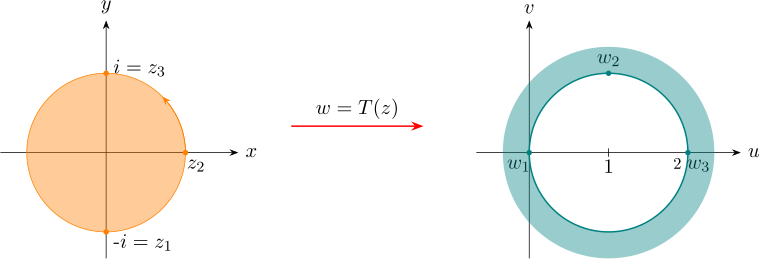
The interior of the circle \(\,\left |z\right | = 1\,\) is mapped onto the exterior of the circle \(\,\left |w - 1\right |=1\,\) in the \(w-\)plane.
This is because the LFT is conformal and so maintains the orientation.
Example 5.18. Show that the line \(\, 3y = x\,\) is mapped onto the circle under the LFT \(\, w = \frac {iz + 2}{4z + i}.\) Find the centre
and radius of the circle.
\(\big [\)Hint: Write \(x\) and \(y\) in terms of \(u, v\) and use \(\, 3y = x \big ]\)
Example 5.19. Find the LFT which maps
- (a).
- \(\, - 1, \, 0, \, 1\,\) onto \(\, 0, \, i, \, 3i\)
- (b).
- \(\, i, \, 1, \, -1\,\) onto \(\, 1, \, 0, \, \infty \)
respectively.
Solution \[\frac {\big (w - w_1\big )\big (w_2 - w_3\big )}{\big (w - w_3\big )\big (w_2 - w_1\big )} = \frac {\big (z - z_1\big )\big (z_2 - z_3\big )}{\big (z - z_3\big )\big (z_2 - z_1\big )}\]
- (a).
- So, we have that \(\, z_1 = 1,\, z_2 = 0, \, z_3 = 1\,\) and \(\, w_1 = 0, \, w_2 = i\, w_3 = 3i\).
\[\implies \, \frac {\big (z - z_1\big )\big (z_2 - z_3\big )}{\big (z - z_3\big )\big (z_2 - z_1\big )} = \frac {(z + 1) (-1)}{(z - 1) (+ 1)} = \frac {-(z + 1)}{(z - 1)} \]
and \[\frac {\big (w - w_1\big )\big (w_2 - w_3\big )}{\big (w - w_3\big )\big (w_2 - w_1\big )} = \frac {(w - 0)(-2i)}{(w - 3i)(3i)} = \frac {(-2i)w}{3i(w - 3i)}\] \begin {align*} \implies \quad \frac {z + 1}{z - 1} & = \frac {2w}{3 (w - 3i)}\\\\ \implies \quad 3wz - 9zi + 3w - 9i & = 2wz - 2w\\ \implies \quad w & = \frac {9i ( z + 1)}{(z + 5)} \end {align*}
Therefore, \(\, w = \frac {9i( z+ 1)}{z + 5}\)
- (b).
- We have that \(\, z_1 = i, \, z_2 = 1, \, z_3 = 0\,\) and \(\, w_1 = 1, \, w_2 = 0, \, w_3 = \infty \)
\[\implies \lim \limits _{w_3\rightarrow \infty }\quad \frac {\big (w - w_1\big )\big (w_2 - w_3\big )}{\big (w - w_3\big )\big (w_2 - w_1\big )} = \frac {w - w_1}{w_2 - w_1}\]
\[\implies \quad \frac {w - w_1}{w_2 - w_1} = \frac {w - 1}{-1} = -(w- 1)\]
\[\implies \quad \frac {\big (z - z_1\big )\big (z_2 - z_3\big )}{\big (z - z_3\big )\big (z_2 - z_1\big )} = \frac {(z - i)(1)}{(z)(1-i)} = \frac {(z - i)(1 + i)}{2z}\]
\(\implies \quad -(w - 1)= \frac {(z - i)(1 + i)}{2z}\)
\(\implies \quad T(z) = w = 1 - \frac {(z - i)(1 + i)}{2z}\)
Example 5.20. Find a LFT that maps the crescent-shaped region that lies inside the circle \(\, \left |z - 2\right | < 2\,\)
and outside the circle \(\, \left |z - 1\right | > 1\,\) onto a horizontal strip in the upper half plane.
\(\big [\) Choose points \(\, z_1 = 4, \, z_2 = 2 + 2i, \,\) and \(\, z_3 = 0\,\) on \(\,\left |z - 2\right | = 2\,\) and \(\, w_1 = 0, \, 1, \,\\ w_3 = \infty \big ]\,\) Horizontal strip \(\, v = 1, \, v = 0, \, u>0\).
Questions on this section
Stuck on something here? Ask below and it stays attached to this topic.