6.3 The Cauchy - Goursat Theorem
Definition 6.10. We say that \(z_0\) is a singular point of \(f(z)\) if \(f(z)\) is not analytic at \(z_0\) but is differentiable in the neighbourhood of \(z_0\).
Definition 6.11. The point \(z_0\) is a isolated singularity if \(f(z)\) is analytic everywhere in the neighbourhood of \(z_0\) except at \(z_0\).
- 1.
- \(f(z) = \frac {1}{z}\,,\,\) singular point at \(z = 0\), and is isolated.
- 2.
- \(f(z) = \frac {z(3 + z)}{\big (z^2 + 4\big )\big (z^2 - 1\big )}\,,\,\) singular points are \(z = \pm 1,\, \pm 2i\) and they are all isolated.
- 3.
- \(f(z) = \frac {1}{\cos z}\,\) singular points \(z = \frac {n\pi }{2}, \quad n = \pm 1, \, \pm 3, \, 5,\,\pm 7,\cdots \,\) and they are all isolated.
- 4.
- \(f(z) = \frac {1}{\sin \Big (\frac {1}{z}\Big )}\,, \,\) singular points \(\frac {1}{z} = 0, \, \pi , \,, 2\pi , \, 3\pi \,\cdots \)
\(\implies \frac {1}{z} = n\pi , \, n\in \mathbb {Z}\)
\(\implies z = \frac {1}{n\pi }\,,\, n\in \mathbb {Z}\)
and \(z = 0\)
Singularities of the form \(z = \frac {1}{n\pi }\) are isolated but \(z = 0\) is not.
Definition 6.13. A region \(\Omega _x\) will be said to be \(x-\)simple if any line in \(\Omega _x\) drawn parallel to \(y-\)axis crosses
the boundary of \(\Omega _x\) only twice.
Similarly, \(\Omega _y\) is \(y-\)simple if a line drawn parallel to the \(x-\)axis only crosses the boundary twice.
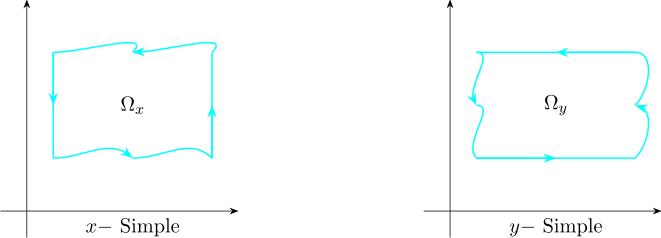
If a region is both \(x-\)simple and \(y-\)simple then it is said to be simple.
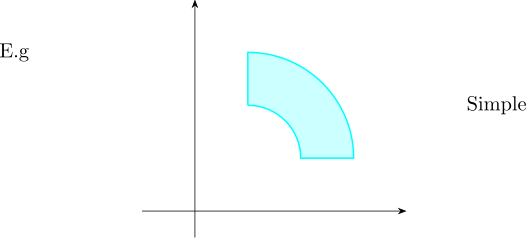
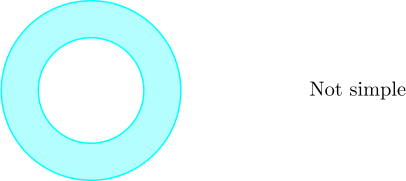
Theorem 6.14 (Green’s Theorem for Simple Region). Let \(\Omega \) be a simple region in the \(xy-\)plane with boundary \(\Gamma \) oriented counter clockwise then if \(P(x,y)\) and \(Q(x,y)\) together with its partial derivatives are continuous in \(\Omega \), then \[ \iint \limits _{\Omega } \Bigg (\frac {\partial Q}{\partial x} - \frac {\partial P}{\partial y}\Bigg )dxdy = \int \limits _{\Gamma } \Big [Pdx + Qdy\Big ]\]
Proof. Take \(\Omega \) simple, meaning it can be described both as \(a\leq x\leq b\), \(g_1(x)\leq y\leq g_2(x)\) and as \(c\leq y\leq d\), \(h_1(y)\leq x\leq h_2(y)\). It is enough to prove the two halves \[\iint _{\Omega }\frac {\partial P}{\partial y}\,dx\,dy=-\int _{\Gamma }P\,dx, \qquad \iint _{\Omega }\frac {\partial Q}{\partial x}\,dx\,dy=\int _{\Gamma }Q\,dy,\] and subtract.
For the first, use the description by vertical slices and integrate in \(y\) first: \[\iint _{\Omega }\frac {\partial P}{\partial y}\,dy\,dx =\int _a^b\Big [P\big (x,g_2(x)\big )-P\big (x,g_1(x)\big )\Big ]dx .\] Now traverse \(\Gamma \) counter-clockwise: the lower boundary \(y=g_1(x)\) is covered left to right and the upper boundary \(y=g_2(x)\) right to left, so \[\int _{\Gamma }P\,dx=\int _a^b P\big (x,g_1(x)\big )dx-\int _a^b P\big (x,g_2(x)\big )dx ,\] the vertical sides contributing nothing since \(dx=0\) there. Comparing the two displays gives the first identity. The second is the same argument using horizontal slices, and subtracting yields Green’s theorem. □
Theorem 6.15 (Cauchy - Goursat). If \(f(z)\) is analytic in a simply connected region \(D\) and also on its boundary \(C\) which is a smooth closed curve, then \[\oint _C f(z) dz = 0\]
Proof. If \(f(z) = u + iv\), then \(\displaystyle {\oint _C f(z) dz = \int _C \Big [ u dx - vdy\Big ] + i \int _C \Big [udy + vdx\Big ]}\)
Assuming \(f(z)\) and \(f'(z)\) are continuous. Then we can apply Green’s theorem
\[\implies \quad \int _Cf(z) dz = - \iint \limits _D \Bigg (\frac {\partial v}{\partial x} + \frac {\partial u}{\partial y}\Bigg ) dxdy + i \iint \limits _D \Bigg (\frac {\partial u}{\partial x} - \frac {\partial v}{\partial y}\Bigg )dxdy\]
Since \(f(z)\) is analytic in \(D\), it satisfies the Cauchy - Riemann equations. Thus
\[\int _C f(z) dz = 0\]
. □
Theorem 6.16 ( Generalised Cauchy - Goursat). Let the domain \(D\) be bounded externally by a simple closed contour \(C_0\) and internally by non intersecting closed contours \(C_1, C_2, \ldots , C_n\). Let both the external and internal contours be positively oriented. Then if \(f(z)\) is analytic in \(D\) then \[ \int _{C_0} f(z)dz = \sum ^n_{r = 1} \int _{C_r}f(z)dz\]
Proof. Introduce cross-cuts: join \(C_0\) to \(C_1\) by a curve \(L_1\), then \(C_1\) to \(C_2\) by \(L_2\), and so on, choosing the cuts so that they do not meet each other. Cutting along them turns \(D\) into a single simply connected region whose boundary is one closed contour \(\Gamma \), traversed so that \(D\) stays on the left throughout.
Since \(f\) is analytic on and inside \(\Gamma \), the Cauchy–Goursat theorem gives \[\int _{\Gamma }f(z)\,dz=0 .\] Now read off what \(\Gamma \) consists of: the outer contour \(C_0\) described once positively, each inner contour \(C_r\) described once negatively, and each cross-cut traversed twice in opposite directions. The cross-cut contributions cancel in pairs, leaving \[\int _{C_0}f(z)\,dz-\sum _{r=1}^{n}\int _{C_r}f(z)\,dz=0 ,\] which rearranges to the statement.
This is the result that lets a contour be deformed freely across a region where \(f\) is analytic: only the holes matter, and each contributes once. □
Example 6.17. Evaluate \(\displaystyle {\int _C \frac {\big (4 - 2i\big ) z^2 + \big (2 - 5i\big ) z + \big (3 - 2i\big )}{\big (z^2 + 1\big )\big (z + 2\big )}dz}\) where
- 1.
- \(C\) is the square \(C_1\) with corners \(\frac {1}{2}+ \frac {1}{2}i\,, \quad \frac {-1}{2}+ \frac {1}{2}i\,, \quad \frac {-1}{2} - \frac {1}{2}i\,, \quad \frac {1}{2}-\frac {1}{2}i\)
- 2.
- \(C\) is the unit circle \(C_2\) centred on \(z = i\).
- 3.
- \(C\) is the unit circle \(C_3\) centred at \(z = -2\).
Working
- 1.
-
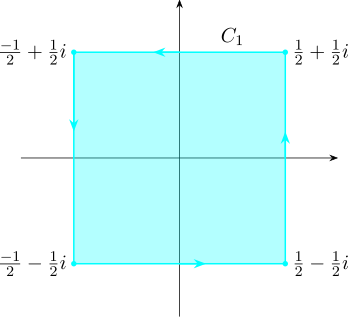
We first check if \(\displaystyle { \frac {\big (4 - 2i\big ) z^2 + \big (2 - 5i\big ) z + \big (3 - 2i\big )}{\big (z^2 + 1\big )\big (z + 2\big )}}\) is analytic inside the region enclosed by \(C_1\). \(f(z)\) has singularities at \(z = \pm i,\, z = -2,\,\), clearly are not in the enclosed region. Thus \(f(z)\) is analytic in the region. By Cauchy Goursat we have \[\int _{C_1} f(z)dz = 0\]
- 2.
-
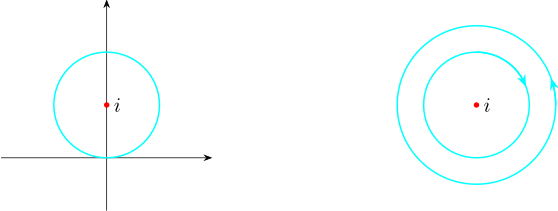
Clearly \(i\) is in the enclosed region. Thus by Cauchy Goursat \(\quad \displaystyle {\int _{C_2} f(z)dz = \sum ^1_{r=1} \int f(z)dz}\) \[f(z) = \frac {-i}{z - i} + \frac {1 + i}{z + i} + \frac {3}{z + 2}\]
So that \(\quad \displaystyle {\int _{C_2}f(z)dz = -i \int _{C_2} \frac {1}{z - i}dz + \big (1 + i\big )\underbrace {\int _{C_2} \frac {1}{z + i}dz}_0 + 3 \underbrace {\int _{C_2}\frac {1}{z + 2}dz}_0}\)
\begin {align*} \therefore \quad \int _Cf(z) dz & = - i \int _{C_2} \frac {1}{z - i}dz\\ & = -i \int ^{2\pi }_0\\ & = 2\pi \\ \end {align*}
- 3.
- When \(C\) is the unit circle \(C_3\) centred on \(z = -2\)
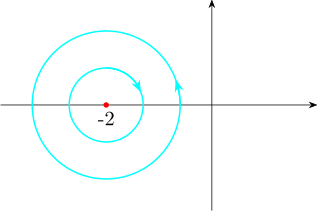
\begin {align*} \text {Thus}\quad \int _{C_3}f(z)dz & = 0 + 0 + \int _{C_3} \frac {1}{z + 2}dz\\ & = 3(2\pi i)\\ & = 6\pi i\\\\ \end {align*}
Example 6.18. Evaluate \(\displaystyle {\int _C\frac {z^2 + \big (10- i\big )z - \big (4 + 2i\big )}{\big (z^2 + 1\big )\big (z + 2\big )}dz}\) where \(C\) is the circle \(\left |z\right | = 3\).
Singular points are \(\, z = \pm i, \, z = -2\)
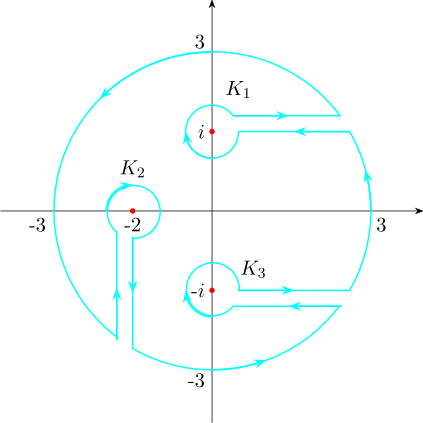
Let \(K_1, K_2, K_3\) be the closed contours as shown. Since \(f(z)\) is analytic in \(D\), thus by Cauchy - Goursat
\[\int _C f(z) dz = \int _{K_1}f(z)dz + \int _{K_2}f(z)dz + \int _{K_3}f(z)dz\]
\[f(z) = \frac {2}{z - i} + \frac {3}{z + i} - \frac {4}{z + 2}\]
\begin {align*} \therefore \quad \int _C f(z)dz & = 2 \int _{K_1} \frac {1}{z - i}dz - \int _{K_2}\frac {1}{z + 2}dz + 3\int _{K_3}\frac {1}{z + i}dz\\\\ & = 2\big (2\pi i\big ) - 4\big (2\pi i\big ) + 3\big (2\pi i\big )\\\\ & = 2\pi i\\\\ \end {align*}
Questions on this section
Stuck on something here? Ask below and it stays attached to this topic.