5.6 The Inversion Mapping \(w = \dfrac {1}{z}\)
In polar form if \(\, z = re^{i\theta }\,\) and \( \, w = \rho e^{i\phi }\,\) then we have
\[\boxed {\rho e^{i\phi } = \frac {1}{r}e^{-i\theta }}\]
So that \(\,\rho = \frac {1}{r}\,\) and \(\, \phi = -\theta .\,\) Since the radius under goes an inversion, the mapping \(\, w = \frac {1}{z}\,\) is called an inversion
mapping.
There is a one-one correspondence between points in the \(z-\)plane and points in the \(w-\)plane, except the
points \(\, z = 0\,\) and \(\, w = 0\,\) which have no images.
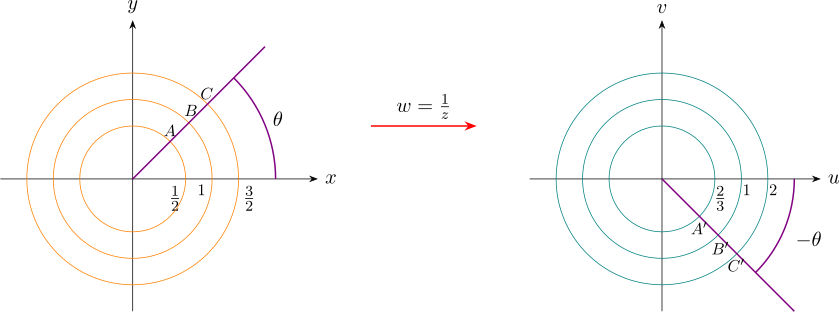
The inversion mapping \(\, w = \frac {1}{z}\,\) sends circles centred at the origin in \(z-\)plane into circles centred at the origin in
the \(w-\)plane.
In general, the mapping \(\, w = \frac {1}{z}\,\) sends circles into circles or straight lines.
Consider any circle \begin {equation} \boxed {(x-a)^2 + (y - b)^2 = c^2} \end {equation}
In the \(z-\)plane centred at \((a,b)\) with radius \(c\). Setting \(\, x = \frac {z + \overline {z}}{2}\,\) and \(\, y = \frac {z - \overline {z}}{2i}\,, \,\) then \((1)\) becomes \begin {equation} \boxed {z\overline {z} + Az + \overline {Az} + B = 0}\\ \end {equation}
From \(\, w = \frac {1}{z}\,, \,\) get \(\, z = \frac {1}{w}\,\) and \(\, \overline {z} = \frac {1}{\overline {w}}\).
So that the image in the \(w-\)plane or the circle \((2)\) is \begin {equation} \boxed {\frac {1}{w\overline {w}} + \frac {A}{w} + \frac {\overline {A}}{\overline {w}} + B = 0}\\ \end {equation}
At this we consider two cases \(\, B\neq 0\,\) and \(\, B = 0;\, B = 0\,\) corresponds the case when the circle \((1)\) passes through the origin
and \(\, B\neq 0\,\), case where circle in \(z-\)plane does not pass the origin.
- 1.
- \(B\neq 0\,\) (circles not through \(z = 0\))
If \(B \neq 0\), we can write (3) as \(\,\boxed {w\overline {w} + \frac {\overline {A}}{B}w + \frac {A}{B}\overline {w} + \frac {1}{B} = 0}, \,\) which is of the same form as (2) since \(\, \frac {1}{B}\,\) is real, and take coefficient \(\,\frac {A}{B}\,\) is the complex conjugate of \(\,\frac {\overline {A}}{B}.\,\) Thus the image is a circle. - 2.
- \(B = 0\) (circles through \( z = 0\))
If \(B = 0\), we can write (3) as \(\, 1 + A\overline {w} + \overline {A}w = 0,\,\) in terms of \(u\) and \(v\) as \[bv - au + \frac {1}{2} = 0\] which is a straight line.
One can show that \(\, w = \frac {1}{z}\,\) sends straight lines that do not pass through the origin into circles and straight
lines through \(z = 0\) into straight lines.
Check by considering \(\,ax + by + c = 0\, \) in the \(z-\)plane. \(\, u + iv = \frac {1}{x + iy}\).
Questions on this section
Stuck on something here? Ask below and it stays attached to this topic.