5.4 The Mapping \(w = z^c\)
Setting \(\, w = \rho e^{i\phi }\,\) and \(\, z =re^{i\theta }\,\) we get, for \(c\) real and \(+ve\), \begin {align*} \rho & = \left |w\right | = r^c \quad \text {and}\\\\ \phi & = c \, Arg(z) + 2k\pi \\ & = c\theta + 2k\pi \,,\, k\in \mathbb {Z}\,, \, \text {under the mapping}\, w = z^c \end {align*}
This shows that when \(c\neq 1\), a non-uniform scale factor \( r^c\) is involved in the mapping, with magnification
when \(r> 1\) and contraction when \(r < 1\).
The ray \(\, r> 0, \, \theta = \theta _0\,\) in the \(z-\)plane is mapped onto the ray \(\, \rho = r^c\,, \, \phi = \phi _0 = c\theta _0\,\) in the \(w-\)plane.
The function \(\, w = z^c\,\) with this gives valued function of the \(z-\)plane onto the \(w-\)plane for \( c > 1\), unless \(\theta \) is suitably
restricted.
Consider, for simplicity, \(c = 2\). The mapping \(\, w = z^c\,\) will then be
\[\boxed {\rho e^{i\pi } = r^2 e^{2i\theta }}\]
The image of the point \((r, \theta )\) in the \(z-\)plane is that point in \(w-\)plane with polar coordinates \(\, (\rho , \phi ) = (r^2, 2\theta )\).
This shows that the first quadrant of the \(z-\)plane is mapped onto the entire upper half plane. For, first
quadrant is \(\, 0 \leq \theta \leq \frac {\pi }{2}, \, r> 0\,\) and the upper half plane is defined by
\(\, 0 \leq \frac {\phi }{2}\leq \frac {\pi }{2}\,, \, \rho = r^2 \)
\[\implies \quad 0 \leq \phi \leq \pi \,, \quad \rho = r^2 > 0\]
circles about the origin, \(r = r_0\) are transformed into circles \(\rho = r^2\) in the \(w-\)plane.
The semicircular region \(r = r_0, \, 0\leq \theta \leq \pi \,\) is mapped into the circular region \(\, \phi = r^2_0\).
In Cartesian form, set \(\, w = u + iv\,\) and \(\, w = z^2,\, \) we have \(\, u = x^2 - y^2\, , \, v = 2xy\)
Hence the hyperbolas \(\, x^2 - y^2 = c\) and \(\, 2xy = d\,\) are mapped by \(\, w = z^2\,\) into straight line \(\, u = c \,\) and \(\, v = d\).
One fact is that when \(c\) and \(d\) are not zero, the hyperbolas intersect at right angles, just their
images.
Example 5.6. Find the image of the vertical strip \(\, 0\leq x \leq c\,, \, y\leq 0\,\) under the map \(\, w = z^2\).
Solution
Let \(\, x = \alpha \,, \, 0 < \alpha < c\,\) be a line in the region and let \((\alpha ,y)\) be a movable point on the line \(\, x = \alpha \).
The image of this point is given by the relations \(\, u = \alpha ^2 - y^2\,, \, v = 2\alpha y \,, \, y\leq 0\).
Eliminating \(\, y\) , get \(\, v^2= -4\alpha ^2 (u- \alpha ^2)\).
This is an equation of a parabola, vertex at \((\alpha ^2, 0)\) and focus at the origin.
Since \(v\) increases as \(y\) increases, the point \((\alpha , y)\) moves upwards on the line \( x = \alpha \) and the image point moves
left on the curve \(A'\).
The image of \(x = c\) is the curve \(c\).
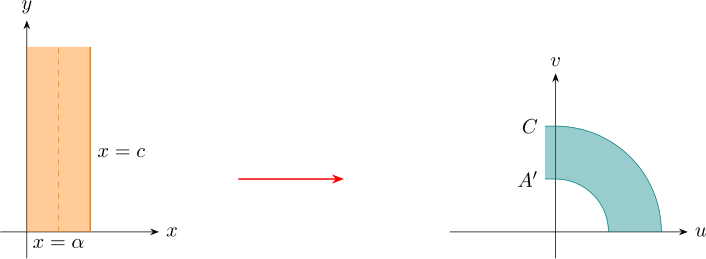
Further, the image of the line \(x = 0\), \(\, y \leq 0\) of the region is found to be \(u = -y^2\,,\, v = 0\).
This means that the negative real axis, the image of the positive \(y-\)axis in the \(z-\)plane.
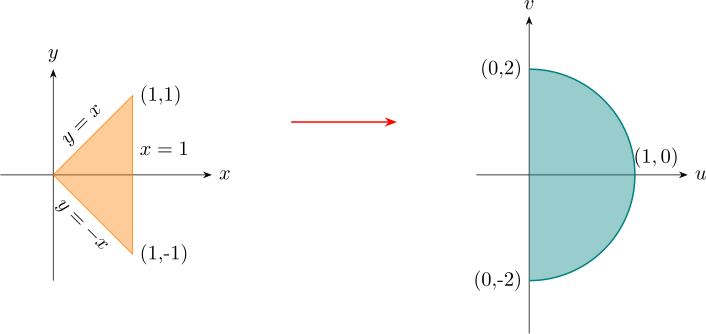
Example 5.7. Show that the image of the closed triangular region formed by the lines \(\, y = \pm x\,\) and
\(\, x = 1\,\) is the closed parabolic region bounded by the segment \(\, -2\leq v \leq 2\,\) of the \(v-\)axis on the right portion of a
parabola \(\, v^2 = -4(u - 1)\,\) under the map \(\, w = z^2\).
Solution
We have \(\, u = x^2 -y^2,\quad v = 2xy\)
- 1.
- The line \(\, y = x\, , \, 0 \leq y \leq 1\,\) is mapped on \( u = 0\) and \(v = 2y^2\) and the point \((1,1)\) is mapped onto \((0,2)\).
- 2.
- The line \(\, y = -x\, , \, -1\leq y \leq 0\,\) is mapped onto \(\, u = 0, \, v = -2y^2\,\) and the point \((1,-1)\) is mapped to \((0,-2)\).
- 3.
- The line \(\, x = 1\,\) is mapped on \(\, v^2 = -4(u - 1)\,\) a parabola with vertex \((1,0)\) and focus at the origin. The parabola
meets the line \(u = 0\) at \((0,2)\) and \((0,-2)\).
Example 5.8. Find the image of each set under \(w = z^2\), sketching the set and its image in their respective planes.
- 1.
- \(\arg z = \frac {\pi }{3}\)
- 2.
- \(\arg z = \frac {-3\pi }{4}\)
- 3.
- \(y = -\frac {1}{4}\)
- 4.
- \(x = 0,\ y > 0\)
- 5.
- the circle \(\left |z\right | = \frac {4}{3}\)
Solution. In polar form \(z=re^{i\theta }\) gives \(w=r^2e^{2i\theta }\): the modulus is squared and the argument doubled. In cartesian form, writing \(z=x+iy\) and \(w=u+iv\), \[u=x^2-y^2,\qquad v=2xy .\] Whichever is easier decides the method.
- 1.
- Doubling the argument, \(\arg w=\frac {2\pi }{3}\): the ray at \(60^{\circ }\) from the origin maps onto the ray at \(120^{\circ }\). Points move outward if \(r>1\) and inward if \(r<1\).
- 2.
- \(\arg w=2\left (-\frac {3\pi }{4}\right )=-\frac {3\pi }{2}\), which is \(\frac {\pi }{2}\) modulo \(2\pi \): the ray maps onto the positive imaginary axis. Doubling an argument can carry a ray past \(\pm \pi \), so the principal value must be restored at the end.
- 3.
- With \(y=-\frac 14\) fixed and \(x\) free, \[u=x^2-\frac {1}{16},\qquad v=-\frac {x}{2}.\] Eliminating \(x=-2v\) gives \[u=4v^2-\frac {1}{16},\] a parabola opening in the direction of increasing \(u\), with vertex at \(\left (-\frac {1}{16},0\right )\). Horizontal lines map to parabolas.
- 4.
- Here \(x=0\), \(y>0\), so \(z=iy\) and \(w=(iy)^2=-y^2\), which runs over all negative reals. The positive imaginary axis maps onto the negative real axis — consistent with (1), since doubling \(\frac {\pi }{2}\) gives \(\pi \).
- 5.
- \(\left |w\right |=\left |z\right |^2=\left (\frac 43\right )^2=\frac {16}{9}\), and as \(\theta \) runs once round \([0,2\pi )\), \(2\theta \) runs twice round. So the circle of radius \(\frac 43\) maps onto the circle of radius \(\frac {16}{9}\), covered twice. That two-to-one behaviour is why \(w=z^2\) needs a branch cut before it can be inverted.
Questions on this section
Stuck on something here? Ask below and it stays attached to this topic.